
Seoul Museum of History to host 12th European Film Festival
The Seoul Museum of History, in collaboration with EUNIC Korea and the Delegation of the European Union to the Republic of Korea, will host the 2026 12th European Film Festival from November 20 to December 6.
The 12th European Film Festival will run from November 20 to December 6 at the Seoul Museum of History, featuring a record 23 films from various European nations. The event includes extended evening screening hours to accommodate office workers and students.
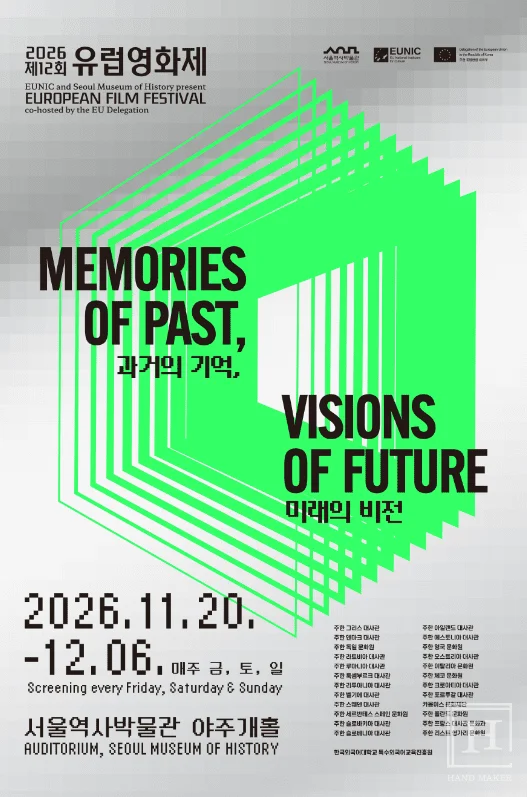
The Seoul Museum of History, together with EUNIC Korea and the Delegation of the European Union to the Republic of Korea, will hold the 2026 12th European Film Festival from the 20th of this month until December 6.
A total of 23 films selected by various European embassies and cultural institutes will be screened for free at Yajugae Hall over nine days, occurring every Friday, Saturday, and Sunday. This year, screening hours have been extended into the evening to allow office workers and university students, who may find it difficult to visit the museum during the day, to attend.
Marking its 12th year since beginning as the "EUNIC Film Festival" in 2015, this year's festival features works from 23 European countries, the largest number of participating nations in its history. Under the theme "Memories of the Past, Visions of the Future," the selection includes films dealing with history, identity, migration, generations, gender, and human rights to encourage reflection on individual and social memories and thoughts on the future.
The opening ceremony will be held at Yajugae Hall on November 20 at 5:30 p.m., followed by the screening of the opening film, the Polish documentary Grandma DJ, Vika! (2024, directed by Agnieszka Zwiefka) at 6:00 p.m. The film depicts 84-year-old Vika, who works as a DJ in Warsaw, as she continues to take on new challenges beyond the boundaries of age. Prior to the screening, Bartosz Wiśniewski, the Ambassador of Poland to the Republic of Korea, will introduce the film's background and Polish culture.
All films are free of charge. Advance reservations can be made through Seoul Public Service Reservation, and if seats remain, entry is available on a first-come, first-served basis starting 10 minutes before each screening.
Reporter at HANDMAKER (핸드메이커), a Korean magazine devoted to crafts and handmade culture. Covers exhibitions, traditional crafts and the makers behind them.
Related Articles
Seoul hosts 2026 Humanities and Culture Festival focusing on human intelligence
Today's Tradition Festival showcases 104 brands at former Seoul Station
Comments 0
Comments are currently disabled.