
[On-site Sketch] Re-weaving Past Times and Memories with Warm Knitting, Hwang Jae-won's 《Connecting Slowly: The Unfamiliar Transformation of Familiar Objects》
Artist Hwang Jae-won is holding a solo exhibition titled 《Connecting Slowly: The Unfamiliar Transformation of Familiar Objects》 at the Savina Museum…
Knitting, which was once a grandmother's hobby, is gradually becoming younger. It has emerged as a new hobby for the younger generation because it allows them to briefly escape a day filled with smartphones and enjoy time to focus quietly on themselves. While people usually make scarves, scrubbers, or bags, for this artist, it becomes a tool to knit "warmth" stitch by stitch.
Artist Hwang Jae-won views knitting through the language of contemporary art, prompting us to look again at the time and memories we have inadvertently passed by in our fast-paced daily lives.
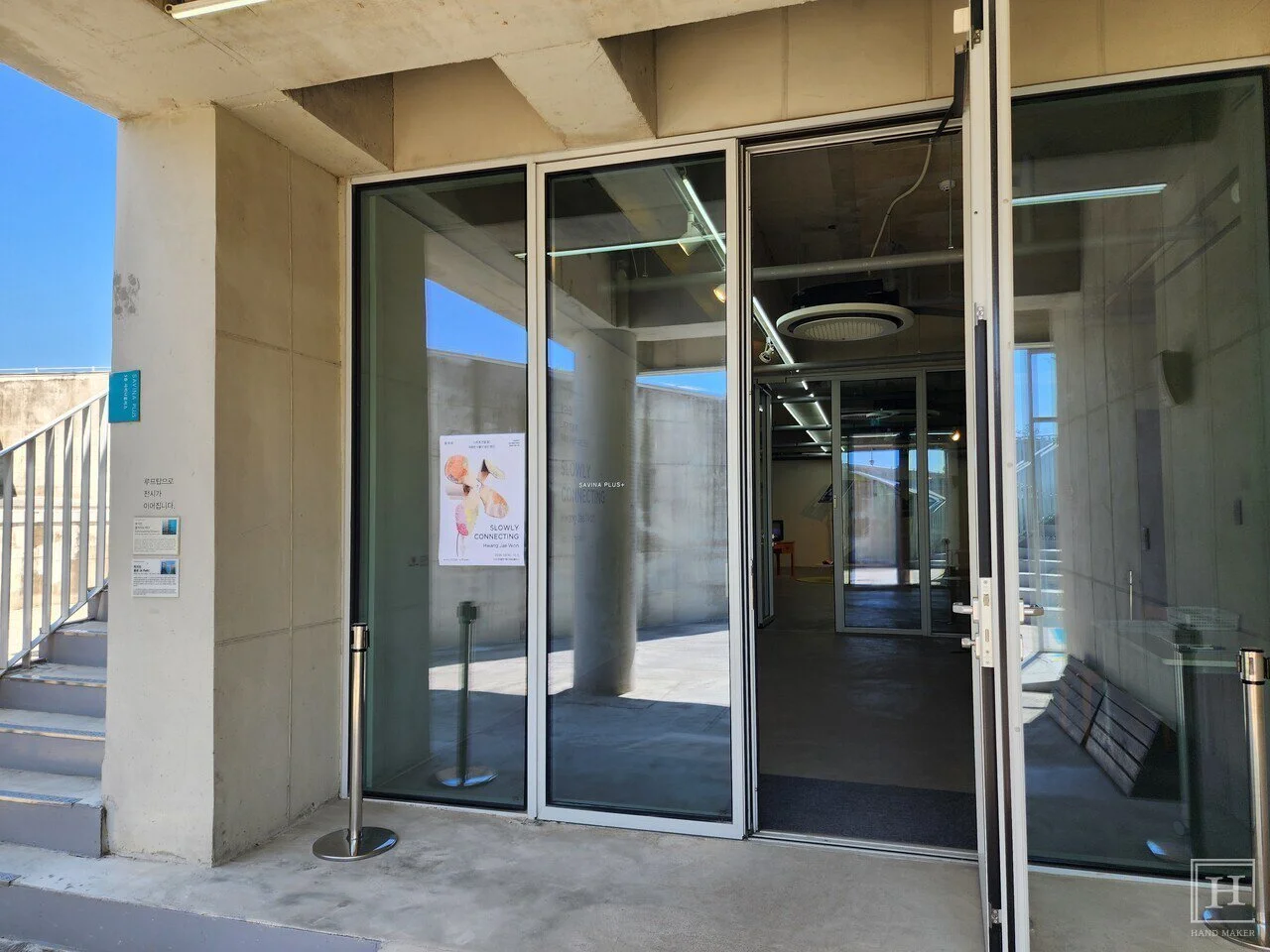
At the Savina Museum of Contemporary Art in Eunpyeong-gu, artist Hwang Jae-won's solo exhibition 《Connecting Slowly: The Unfamiliar Transformation of Familiar Objects》 has been held since the 10th. This exhibition is part of the Savina Museum of Contemporary Art's program to discover emerging artists and support creation, serving as a venue to introduce the artistic world of Hwang Jae-won, who combines everyday objects with knitting.
Savina Plus on the 5th floor, where the exhibition is taking place, is a complex cultural space within the museum where academies held by the museum, experimental exhibitions by emerging artists, and various events are held. Upon entering the cozy space, the works of artist Hwang Jae-won, which fill the walls, floors, and various spots, catch the eye.
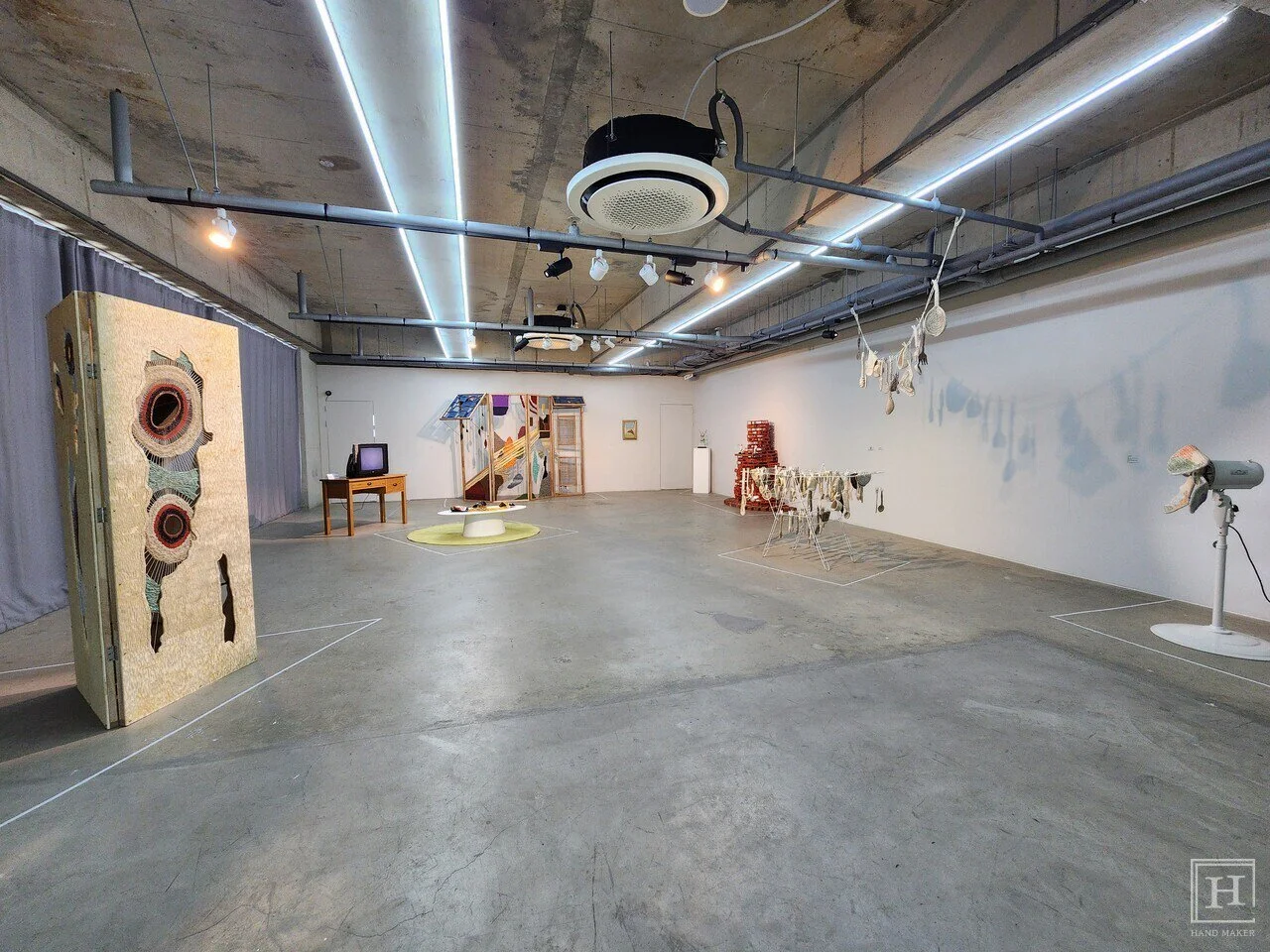
The overall atmosphere of the exhibition feels like visiting the home of an artist filled with knitting and weaving works. For viewers living in a similar generation to the artist, they can feel a familiar and warm affection.
Kang Jae-hyeon, the curator of the Savina Museum of Contemporary Art, explained, "Artist Hwang Jae-won has woven yarn into objects she feels are warm to make them function again," and added, "The knitted works, created with the idea of breaking the original use of objects, make us look at familiar objects in an unfamiliar way."
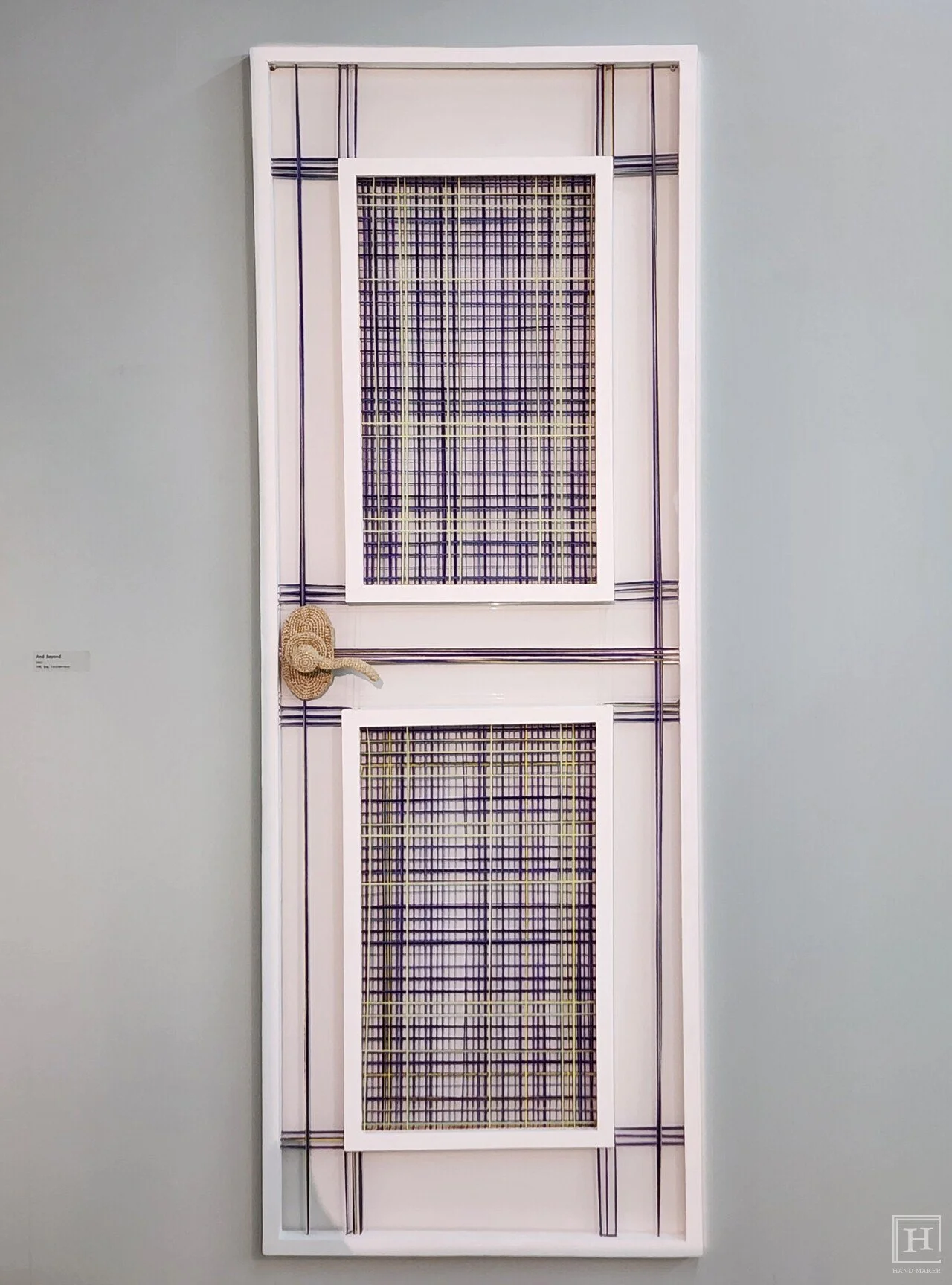
There is a door to a world set by the artist, rather than a door to the exhibition room. A work titled 〈And Beyond〉 features tightly pulled weaving that beautifully decorates a door. The handle knitted with yarn looks soft, but if one had the chance to actually grab it and try to open it, it seems as though it could not be opened. The exquisitely knitted appearance is admirable.
Although it cannot actually be opened, one wonders what lies behind this door. Some might imagine there is an actual space, while others might recall memories of times they wish to return to.
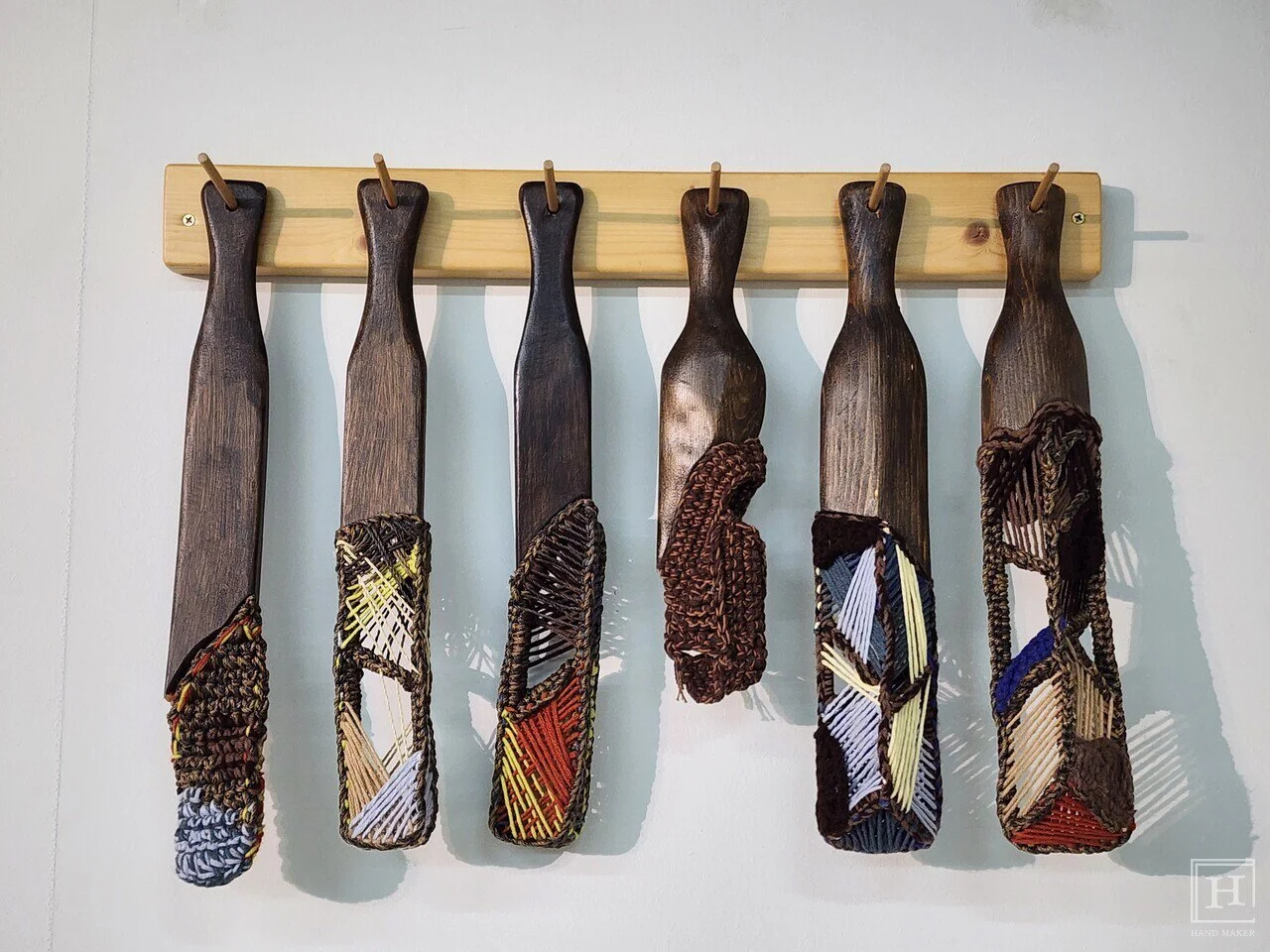
A laundry bat, which our grandmothers' generation would have likely used frequently while doing housework, is hanging. The bat, full of signs of use, has broken or worn down, unable to withstand the power of time. Artist Hwang Jae-won has refilled those traces of time with knitting. Some bats are densely filled, while others only entwine the shape, as if showing the time that has worn away. One can feel the time of endurance of mothers who overcame hard housework with chatter.
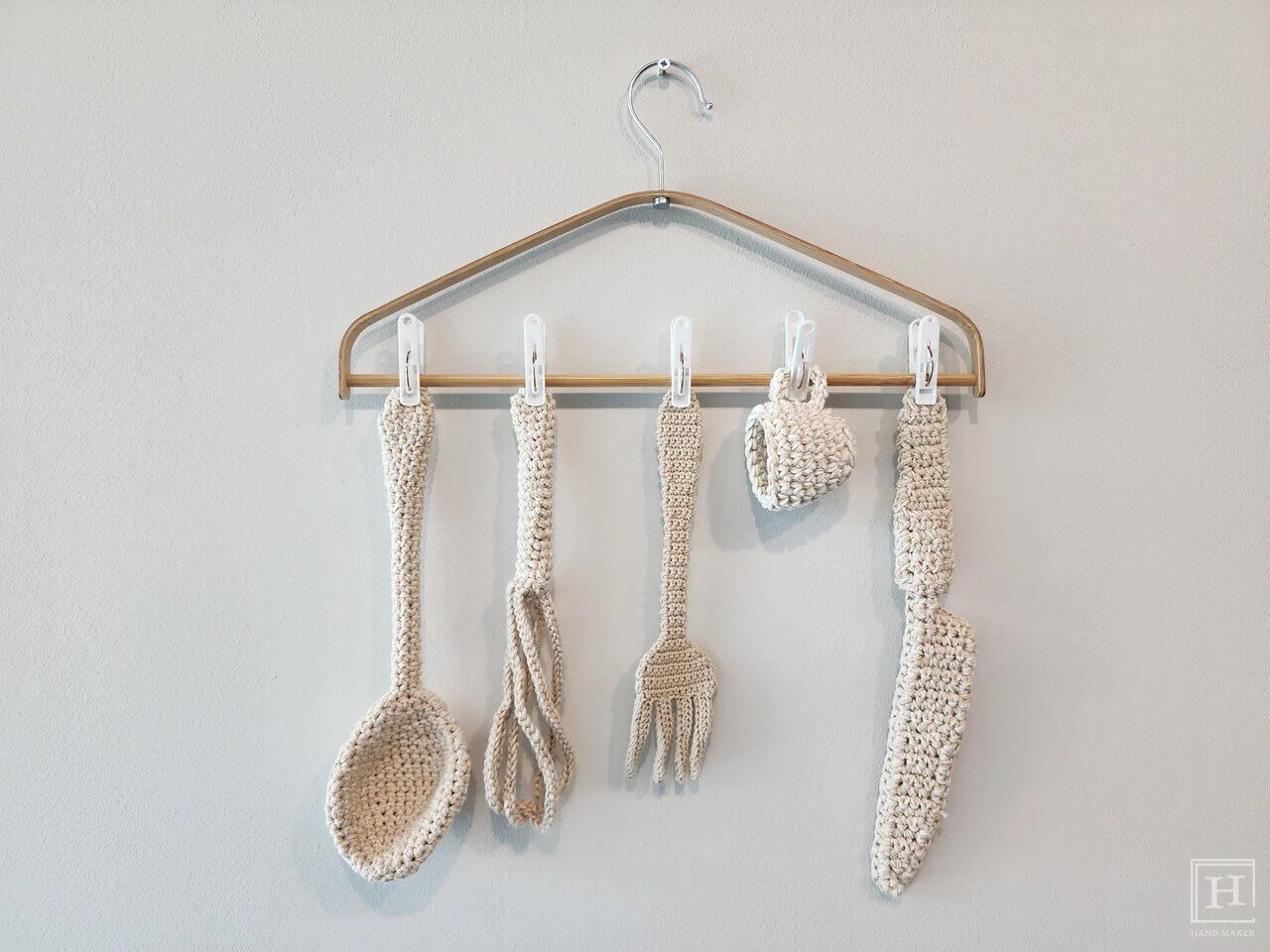
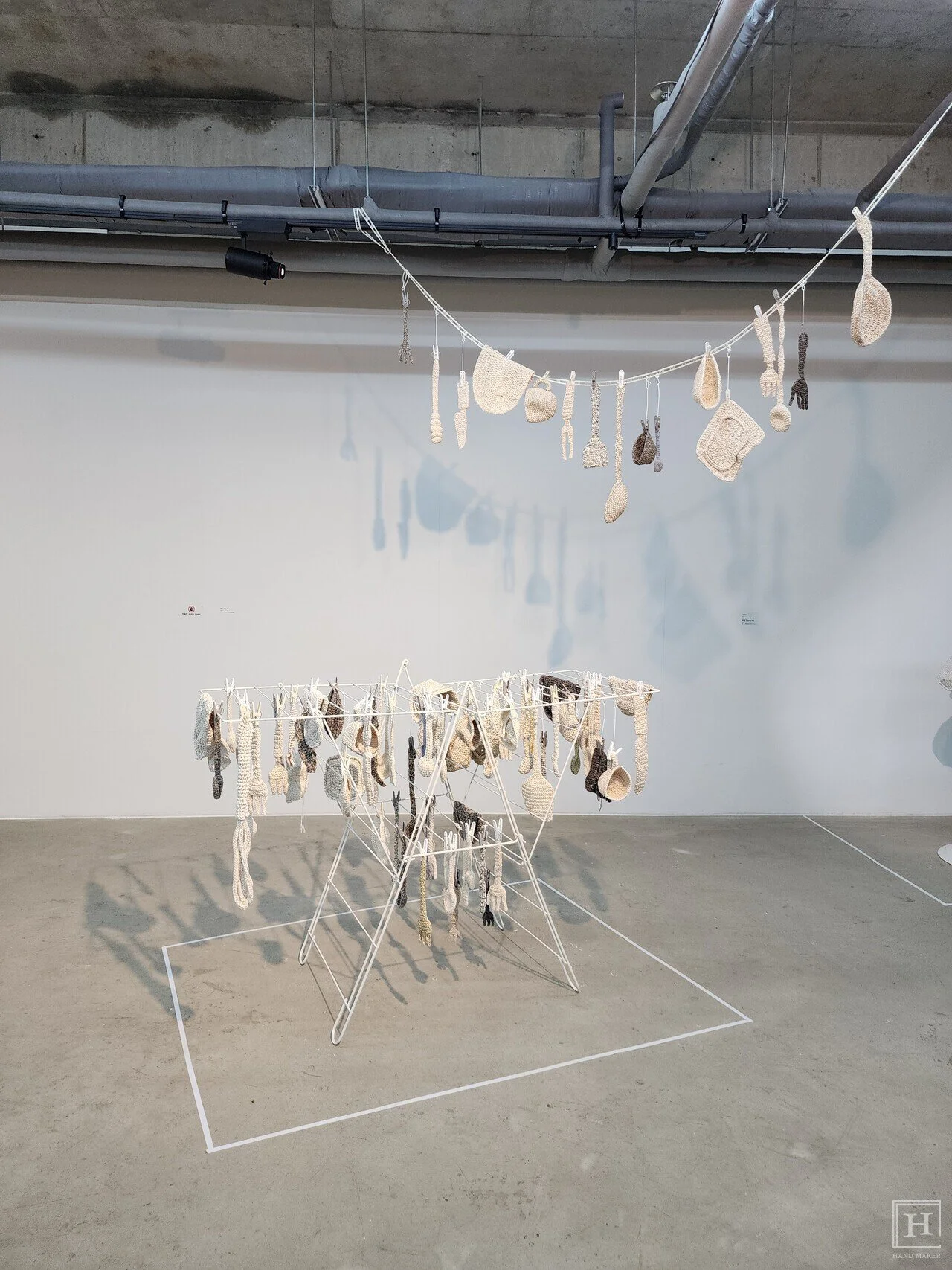
The work 〈Making a Living〉 contains the artistic philosophy of Hwang Jae-won, who transforms everyday objects to make them unfamiliar. Not only are various cooking utensils made larger than their original size, but they are also made of knitting, changing shapes that should be hard into soft ones. The sight of cooking utensils needed for meal preparation hanging on a laundry drying rack also comes across as unfamiliar yet interesting.
Perhaps the artist chose this idea to slowly and leisurely capture the daily lives of mothers contained within cooking utensils through knitting. It acts like a 'reversal device' that flips existing stereotypes or perceptions, allowing the meaning contained within to remain in one's memory for a long time. The cooking utensils, hanging limp like laundry, evoke a feeling of wanting to provide a warm meal, capturing one's gaze for a long time.
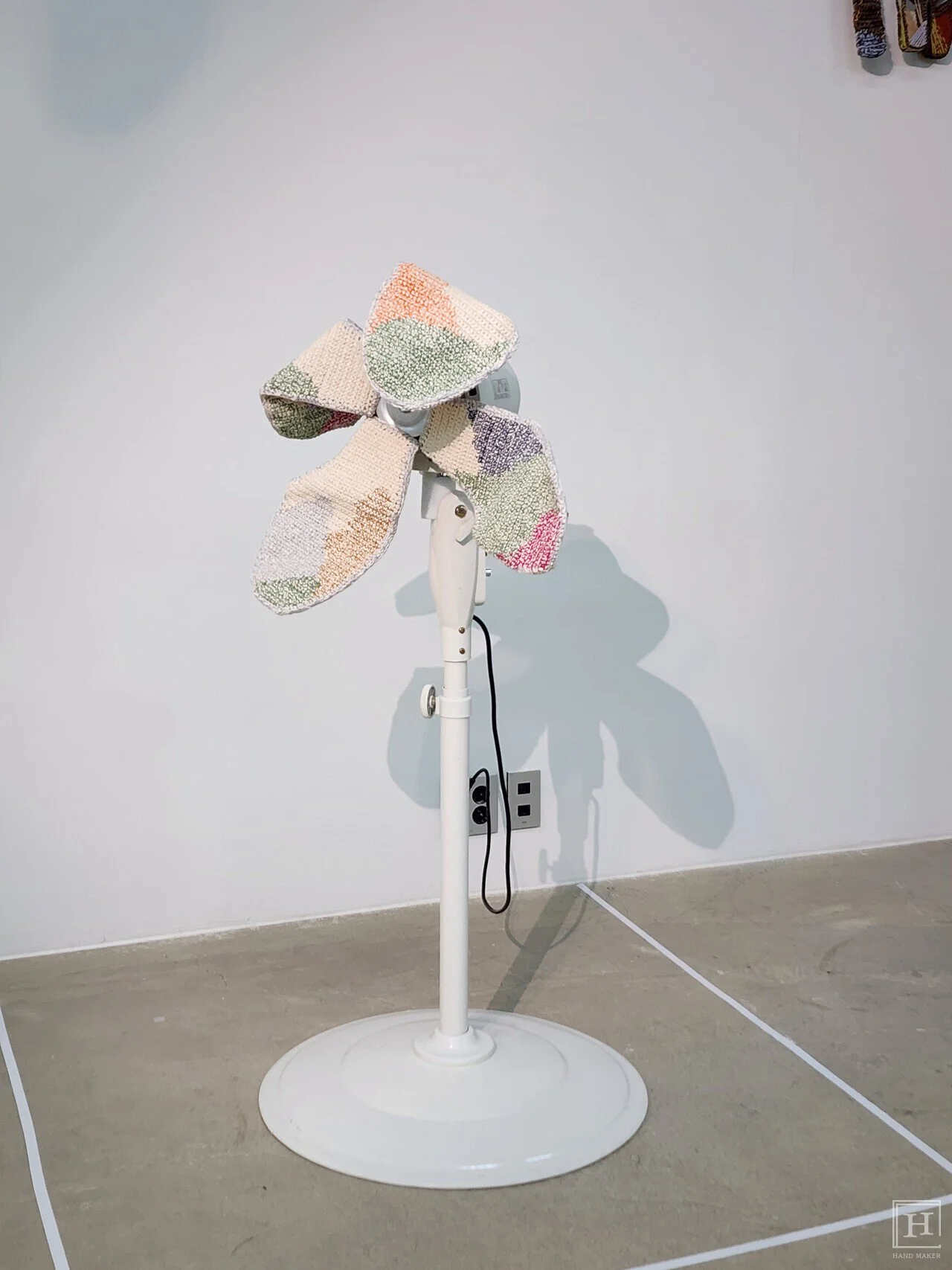
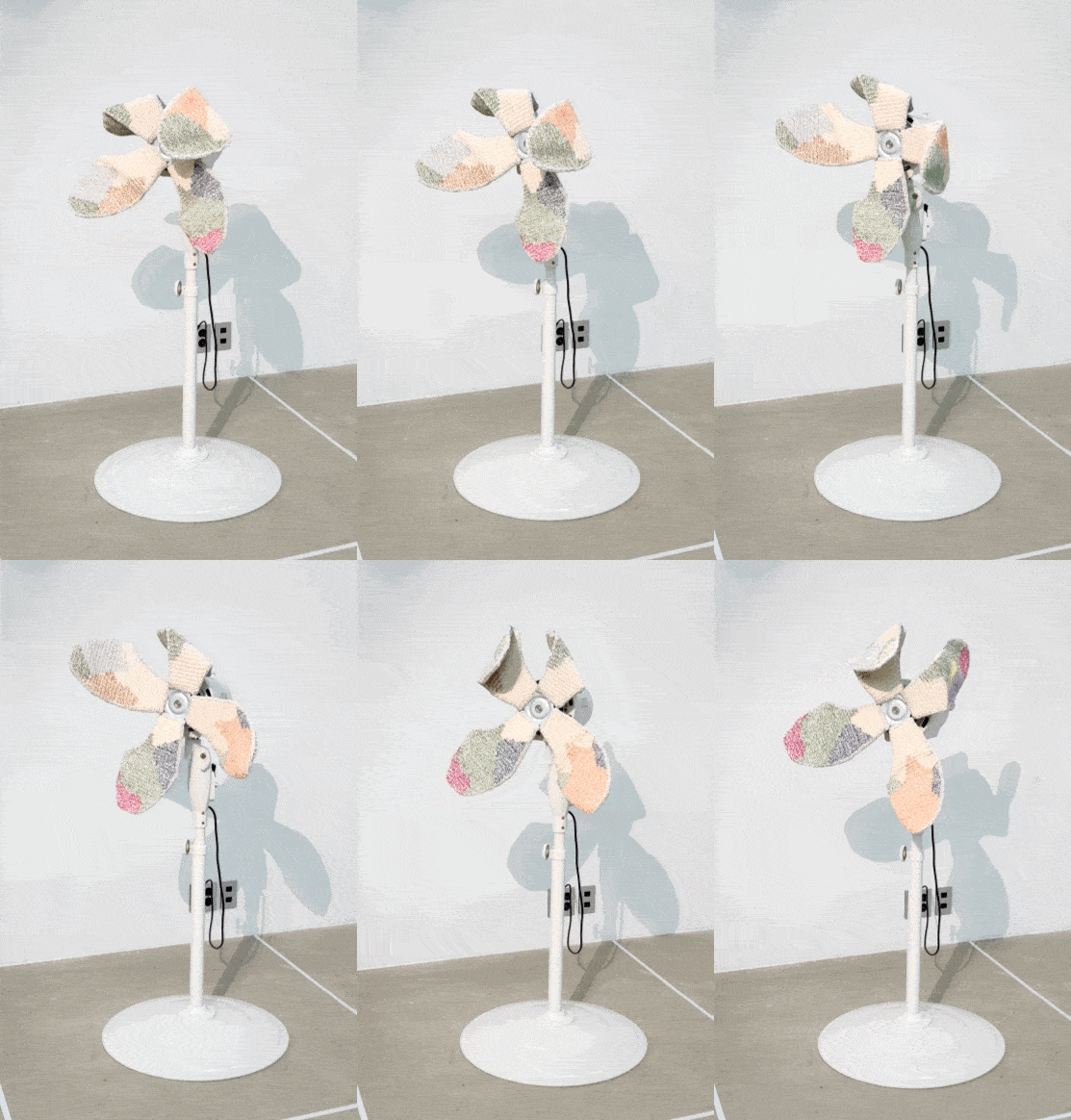
This work is also one of the pieces that shows a 'reversal.' The blades of an actually functioning electric fan were made of knitting. It spins, but it cannot perform the fan's original role of creating a cool breeze. Instead, the sight of the blades folding every time it spins elicits laughter.
During a time when summer is passing, a period when the catchphrase 'Turn on the air conditioner to full power' was rampant, the knitted fan might be a form of wit. However, for us who simply turned on the power without knowing the gratitude for the fan that blew away the heat, the question 〈Feeling Cool?〉 makes us feel unexpectedly solemn. When we take out the fan again next summer, it feels as though we should stroke it warmly.
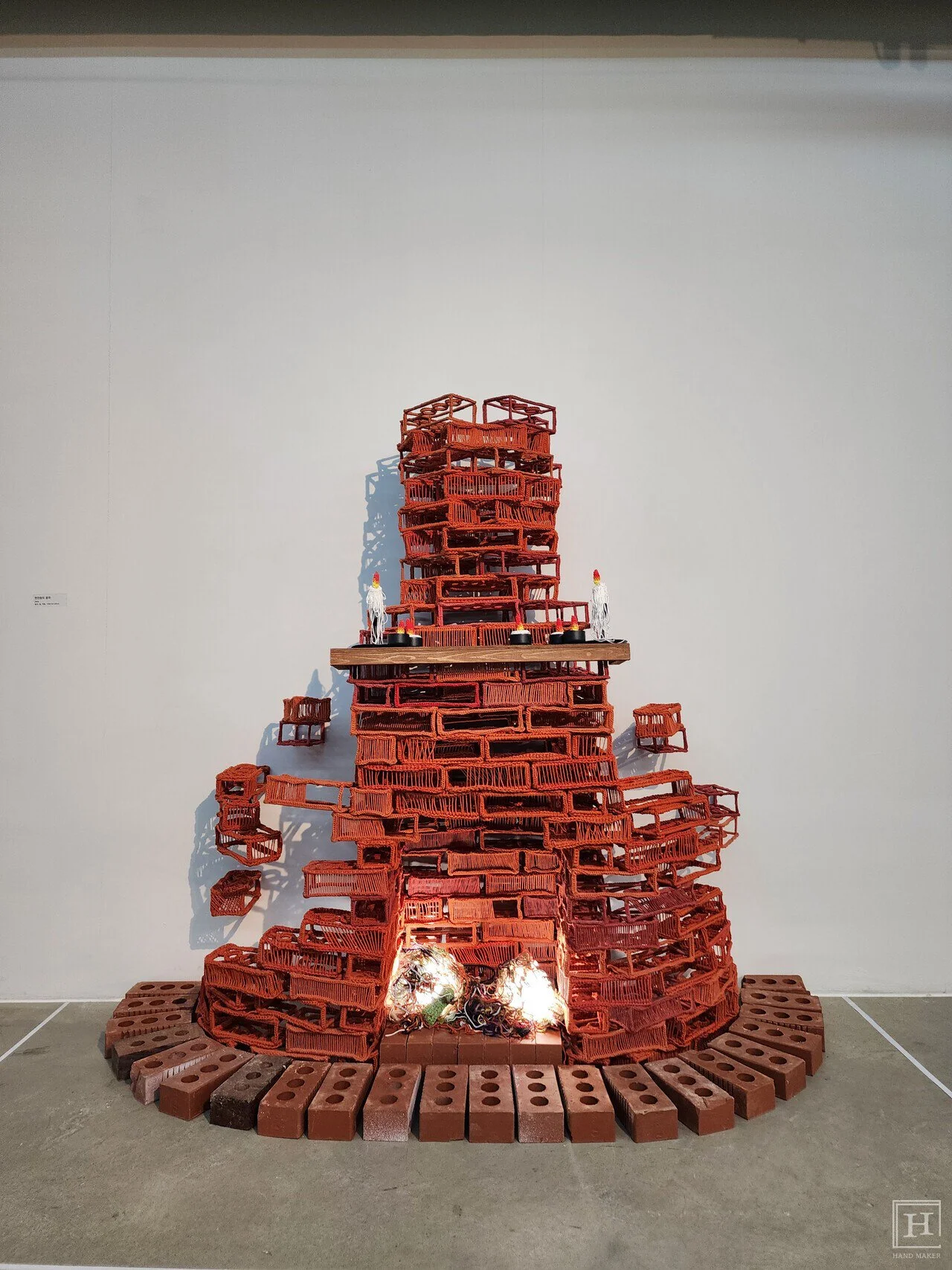
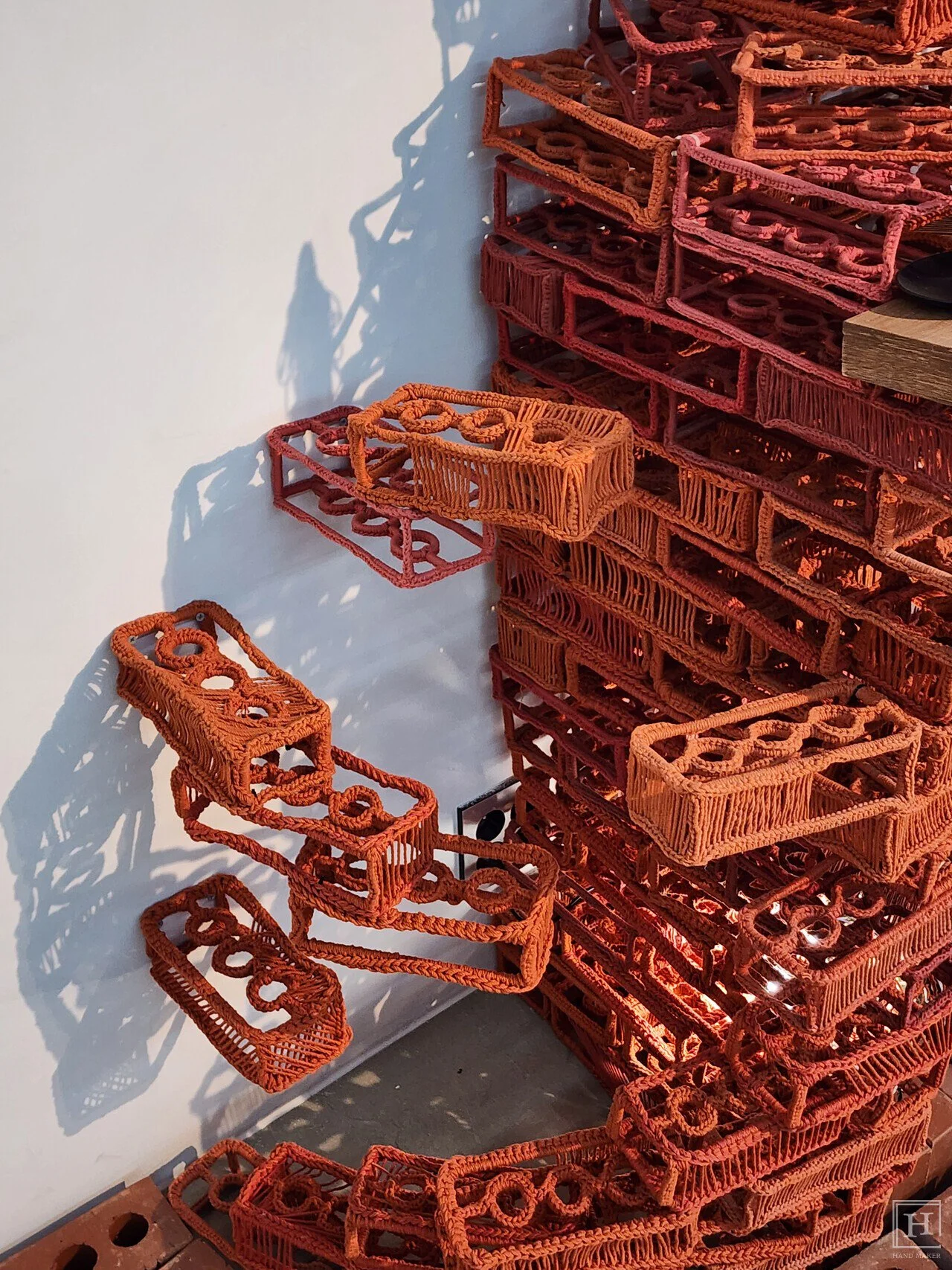
This is the work 〈The Outline of Comfort〉, which brings a warm fireplace to life through knitting. While fireplaces are more common in Western culture than in Korea, the warmth of a stove made by stacking bricks layer by layer is something anyone can easily empathize with. Perhaps the artist wanted to express the stability and comfort provided by warmth through knitting.
Therefore, rather than filling the bricks completely, they were knitted to reveal only their silhouette, leaving gaps in between so that the bricks appear to be floating in mid-air. Comfort is not something with a clear form, but is closer to a sensation or an emotion. One naturally nods at the artist's idea of revealing the invisible comfort through the outlines of bricks.
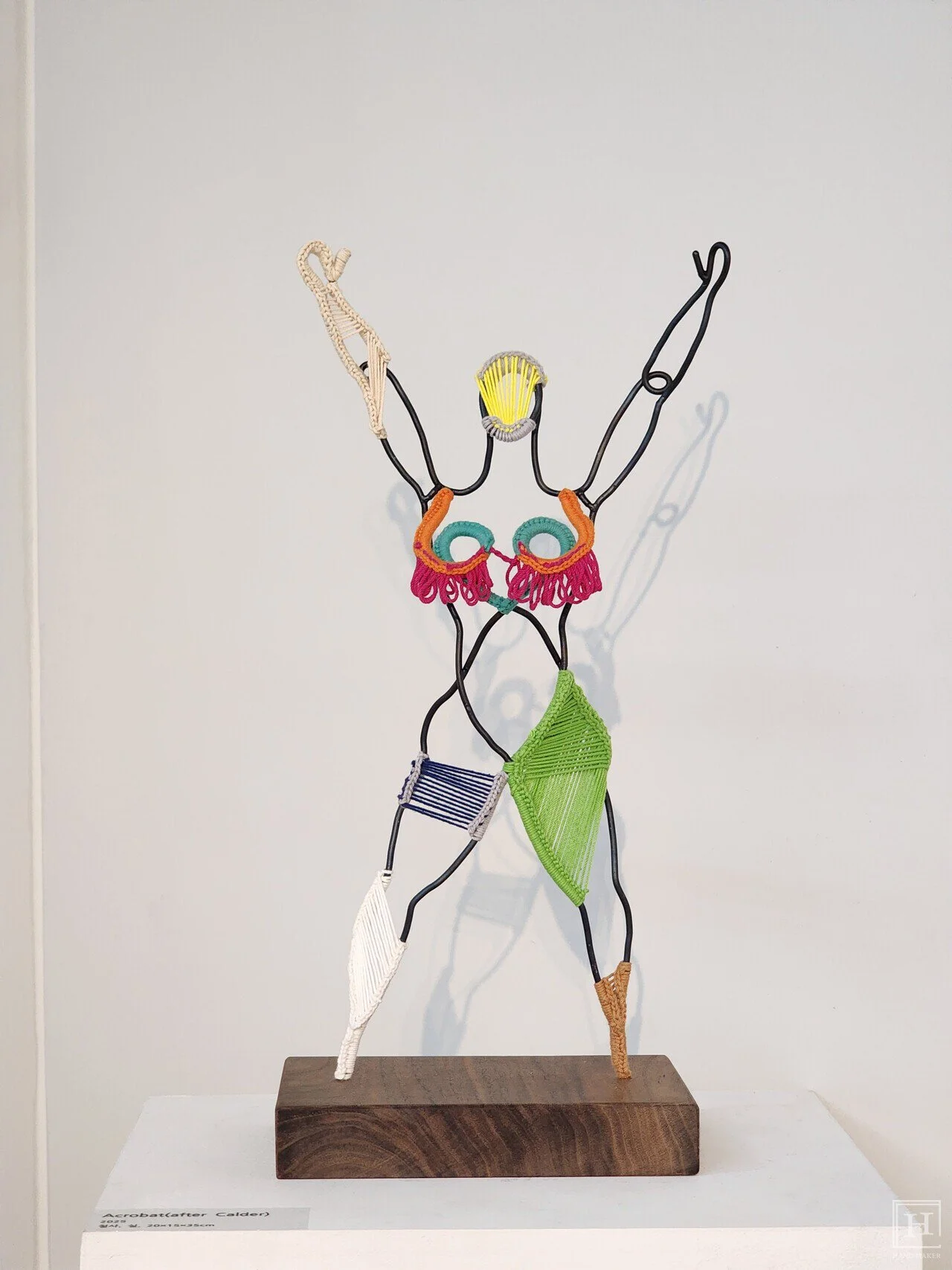
As the name of the work suggests, it is a piece made by weaving wire and thread to resemble an acrobat. By adding color and texture to a light body composed only of lines through knitting and weaving methods, the artist newly interprets the linear sculptures of the American sculptor Alexander Calder using their own unique textile language. Looking at the colorful thread tightly woven around the wire, the characteristic rhythm and movement of the acrobat come to life even more vividly.
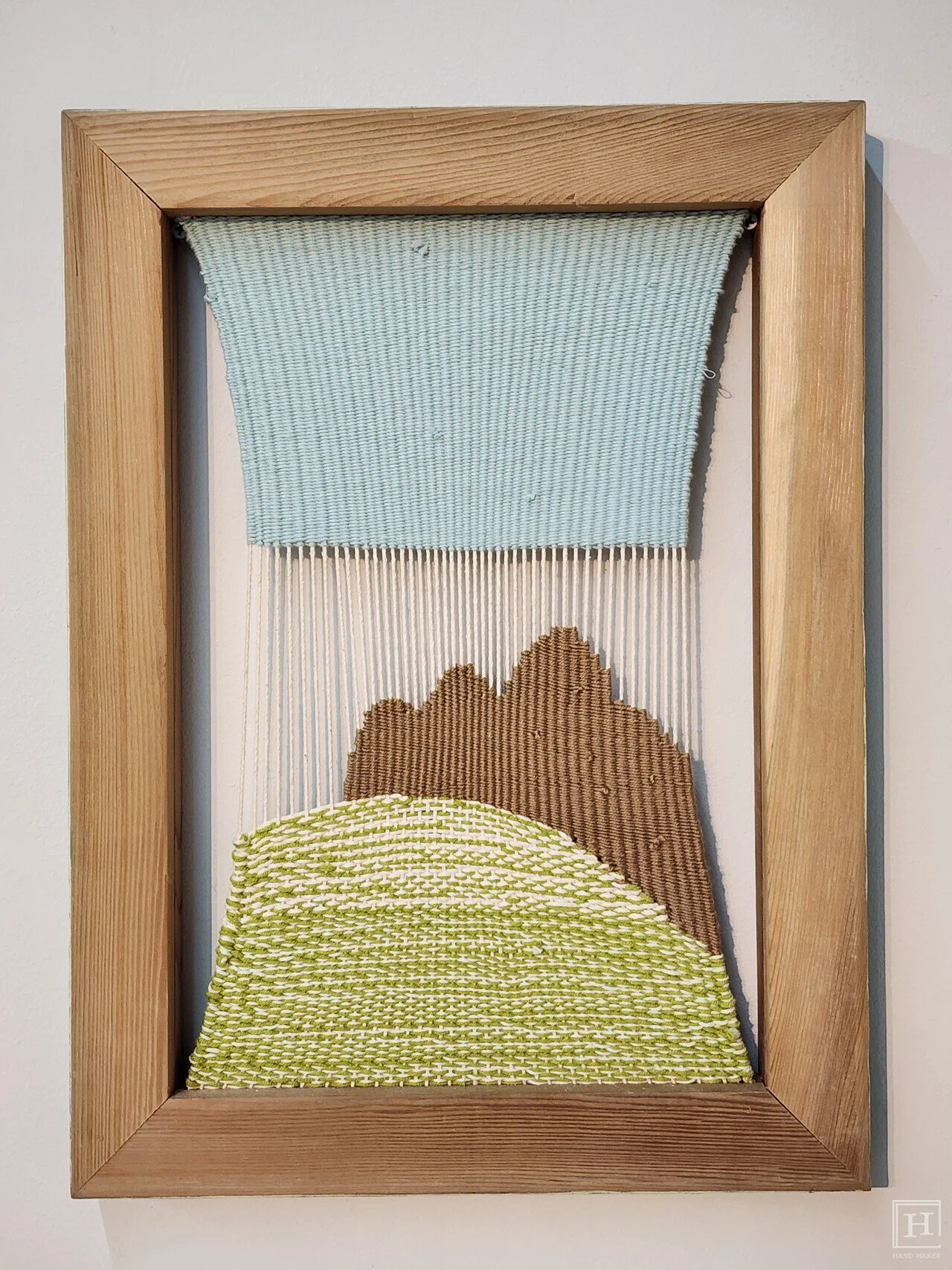
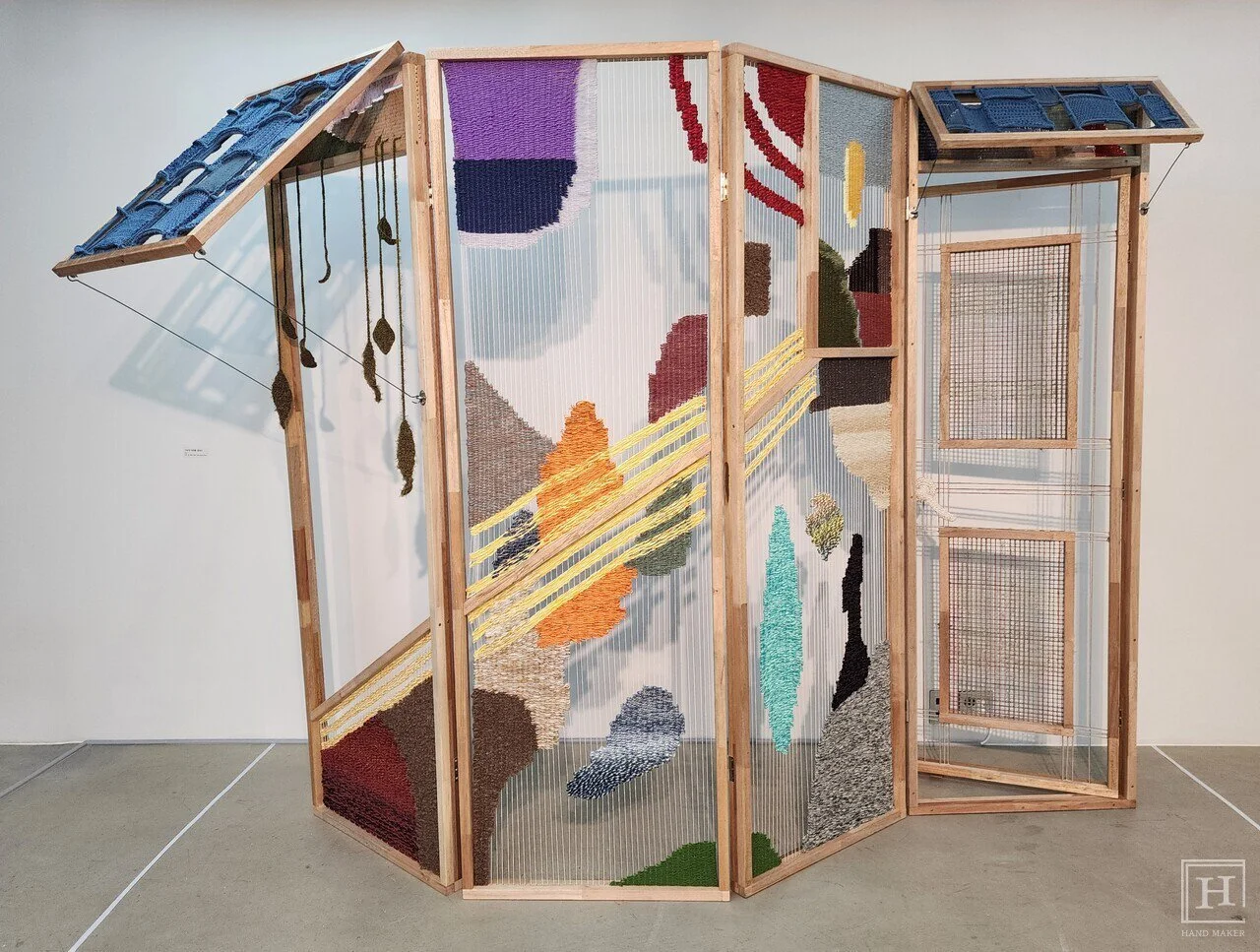
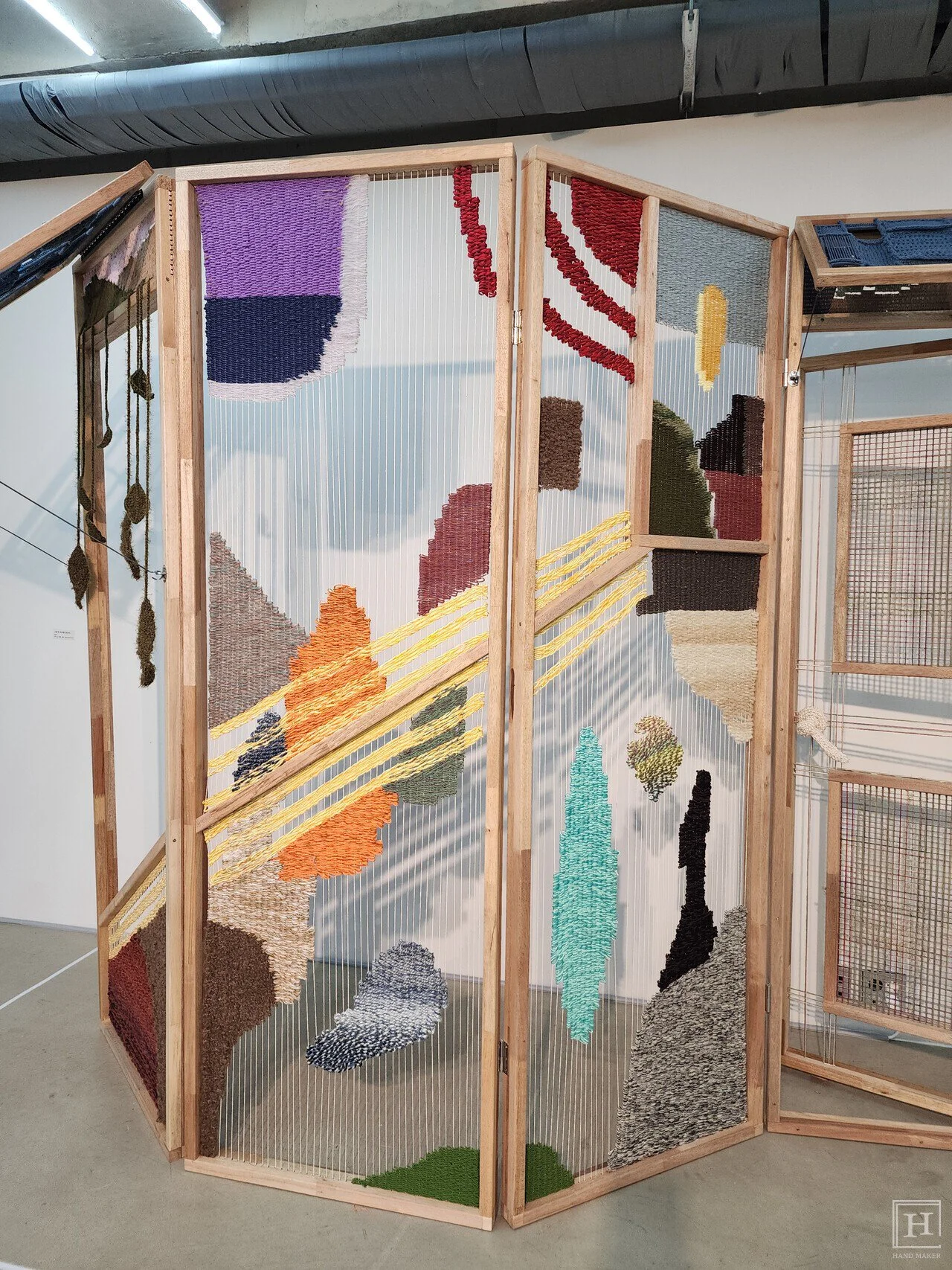
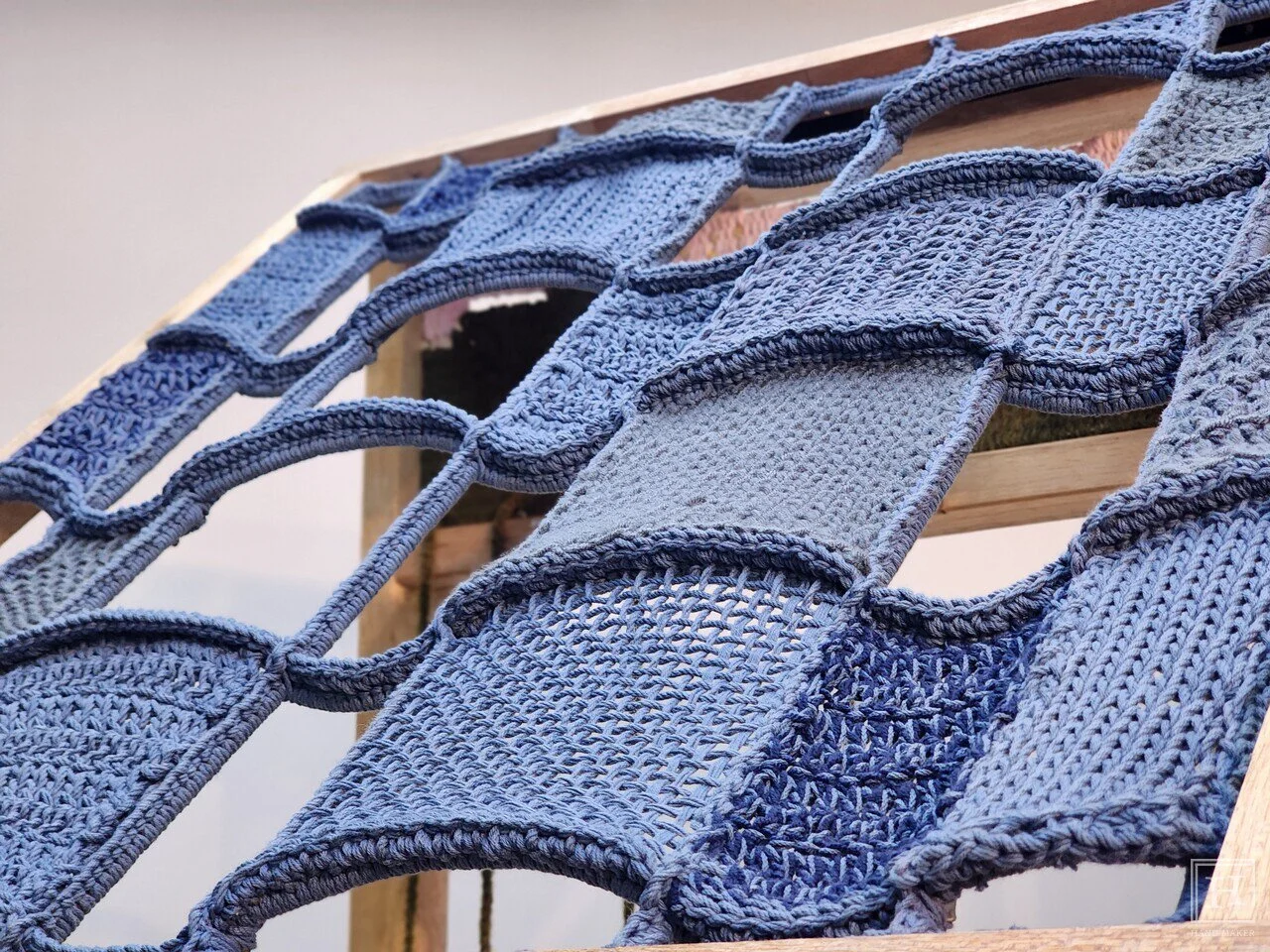
Two works showcasing the artist's delicate weaving expressions give the feeling of having moved natural landscapes and old houses into the exhibition hall. 〈Somewhere〉 looks as if one is peering at the outside scenery through a small window, while 〈And So It Settled In〉 seems to express natural landscapes as the exterior walls of a house.
In particular, 〈And So It Settled In〉 is said to be an abstract expression of the seasonal changes of the scenery the artist viewed while looking out from a room. Depending on the color palette, it conveys everything from the warm feeling of spring to the hot sun of summer, the autumn foliage, and the coldness of winter.
The detailed expressions are also impressive, from objects reminiscent of various crops being hung to dry in a rural house to tiled roofs woven with three-dimensional curves. The works, which took a long time to create through weaving and knitting, make one focus more on the appearance of nature that changes as slowly as that time spent creating them.
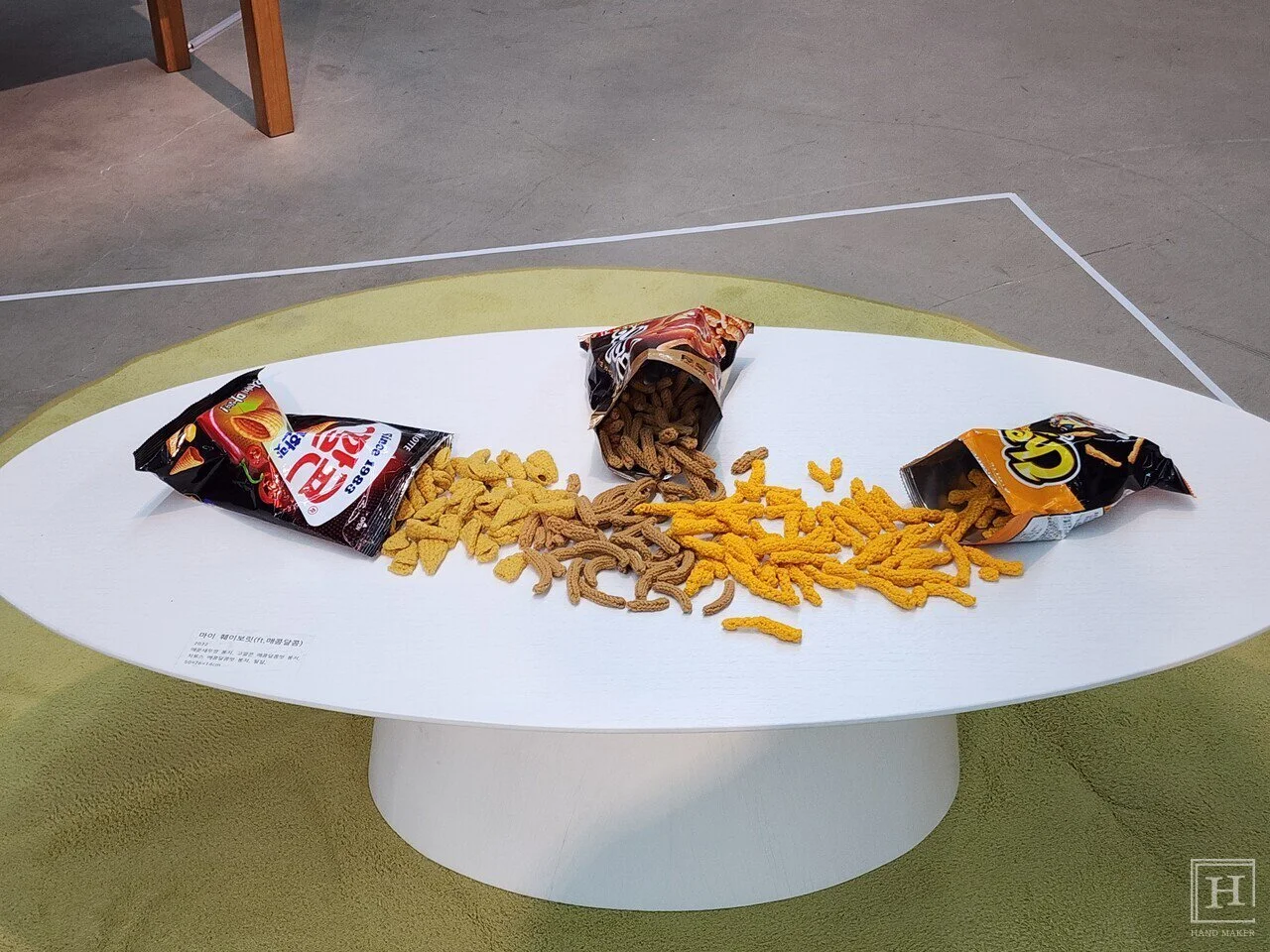
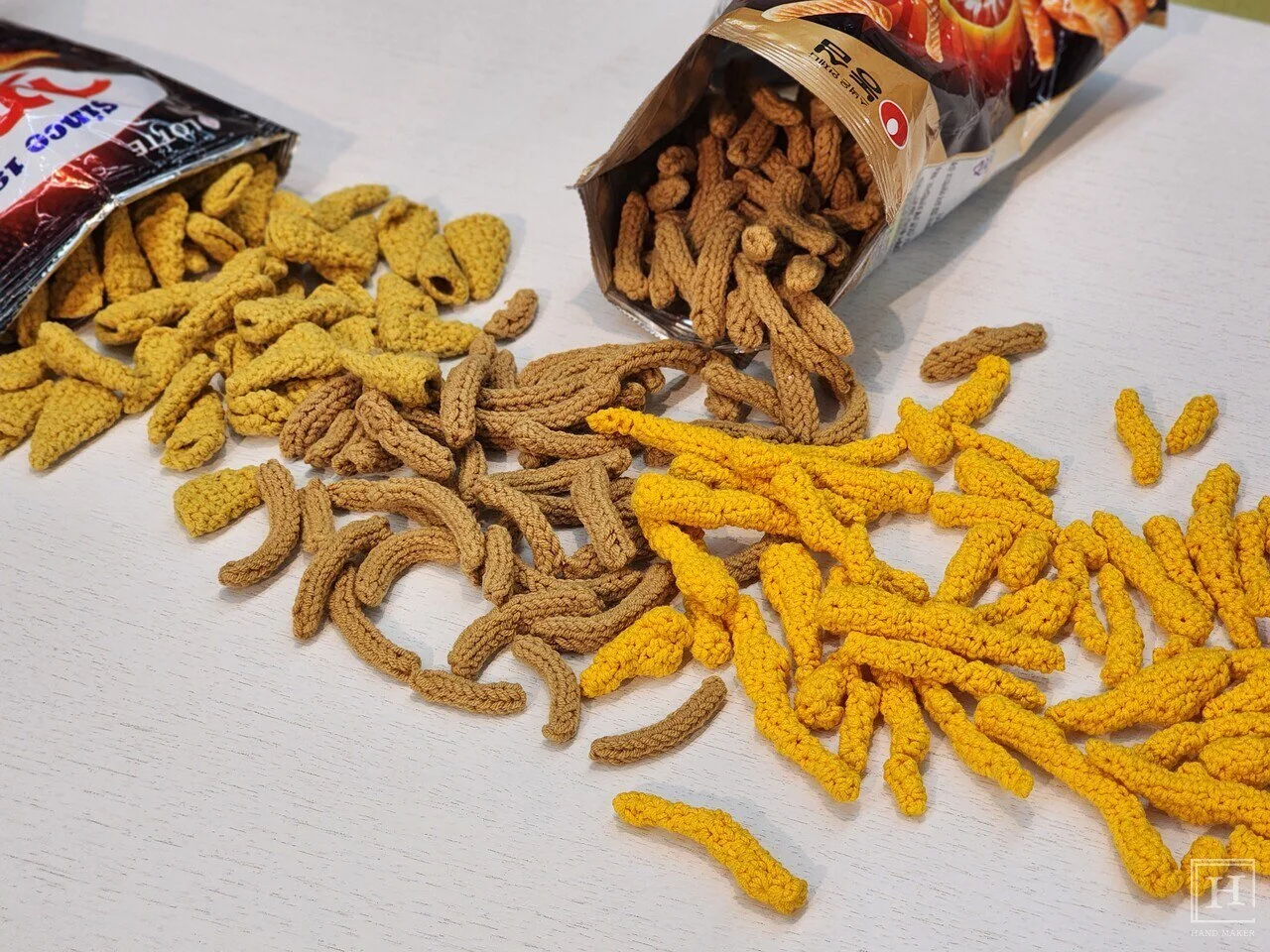
This is the cutest and most interesting work among the exhibited pieces. As the title suggests, it is said that the artist made it through knitting while actually eating the snacks they like. By utilizing actual snack bags, one is marveled by the exquisite appearance made to look similar to the shape of the snacks. If you have experienced eating these snacks, you might experience the illusion of feeling the taste and aroma of the snacks just by looking at them.
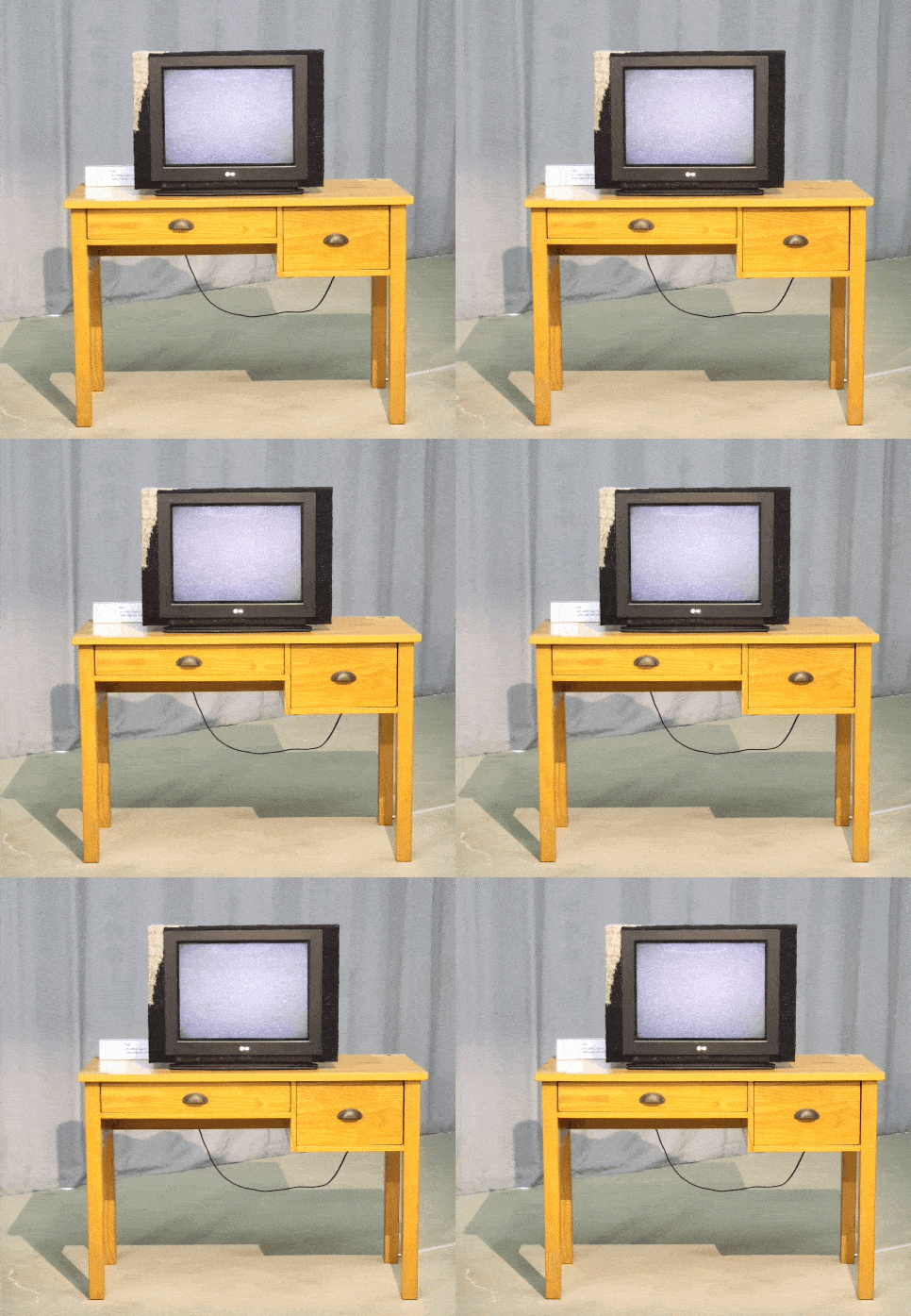
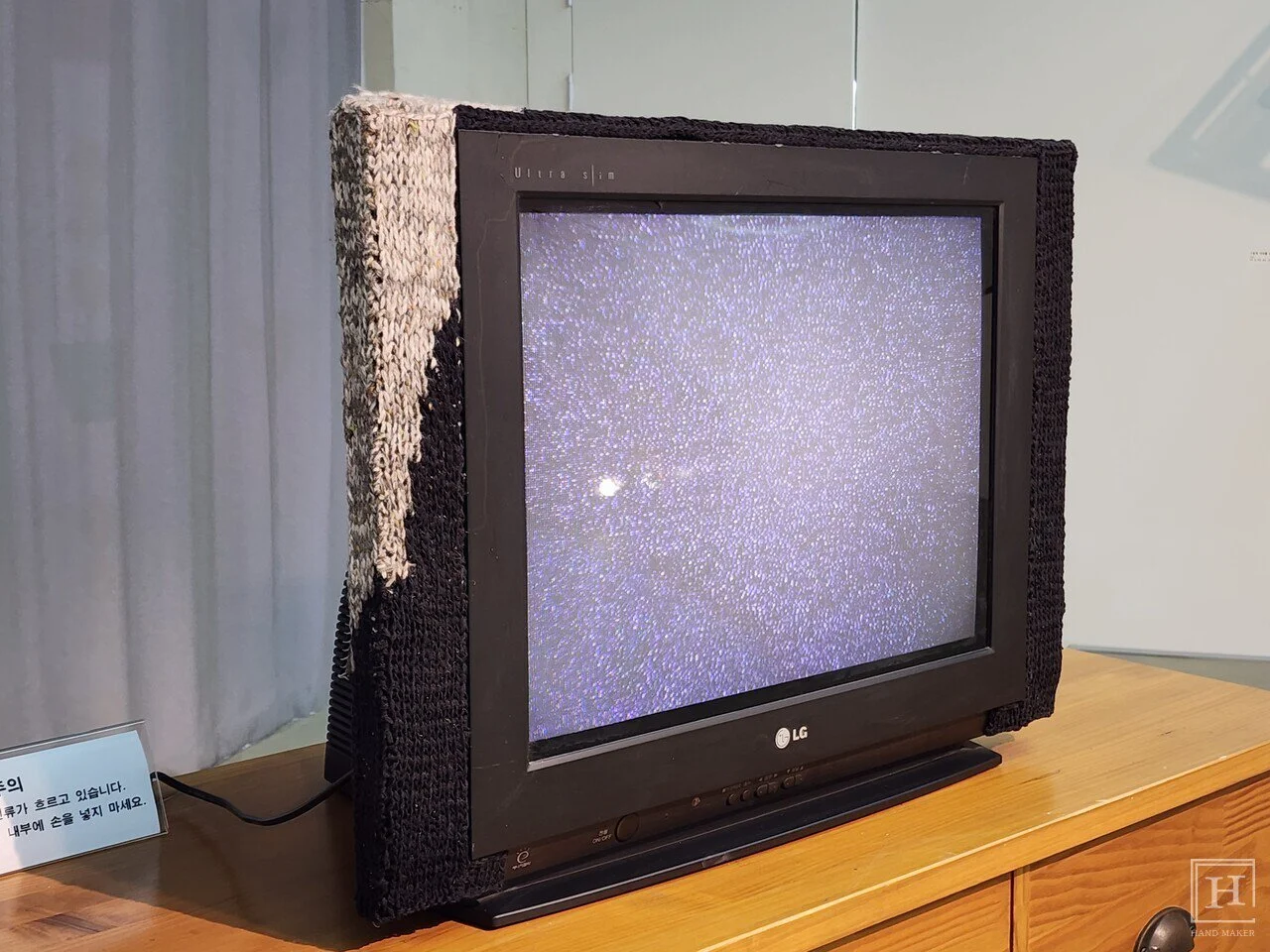
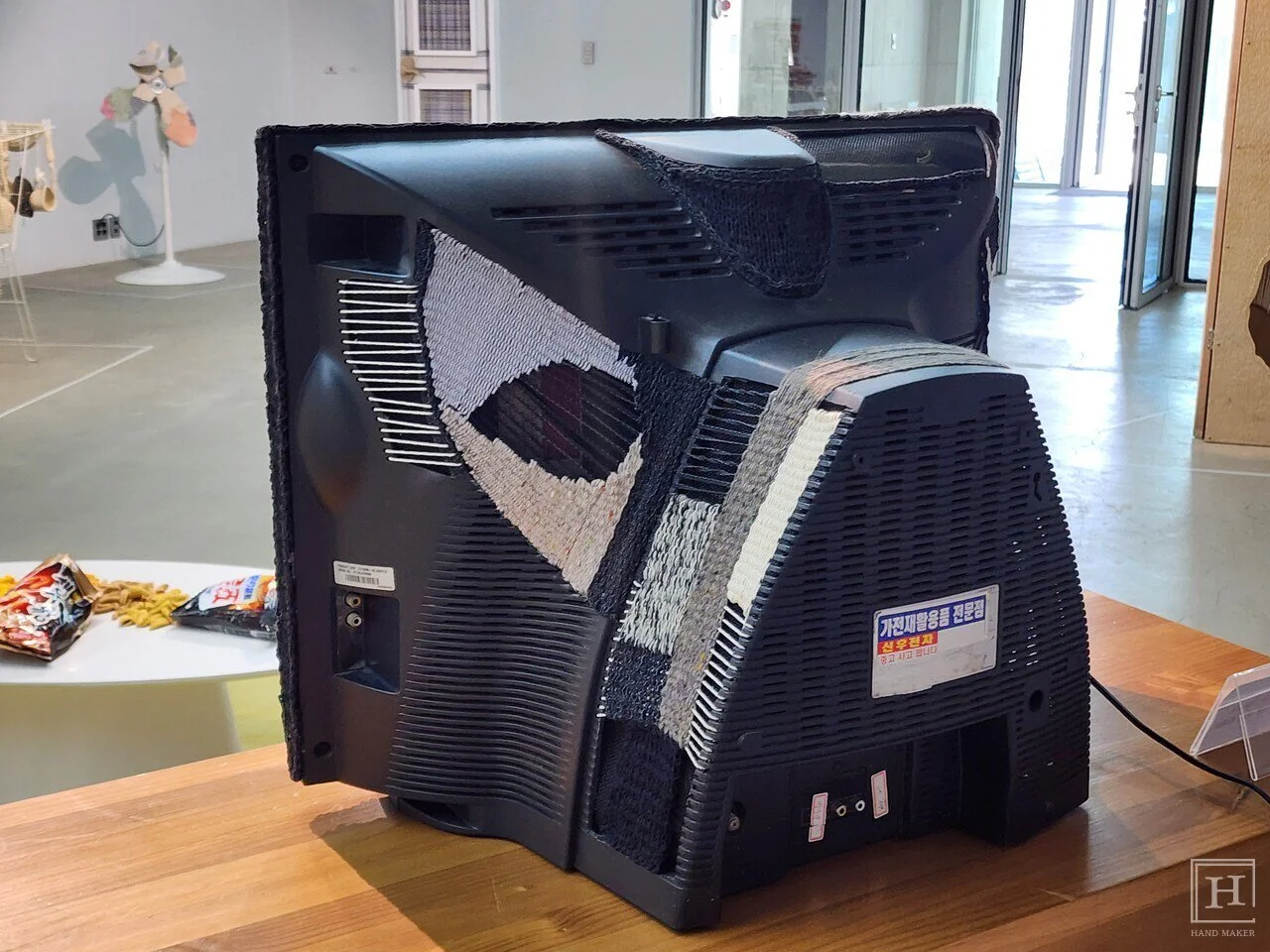
This is a work where a cathode-ray tube TV, which cannot be seen these days, is installed with only a white noise screen turned on. Nowadays, not only are such TVs unavailable, but since broadcasts continue until late at dawn, one cannot see such a screen. The title 〈Even the National Anthem Has Ended〉 and the appearance of the work can only be empathized with by those who have lived through such times.
Nowadays, one can choose and watch desired broadcasts anytime through OTT, IPTV, or YouTube. While it is a world where everything has become easy and convenient, during the period of watching broadcasts on cathode-ray tube TVs, one had to sit in front of the TV to watch a desired program by looking at the schedule in a newspaper. When regular broadcasts ended, Aegukga would play, and when the signal was cut, the screen would change with a "zzzz" sound. At that time, it was familiar, but now it has become an unfamiliar landscape.
To that extent, artist Hwang Jae-won has captured the passed time by knitting onto the TV. While the work description says that warm time was clothed onto hard and cold objects, for those who have lived their lives with such TVs, it serves as a time to briefly return to the past and reminisce about those days.
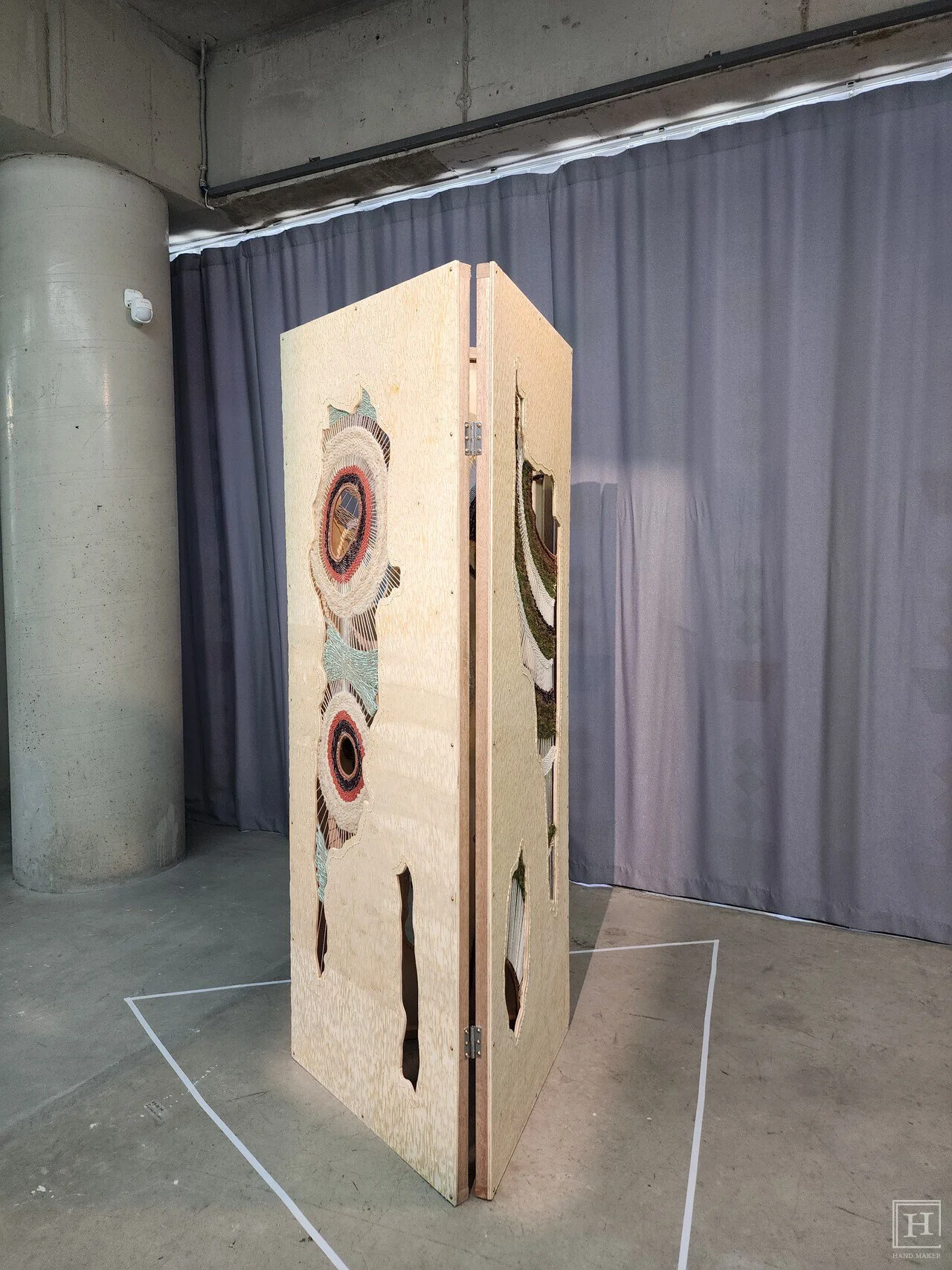
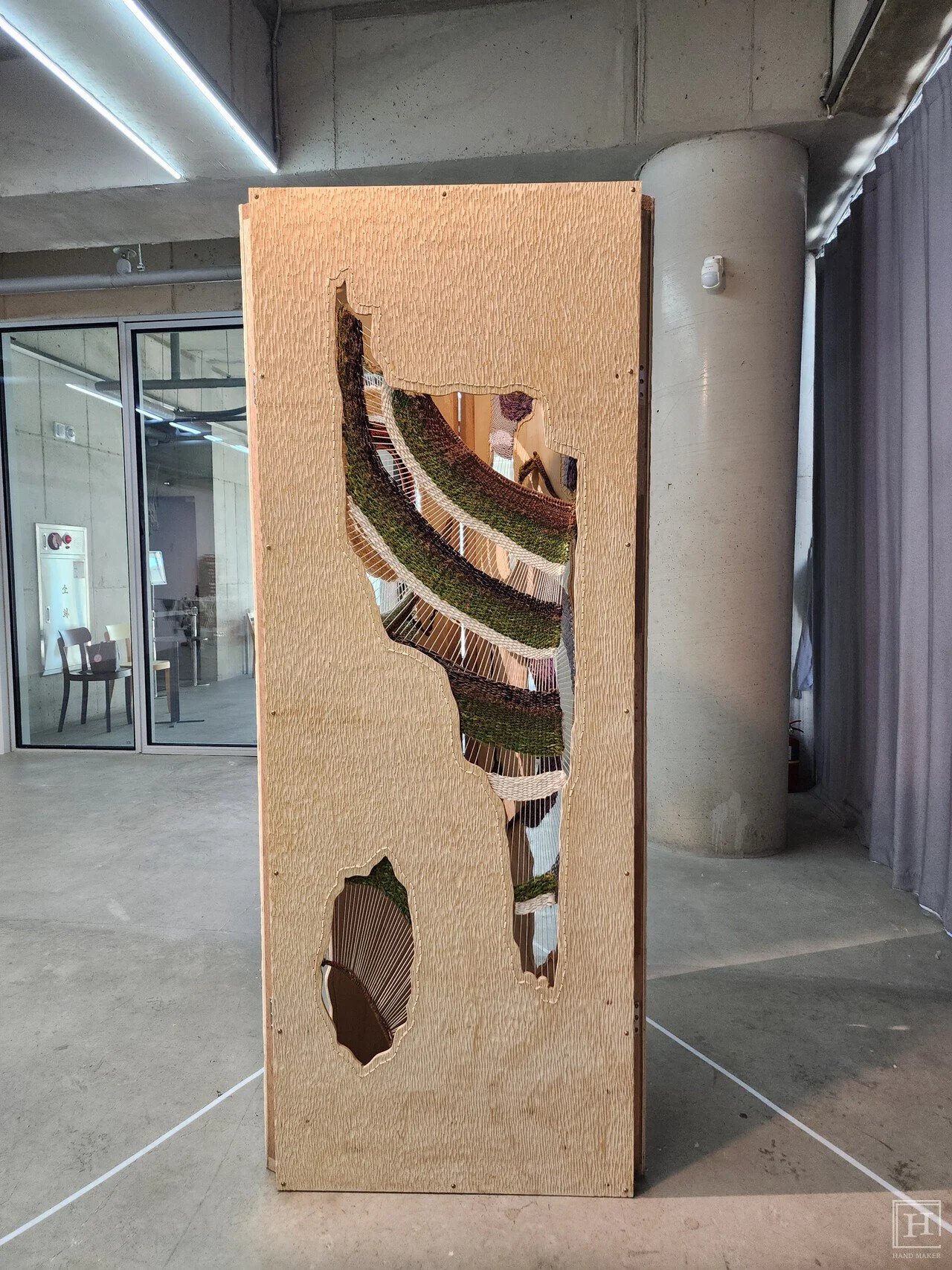
This is a work where abstract forms are knitted onto three sides of plywood. Perhaps it was given the name "A Whole Never Seen" because the entire work cannot be appreciated all at once. When viewed from the outside, one discovers a form of regular weaving within irregular shapes, and the charm of this work lies in looking inside through the gaps.
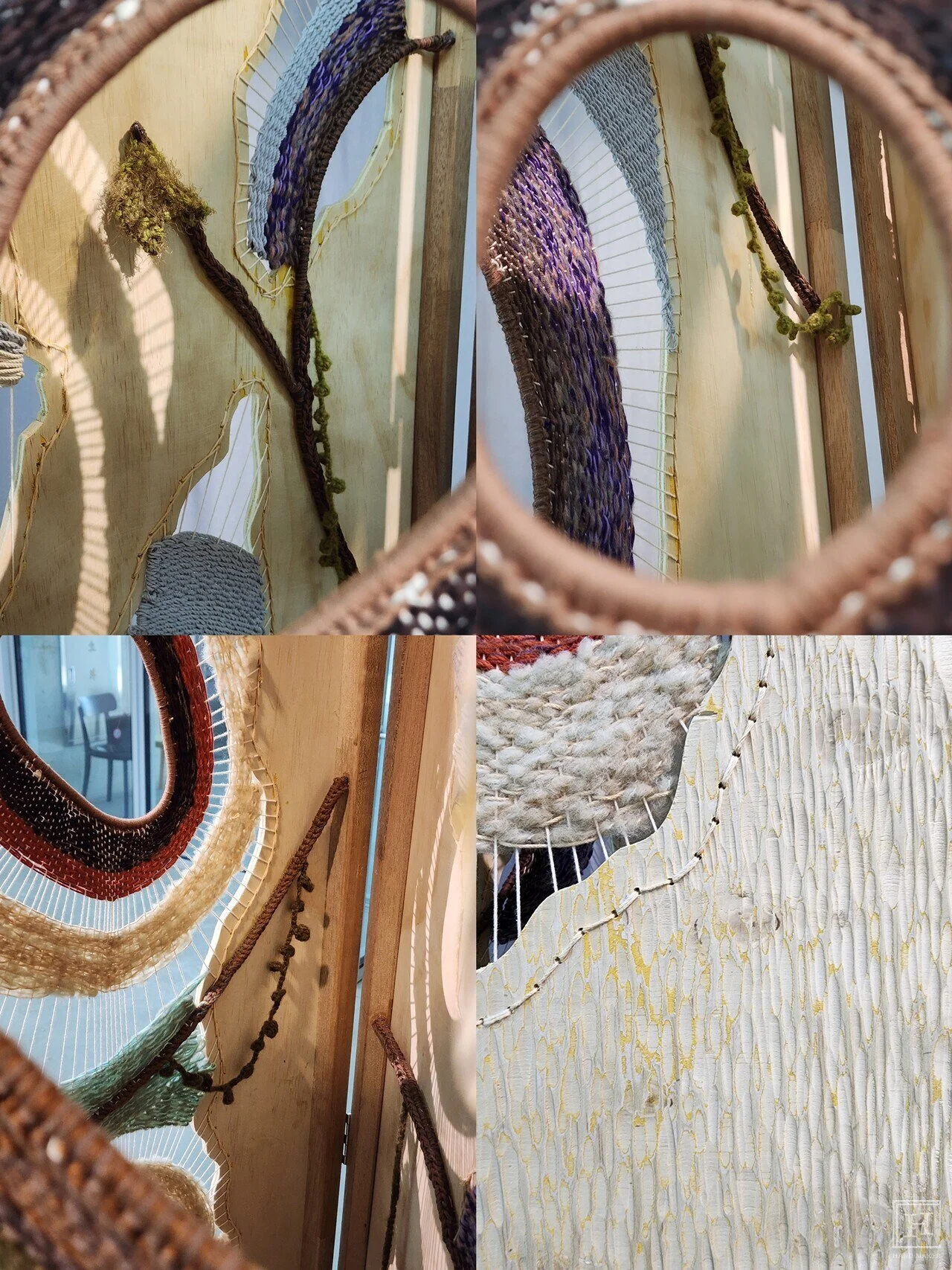
When looking inside the work, one finds a different appearance that could not be seen from the outside. It looks as if vine plants are climbing up inside the work and growing freely. It brings to mind the four-character idiom 'Oeyunaegang' (strong on the inside, soft on the outside). Perhaps it is the artist's message not to pass by by only looking at the external appearance, but to look into the inner appearance that is not easily seen. The way the wooden plywood of the work is carved to preserve its natural grain, and the objects that show another side of the work from the inside, allow one to guess the artist's intention to make viewers look beyond the outward appearance.
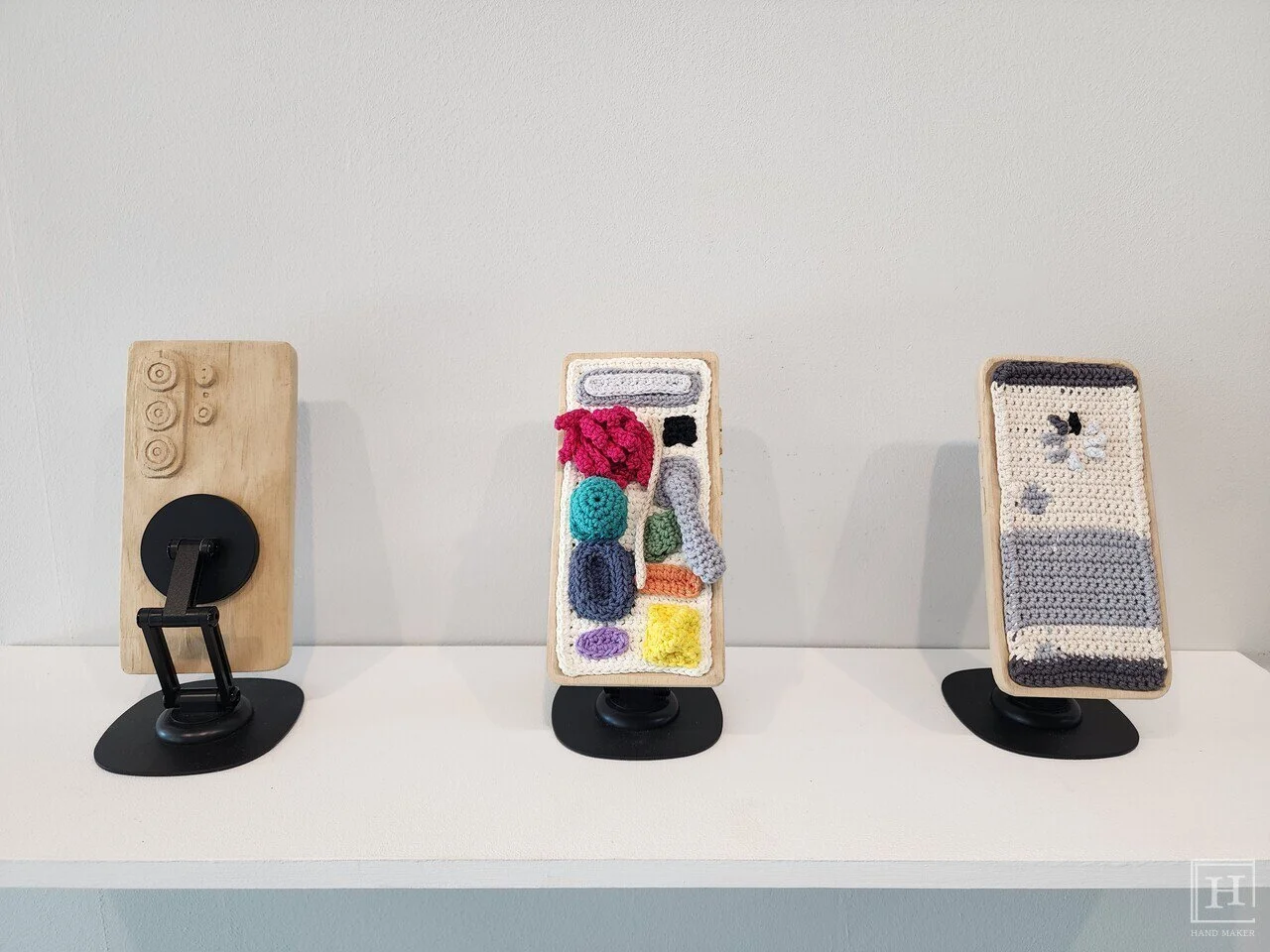
Although it is a work that could be passed by since it is installed outside the exhibition hall, it is a work that best contrastingly represents our appearance, which is accustomed to the digital age. The reason knitting is becoming popular again is that it is an analog hobby for digital detox. One applauds once again at the artist's idea of appropriately combining these two opposing things.
From the appearance of knitting smartphone screens, which make one keep using them, into various shapes, to the appearance of slow loading due to slow internet connection speeds, the artist has created various forms. It is good to use the conveniences of civilization appropriately, but it is problematic to fall deeply into them like an addiction. One can feel the artist's consideration, hoping that we too live while slowly looking around our surroundings, much like knitting, which is the aesthetics of slowness.
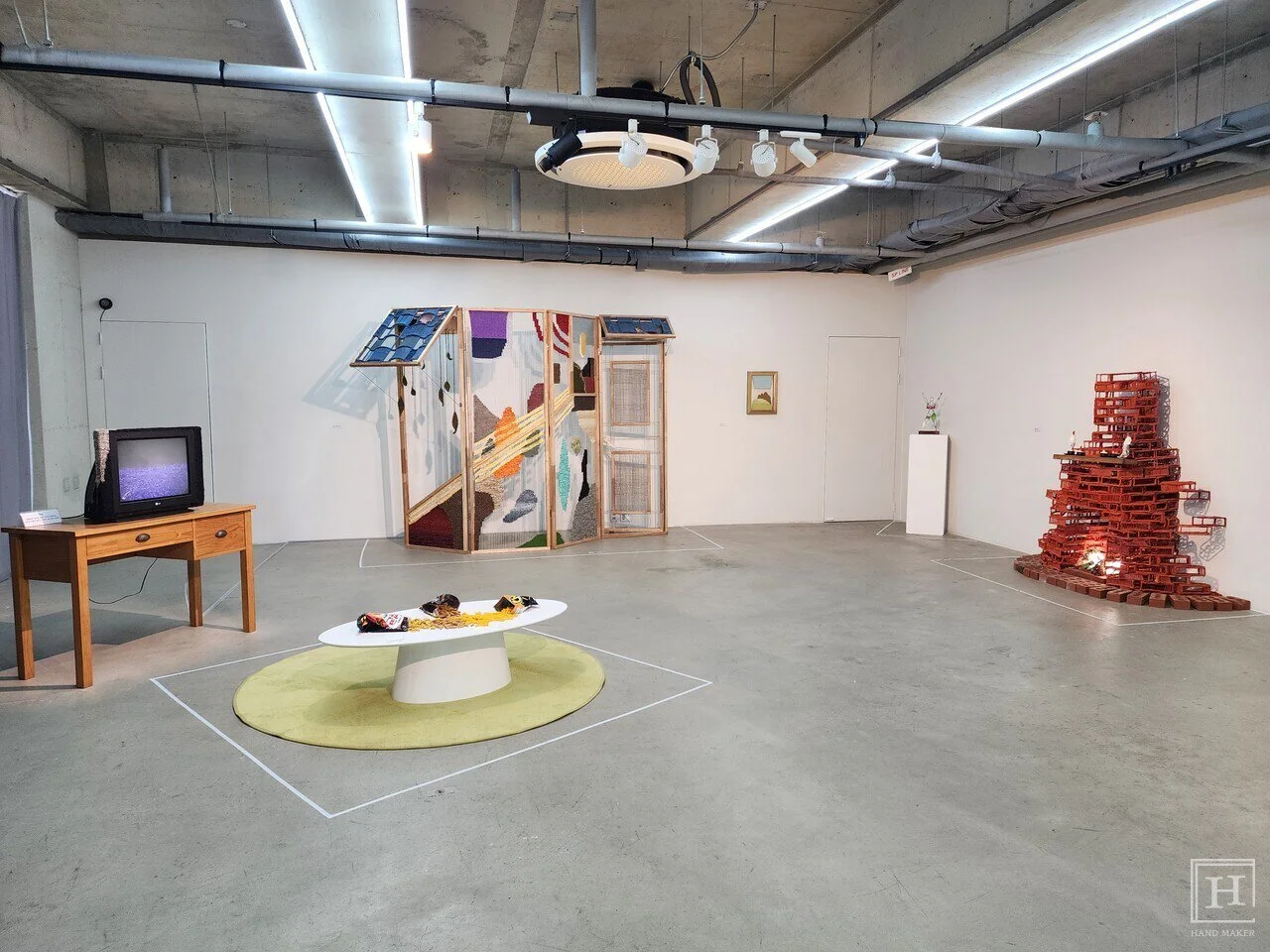
Artist Hwang Jae-won's solo exhibition concludes on October 11. The Savina Museum of Contemporary Art is closed every Monday and can be viewed from 10:00 AM to 6:00 PM.
Reporter at HANDMAKER (핸드메이커), a Korean magazine devoted to crafts and handmade culture. Covers exhibitions, design and the people who make things by hand.
Related Articles
![[Field Sketch] Gyeonggi Ceramics Biennale 2026 ① A creative journey made by clay and the Earth, the "Earth Makes" exhibition](/storage/handmk-global/2026/09/6ef72930-ffbb-4da1-a0aa-9c9ce3c08798-b06a97ce-thumb.webp)
[Field Sketch] Gyeonggi Ceramics Biennale 2026 ① A creative journey made by clay and the Earth, the "Earth Makes" exhibition
![[On-site Sketch] Capturing Light, Shadow, and Even Solitude in a Slice of Cake: 《Hyundai Card…](/storage/handmk-global/2026/09/81dbe9bd-42df-43f7-a1c8-fd5c7c803a58-a4094b1d-thumb.webp)
[On-site Sketch] Capturing Light, Shadow, and Even Solitude in a Slice of Cake: 《Hyundai Card Culture Project 31 Wayne Thiebaud》 Exhibition
![[On-site Sketch] Cutting, Weaving, and Moving Photos: Beyond Recording to Show New Possibilities…](/storage/handmk-global/2026/09/c323a317-58ea-4ccc-92f0-9a8d00d5c66d-599ce664-thumb.webp)
Comments 0
Comments are currently disabled.