
[On-site Sketch] Cutting, Weaving, and Moving Photos: Beyond Recording to Show New Possibilities... Group Exhibition "TRANSITION" by Japanese and Chinese Photographers
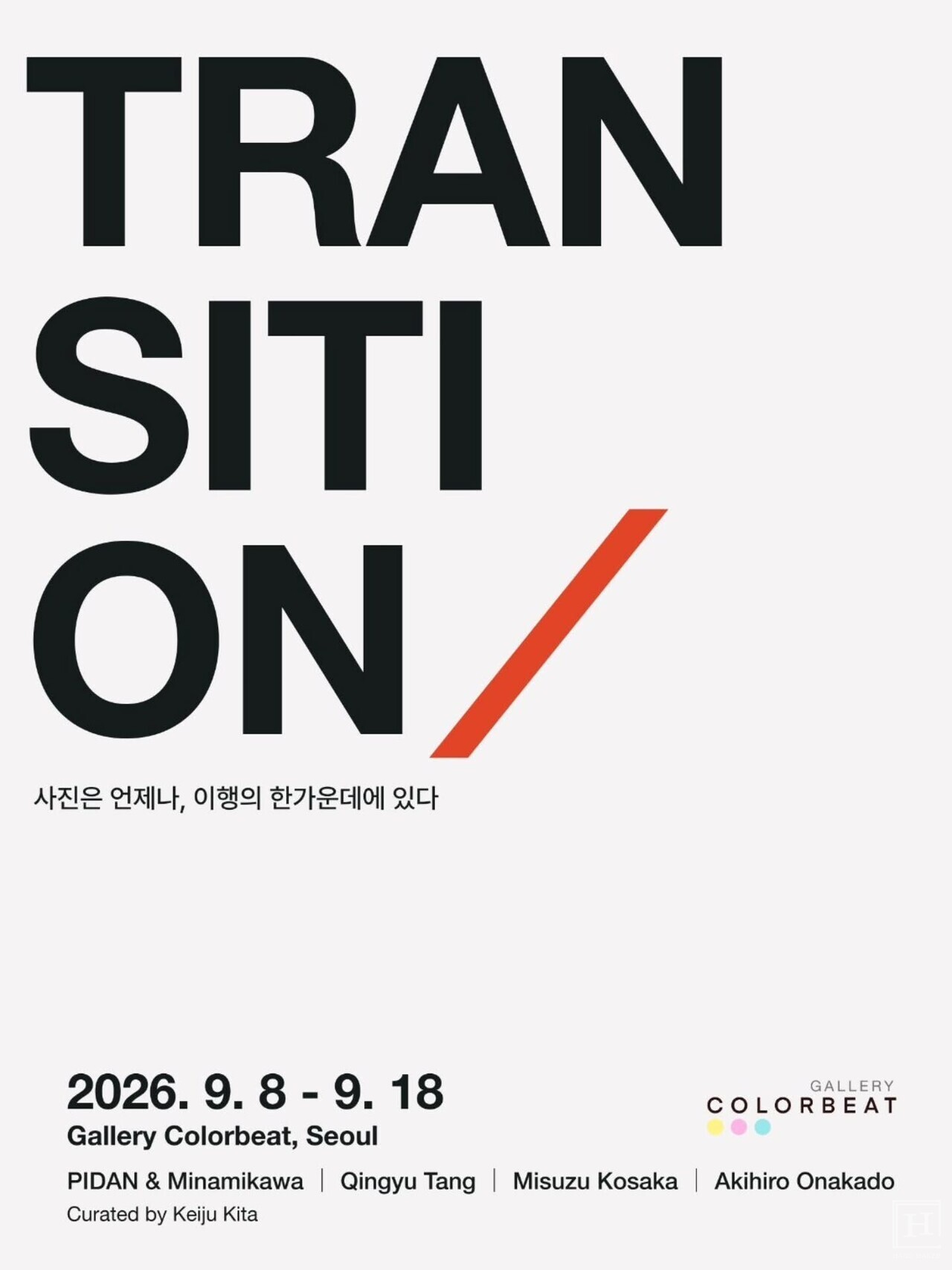
The group exhibition "TRANSITION" at Gallery Color Beat features five artists from Japan and China exploring the boundaries between reality and images.
Photography no longer remains merely at recording the reality before one's eyes. Images captured by a camera are cut, layered, and rearranged, creating meanings different from the actual world. As the boundary between reality and images blurs, how far can photography change and expand?
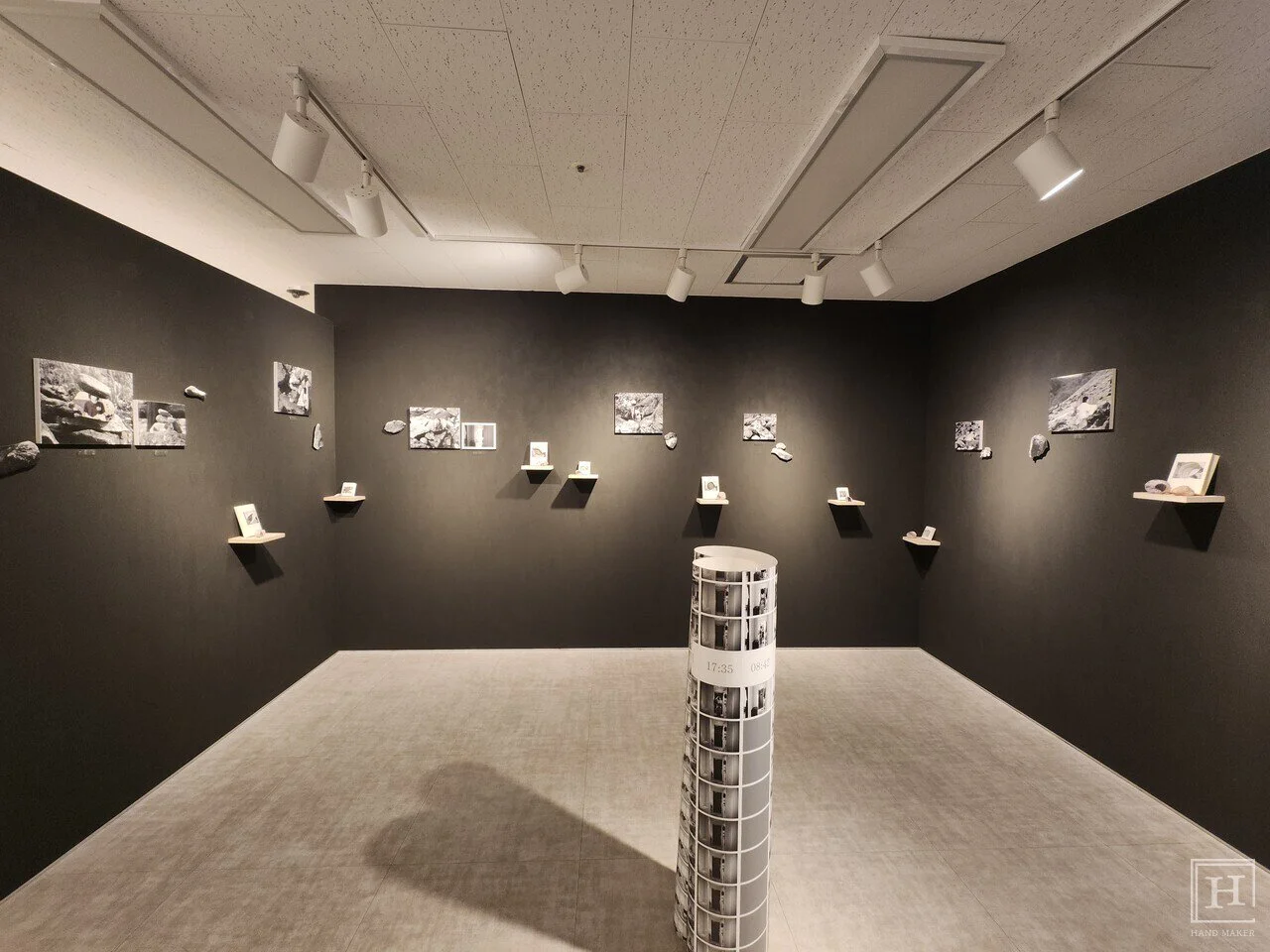
The group photography exhibition 《TRANSITION》 is being held at Gallery Color Beat. This exhibition features five artists from Japan and China participating in four teams, presenting works that cross the boundaries between reality and images, and between photography and other media. Like the exhibition title 'TRANSITION', it introduces artists who expand photography in new ways by focusing on the process where photography moves beyond a single record to transform into other forms and meanings.
The artists move stones into information, rearrange repeating daily routines, prove through records exhibitions that existed but no one saw, and sometimes cut flat images to create new forms. They utilize photography not as a simple record, but as a medium to transfer information, reconstruct reality, and create new forms.
Curator Keiju Kita, who planned the exhibition, explains 'TRANSITION' as "a place where reality and images, the photographic and the non-photographic, connect in a gradation." Rather than clearly distinguishing between photography and non-photography, the focus is on the intermediate zone where they influence each other and change.
Stones and daily life, swapping each other's places
- PIDAN & Eri Minamikawa
Artist PIDAN from China and artist Eri Minamikawa from Japan formed a team to present their works. Using 'stones' as a major motif, PIDAN is interested in the process by which matter existing in reality is converted into images and information through photography. Through this, the artist questions where the 'reality' we speak of exists in contemporary society and how the medium of photography can transfer and transform reality.
Eri Minamikawa begins her work from personal experiences of marriage and childcare. While recording daily life with her family through photography, she looks into how society assigns and fixes the role of 'mother' to an individual. In particular, she rearranges photos taken at 1-minute intervals over several days to fit a 24-hour time axis, creating an 'average day' within the repetitive caregiving and daily routine.
The works of the two artists, starting from different subjects, meet at the point of the process where objects or individuals are fixed into a single meaning and symbol assigned by society.
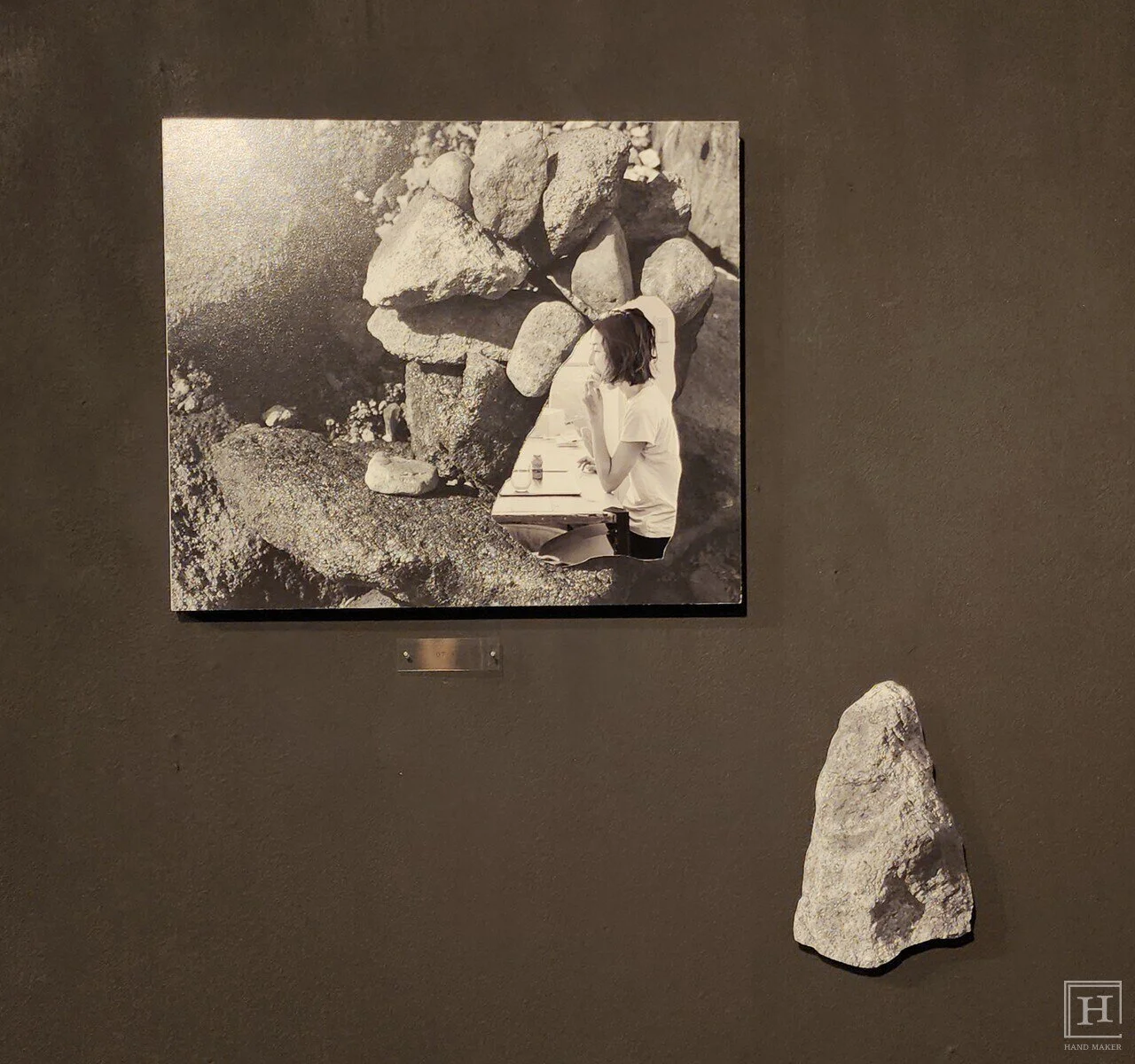
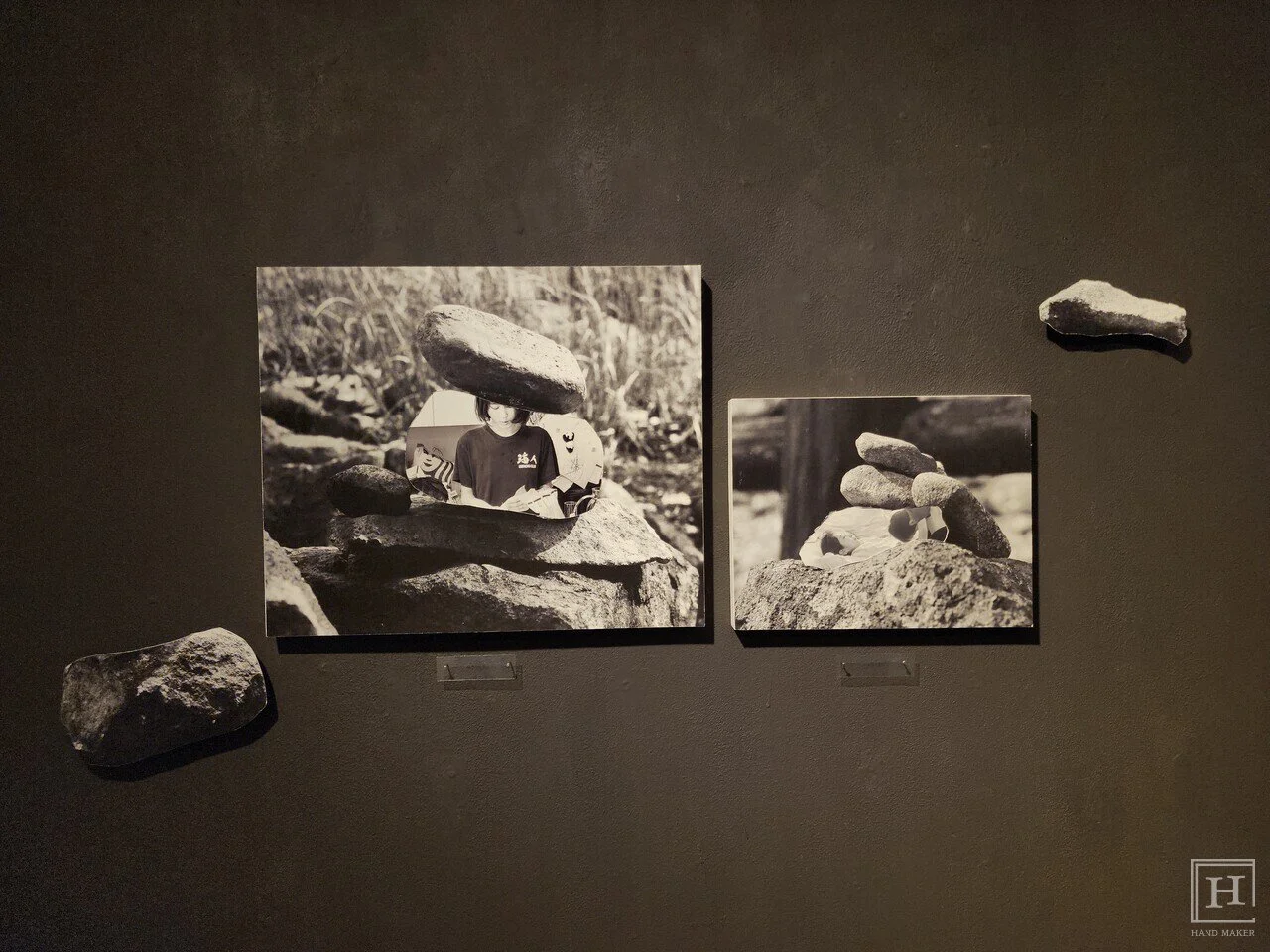
Looking at the works of the two artists, against a background of nature where stones are piled up, a single stone is pulled out like a puzzle piece. Everyday scenes fill the gaps. Setting aside the exhibition theme, looking at these works seems to show the reality that our daily lives are but a tiny part of nature.
Among countless stones, a daily moment of about one minute is an ordinary moment, and just as piled stones gather to form a heap, one minute of daily life gathers to become the precious time called a day. Looking at it that way, a single stone and a one-minute moment appear to overlap as small units that make up a vast landscape and a person's life, respectively.
However, through this intersection of images, the two artists shake the meanings that have been familiarly assigned to objects and individuals. PIDAN's stone is cut out from a fixed natural landscape to become an image and information that can be moved, and Eri Minamikawa's daily life photos take its place, placing the life of an individual, which was tied to the role of 'mother', into a completely different context. As the different images of stones and daily life combine, the meanings that were familiarly attached to each are also temporarily disrupted.
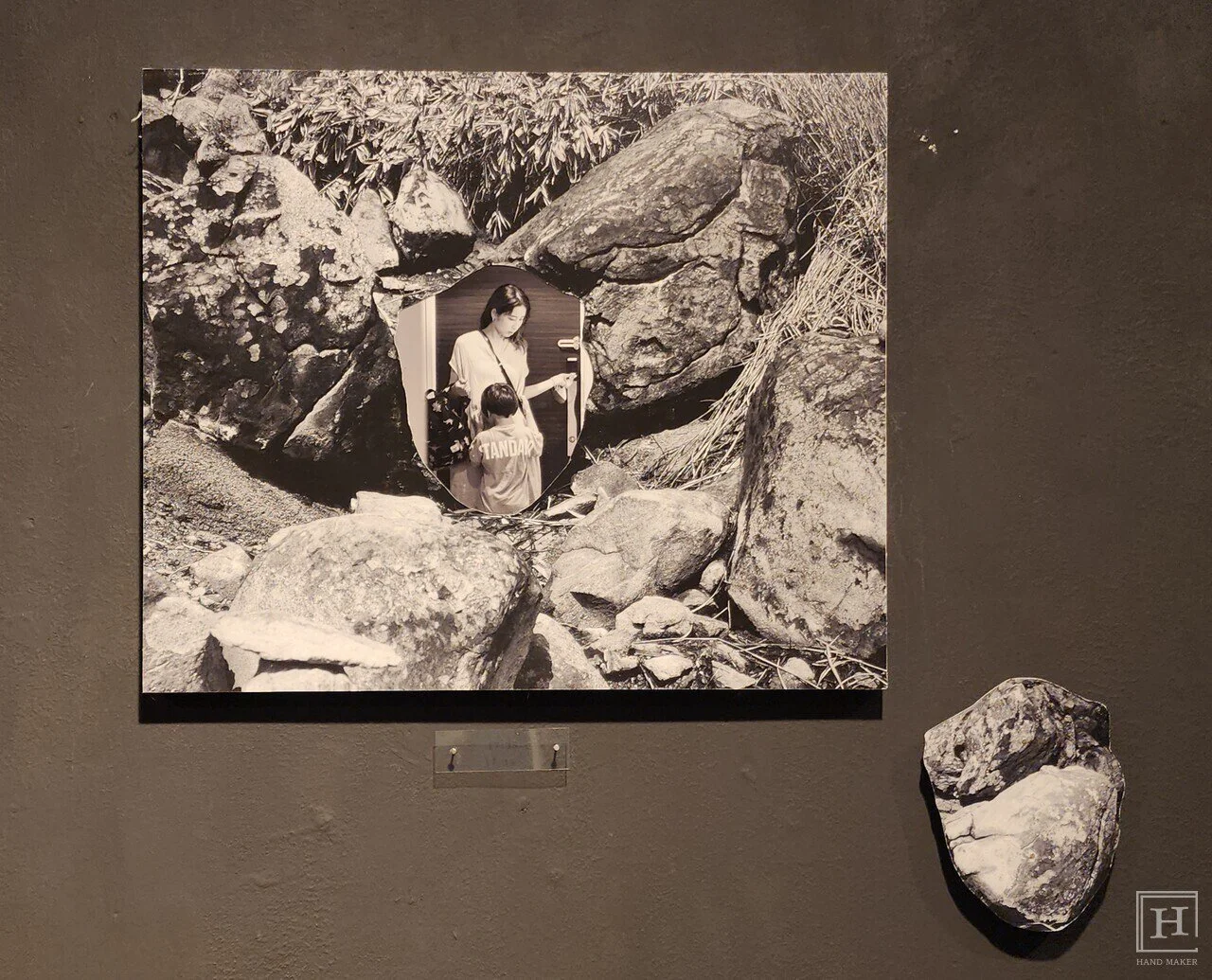
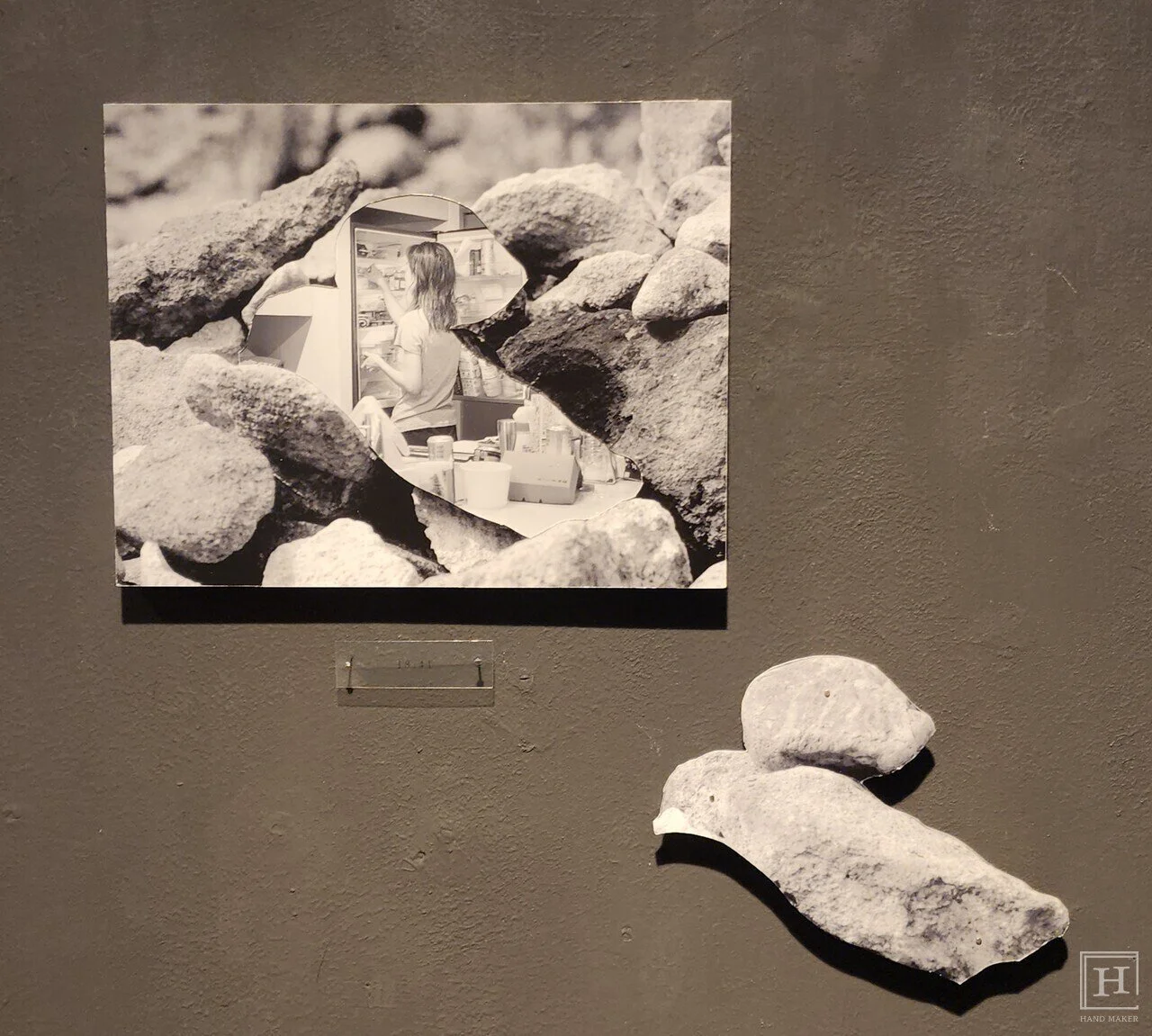
In that way, a single stone cut out from the background gains new meaning and information as it combines with a scene from daily life. A stone, which was once a simple component of nature, becomes a medium that connects a person's life and time. The fact that a photograph, which was a visual flat image, meets different images and is read with another meaning—this is the synergy created by the curator and the artists in this exhibition.
When looking at the daily life in the photographs alongside the times indicated on the works, one naturally empathizes, thinking, "Such a moment could happen at this time." These scenes feel even more familiar to those who are "mothers" spending their days caring for their families, like the artist Eri Minamikawa.
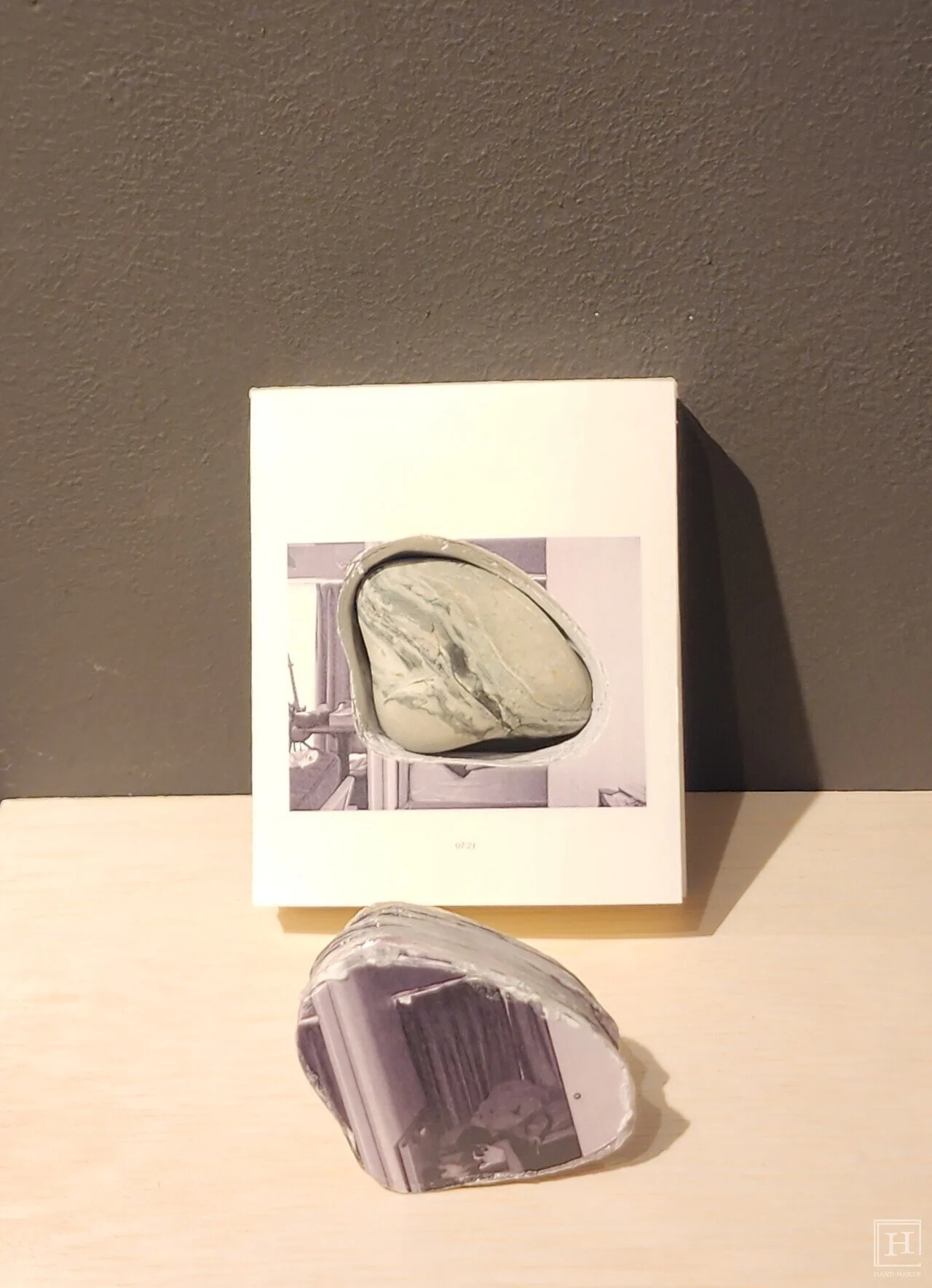
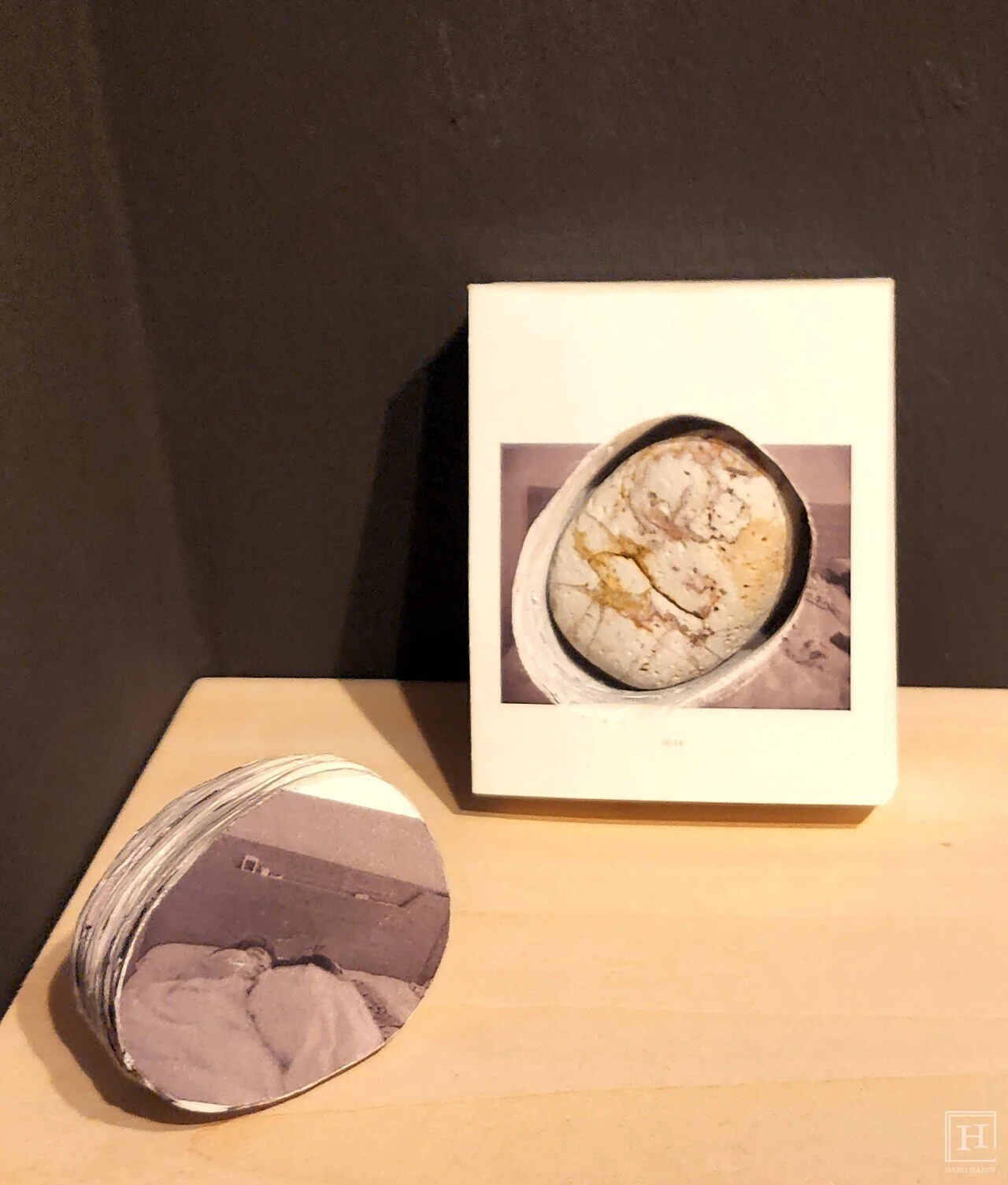
This time, conversely, it is a form where PIDAN's stones penetrate into Eri Minamikawa's art book. Eri Minamikawa's daily life photographs are cut into shapes like stones and placed three-dimensionally outside the art book, with actual stones taking their place. The images of daily life that remained on a plane emerge from the photograph to exist as a material, and conversely, actual stones become part of the photograph.
An interesting part is that PIDAN purchased the stones used in the works online. Although he uses stones as a major motif, he believes it is not right to arbitrarily take stones placed in nature for his work, so he obtains stones that others have already picked up and are selling online. While it is an ironic method, considering the artist's philosophy of moving stones by converting them into images and information to another place instead of moving them directly, one feels that the process of calling stones into his work through the information network called the online world is similar to his way of working.
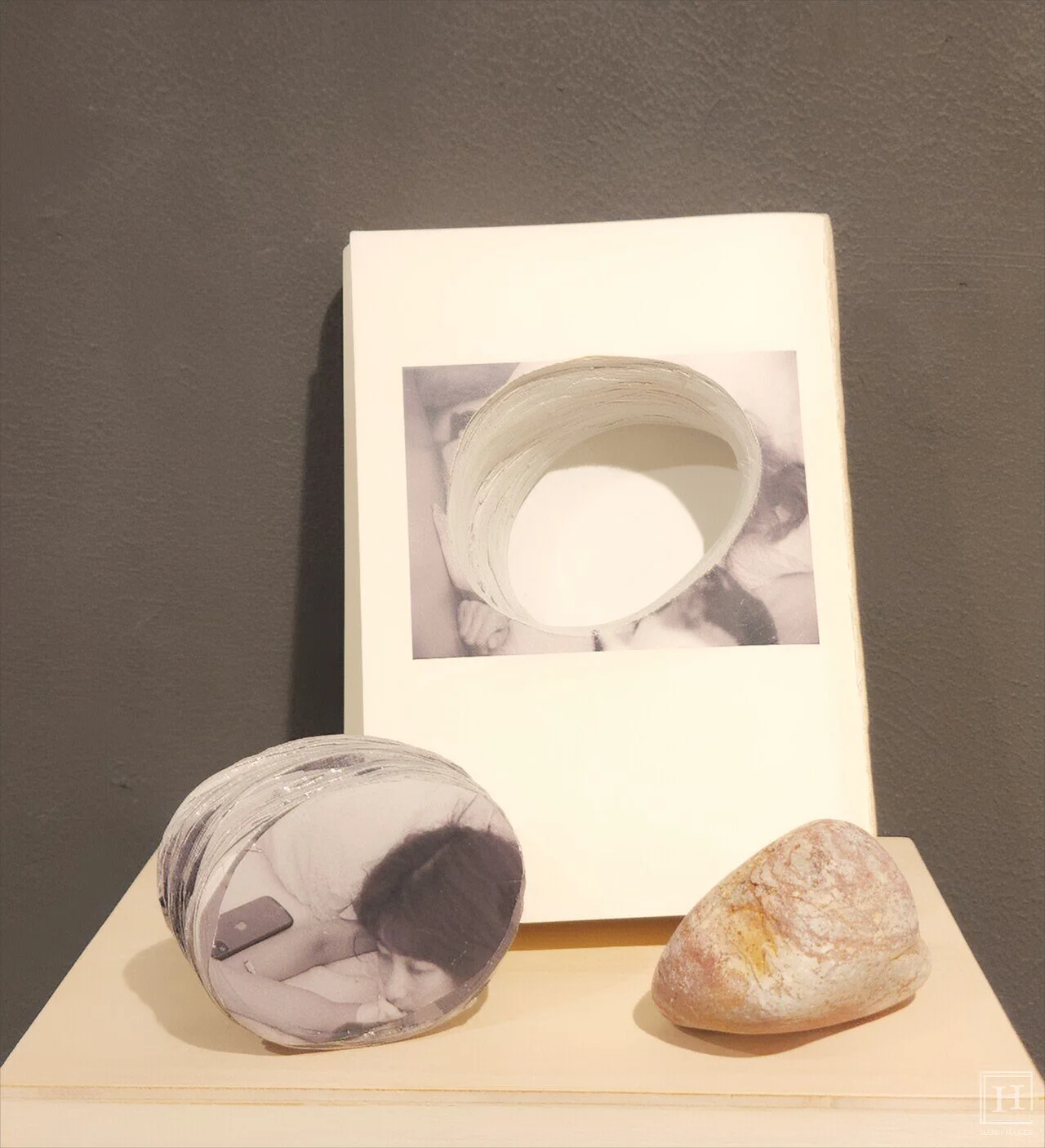
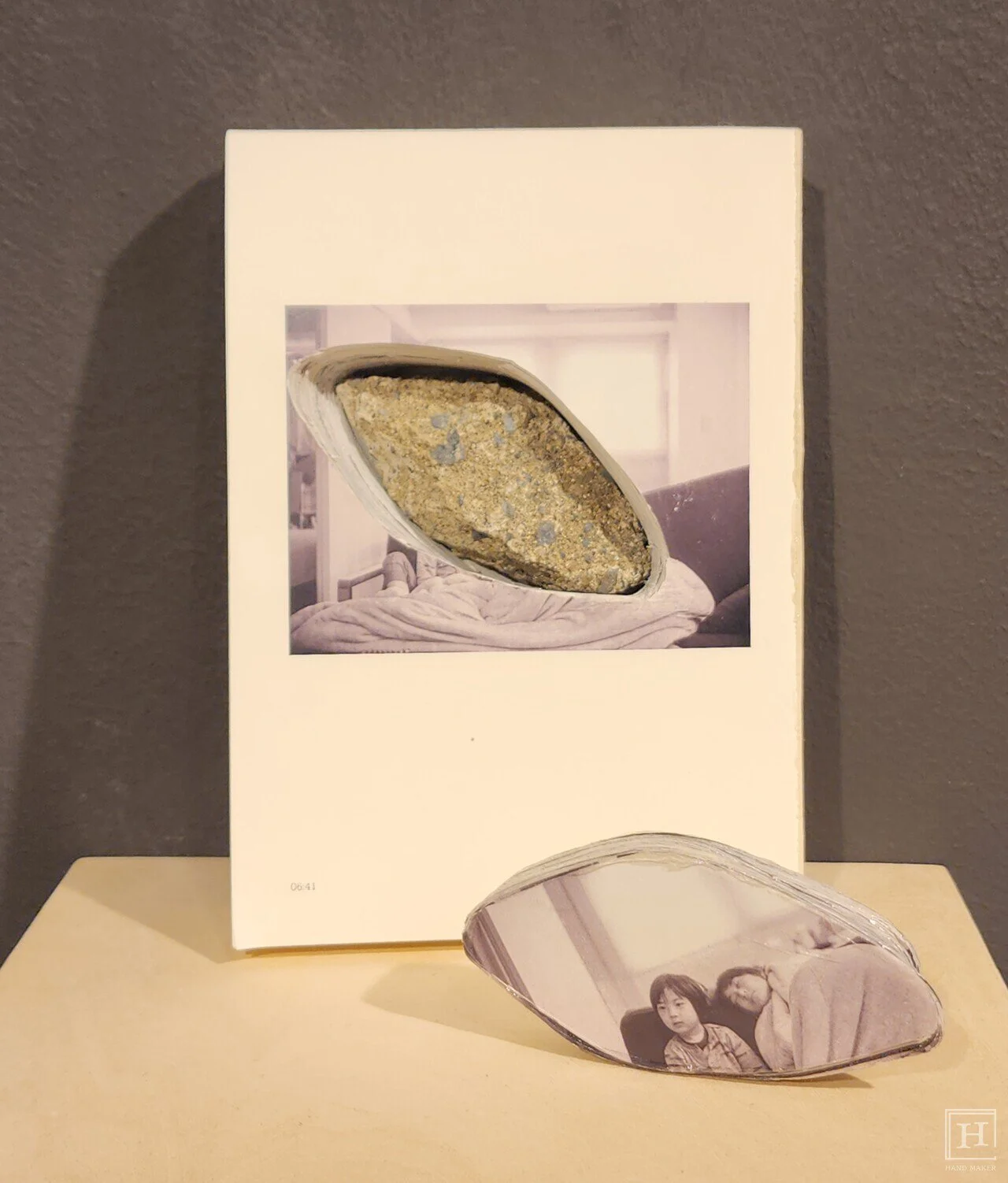
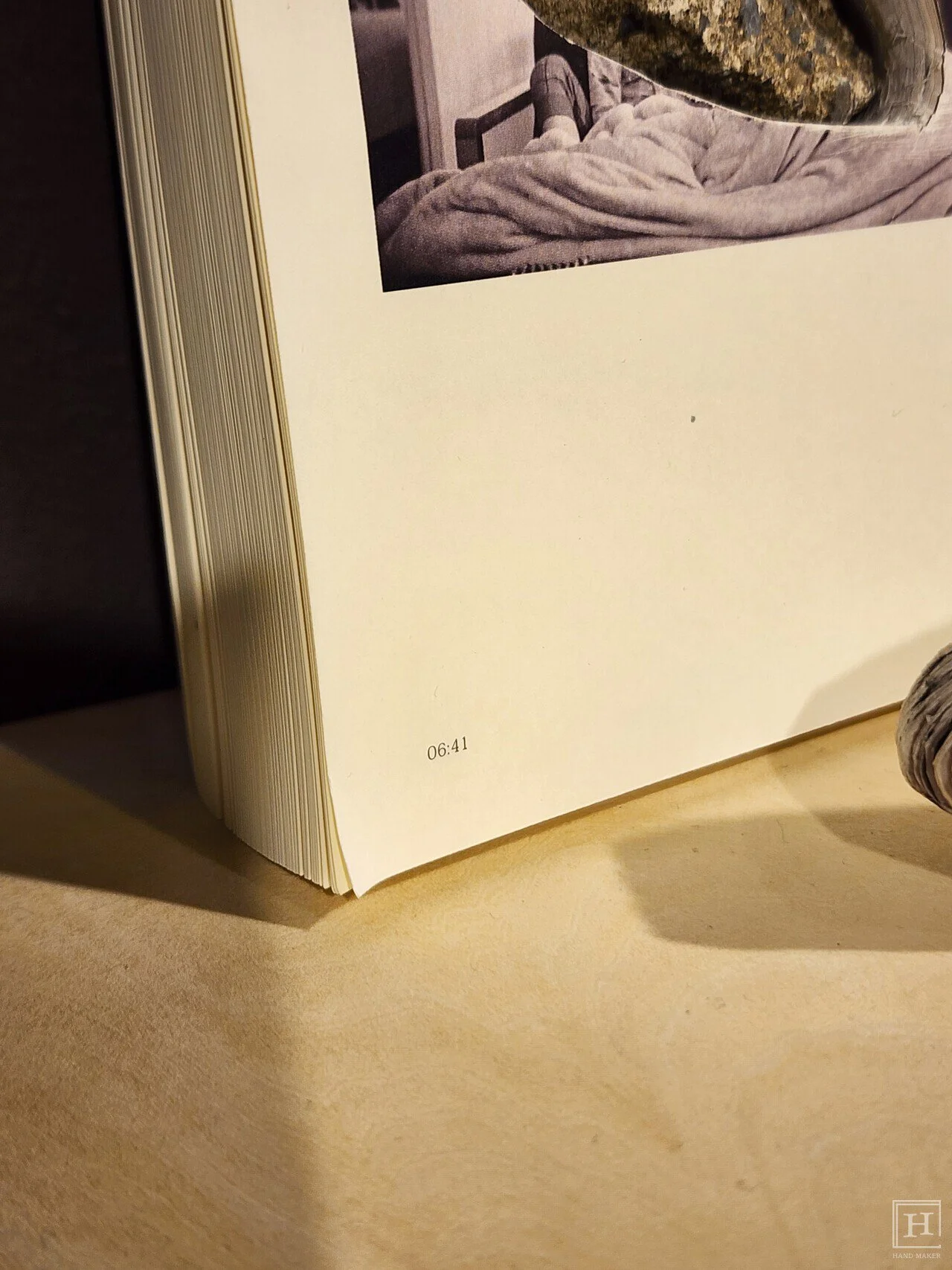
The works collaborated on by the two artists make one focus even more on the artistic philosophy pursued by each artist. Looking closely at the works, one can see the time the photograph was taken written in one corner. Eri Minamikawa captured daily life by the hour and organized it into a single book.
Looking at the moments stacked as thick as the book, one comes to think about how dense and heavy the day of Eri Minamikawa must be, as she lives both the roles of artist and mother. Perhaps, like the stones filled in by PIDAN, it is a time that possesses a clear weight yet naturally interlocks into daily life before one knows it.
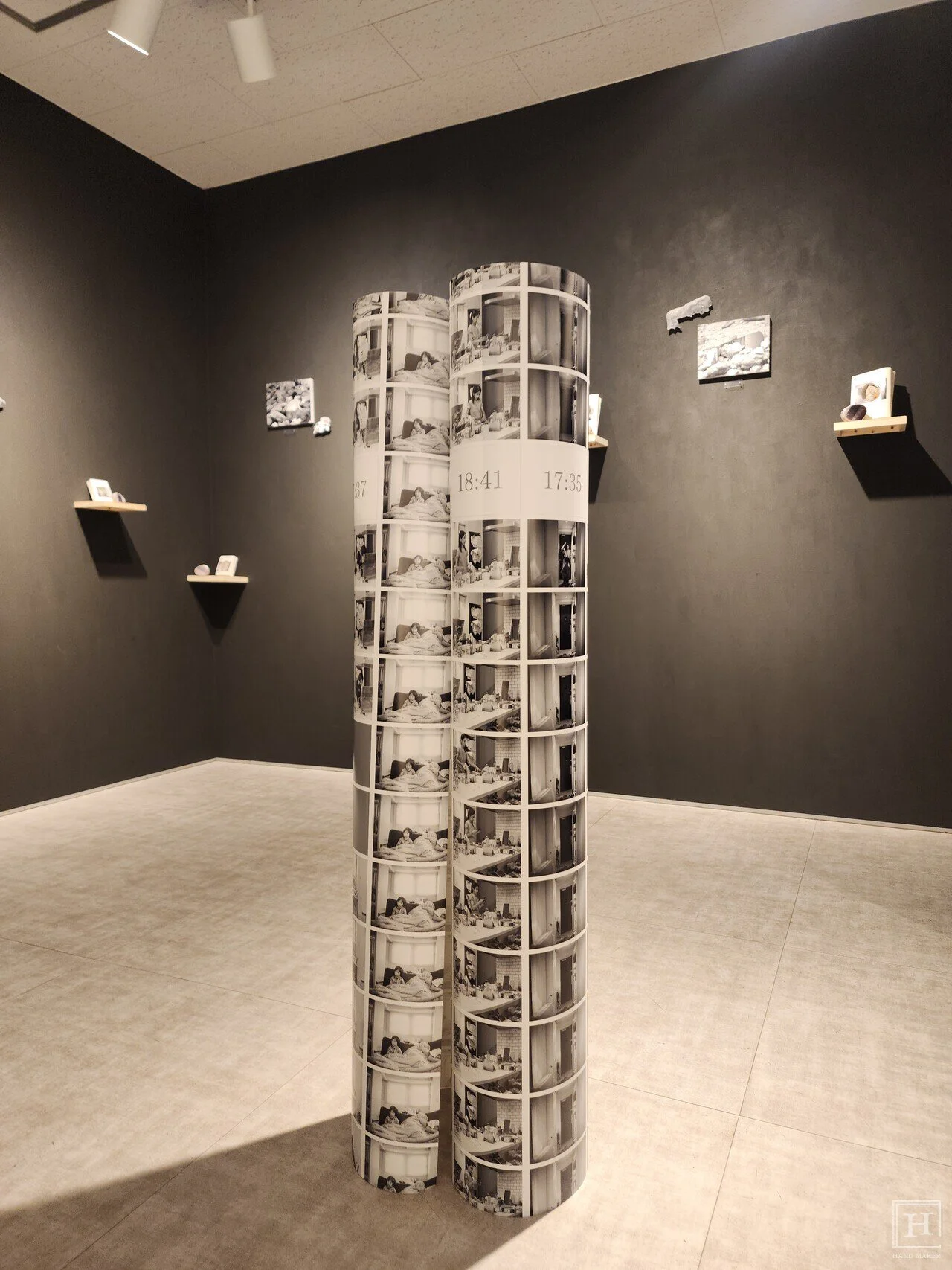
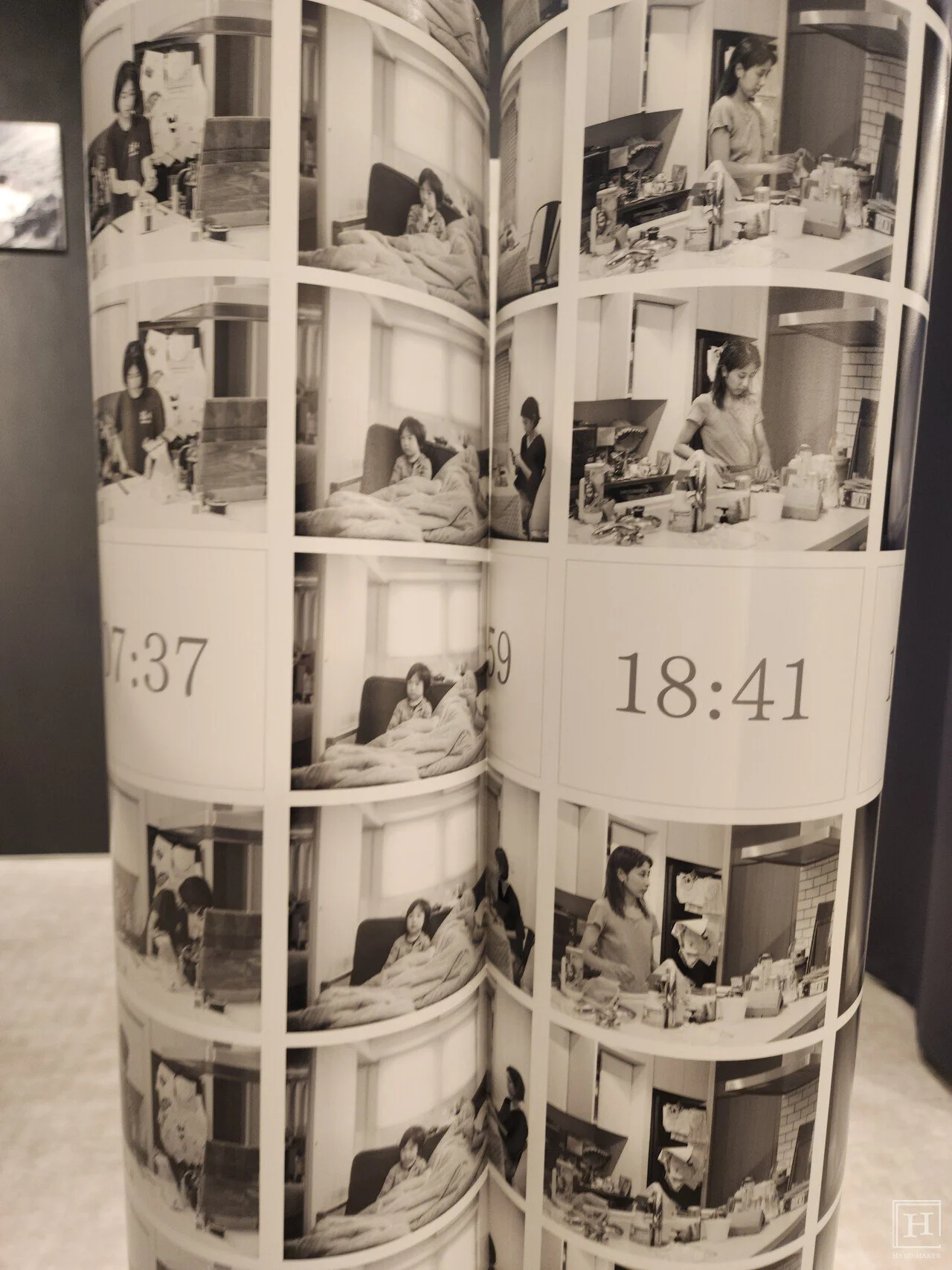
Artist Eri Minamikawa's 〈A Day Roll〉 is a work that takes photos of daily life spent with family, taken at 1-minute intervals, and connects them into a long strip to stand in a cylindrical shape. By arranging photos from different dates to follow the flow of 24 hours regardless of the actual dates, it shows the artist's 'average day' rather than any specific single day. The times marked in between and the repeating scenes of daily life make it visible how ordinary moments constitute a day.
When viewed one by one, they are familiar scenes such as preparing meals or spending time with a child, but as numerous photos connect, that ordinariness feels heavy instead. As the times spent living the two roles of artist and mother simultaneously pile up, it reminds us that moments appearing like 'a day where nothing happened' were actually times when someone was constantly accomplishing something.
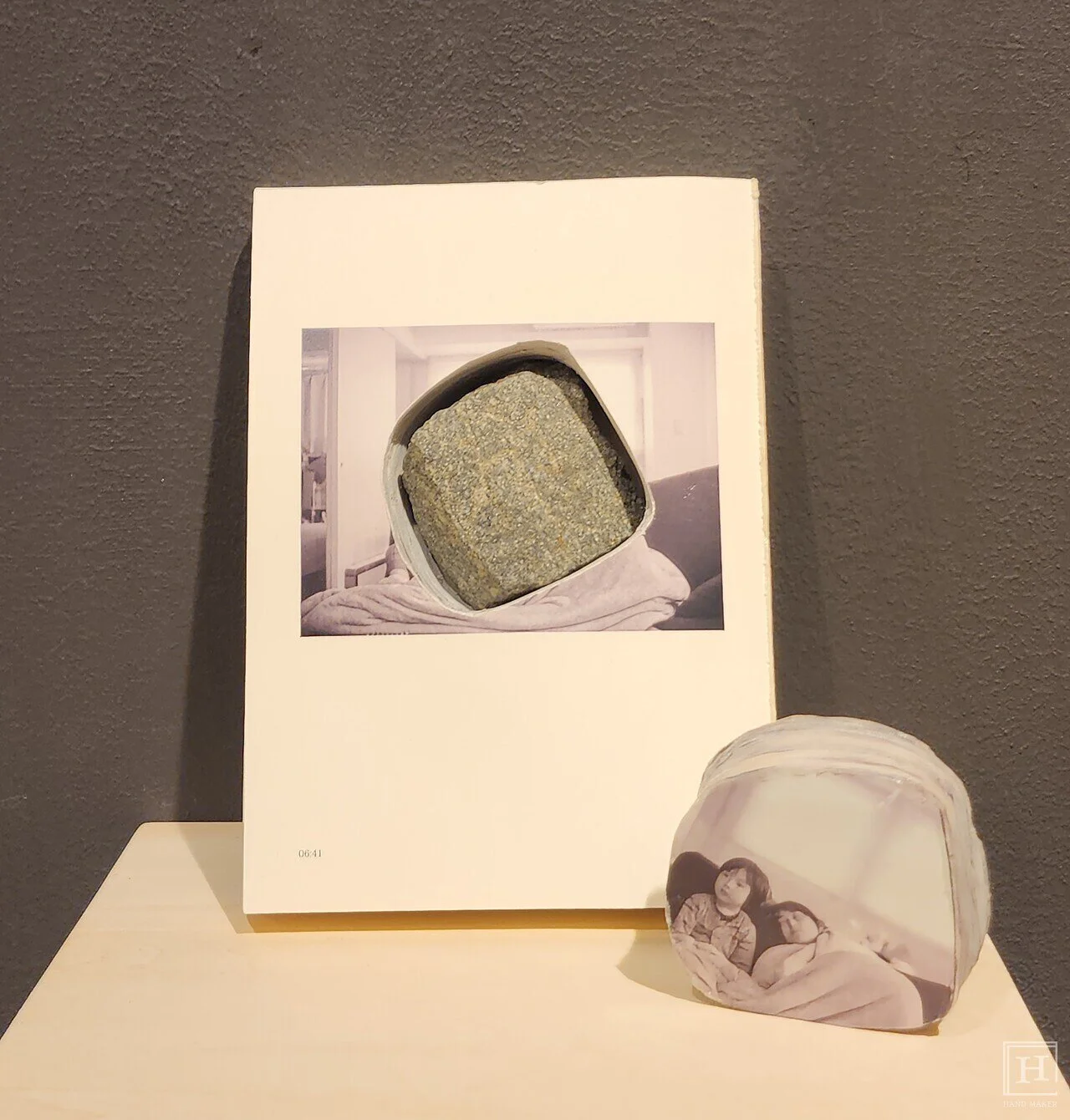
The works of the two artists, starting from different points, fill each other's voids within the exhibition hall to create new scenes. Stones no longer remain merely a fixed part of nature, and daily life does not remain just a simple personal record. At the moment when images and matter, nature and daily life swap places, objects that were fixed to a single meaning begin to be read in a different way. This is another 'TRANSITION' shown by the two artists.
An exhibition seen by no one, known only to the artist
- Akihiro Onakado
Artist Akihiro Onakado approaches photography not simply as an act of creating images, but from the perspective of a 'medium that transports' events that occurred in one place to other people, places, and times. In particular, he questions which among the actual exhibition and the images and documents that record and convey it constitutes the reality of the exhibition.
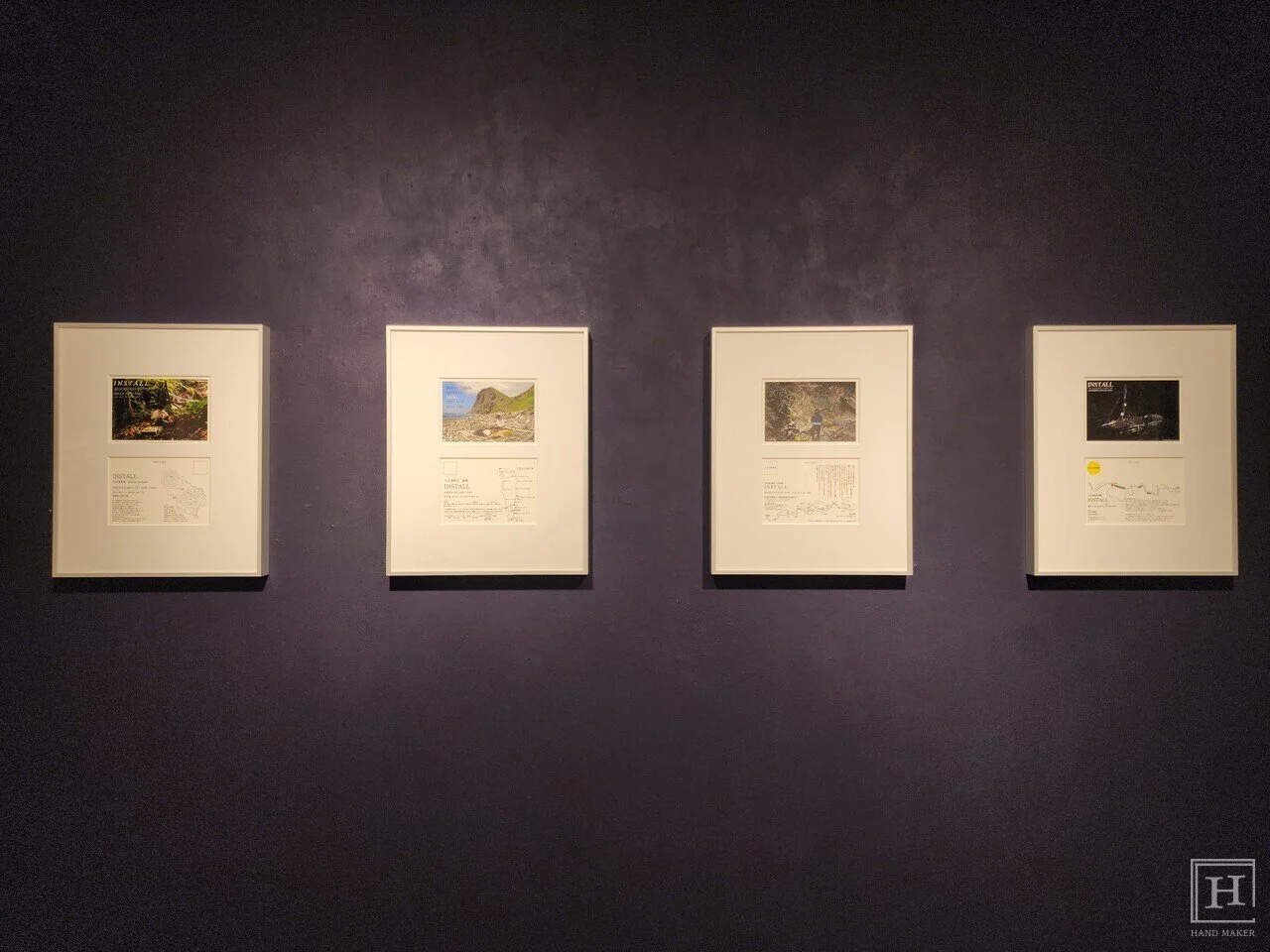
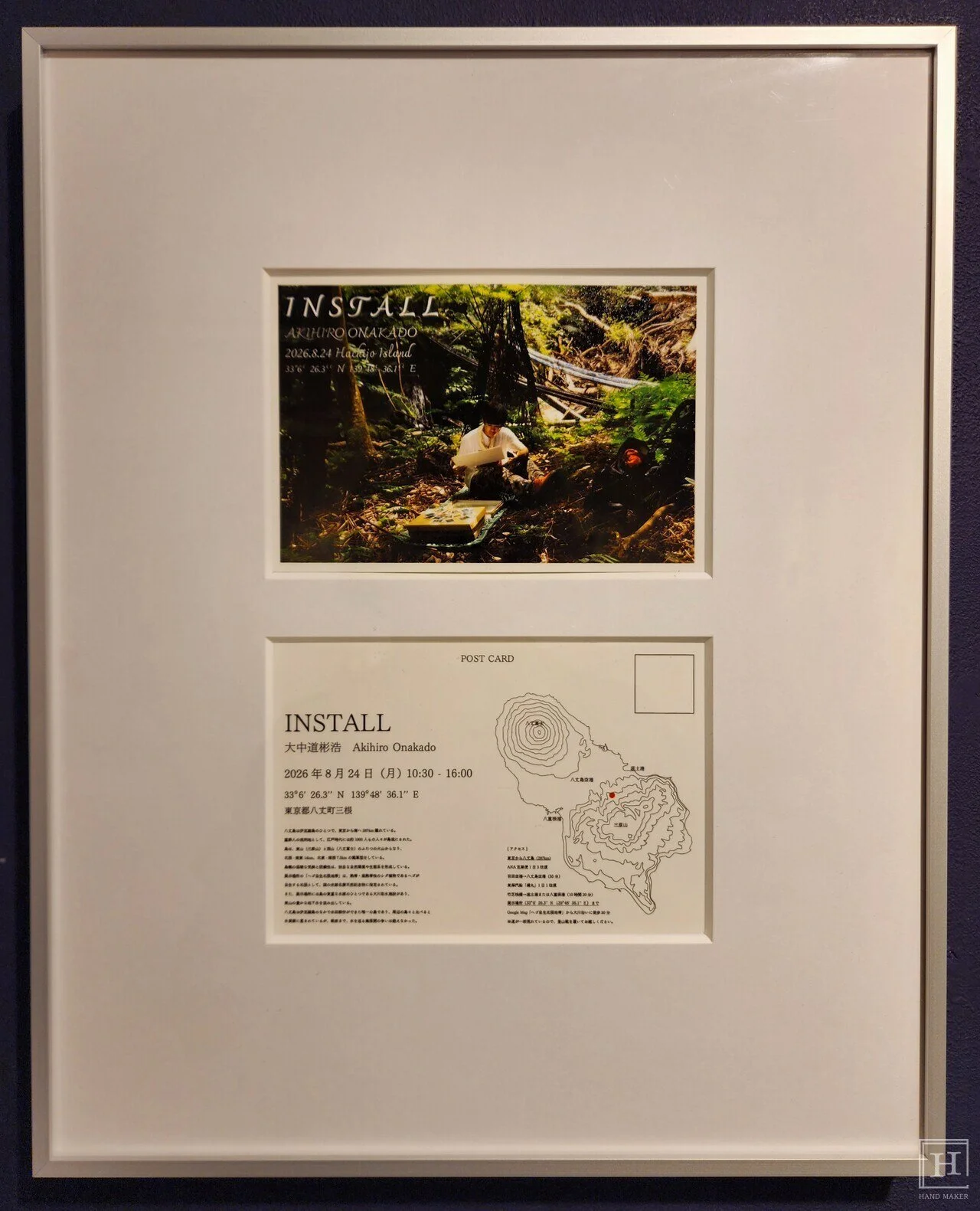
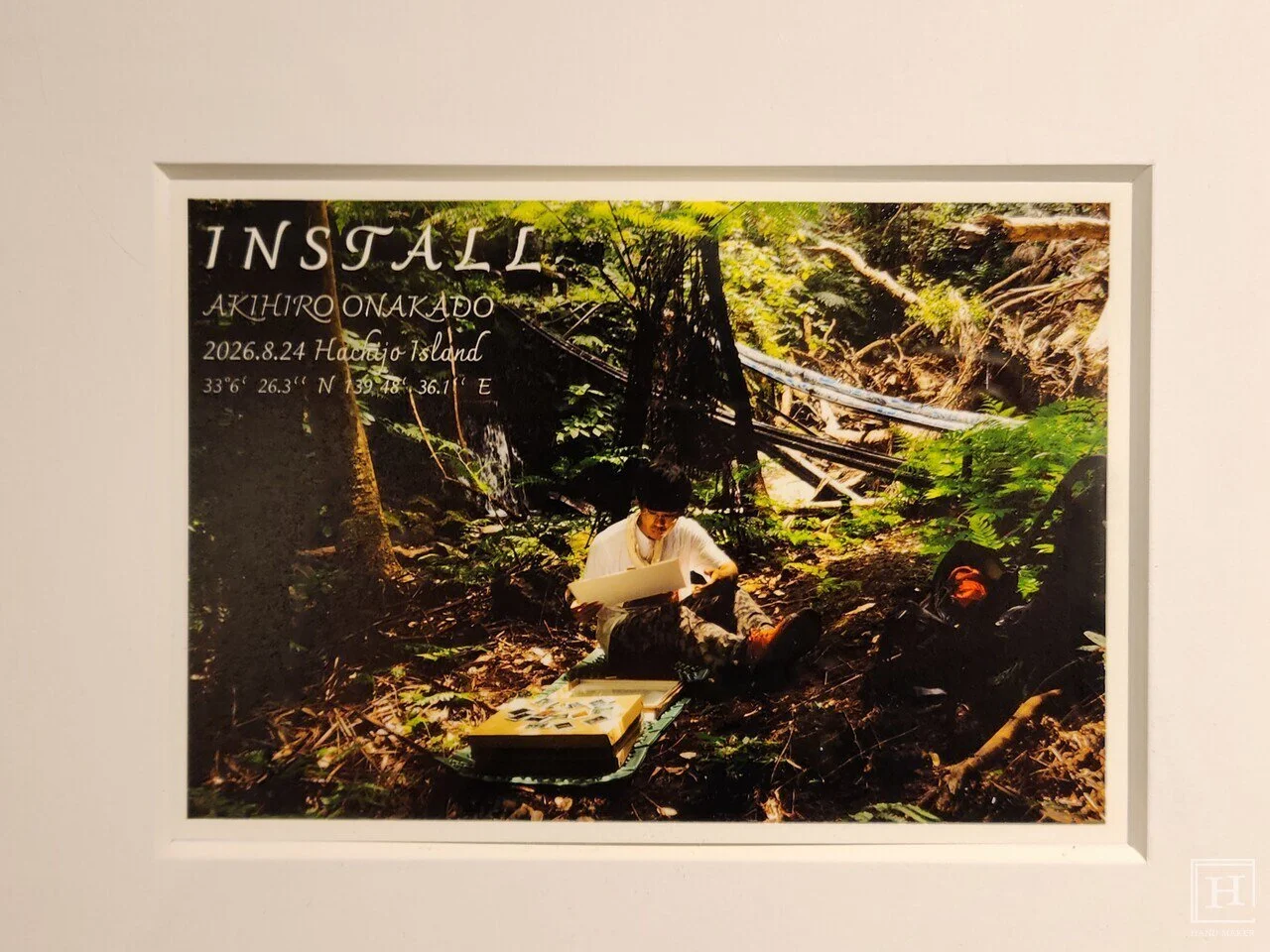
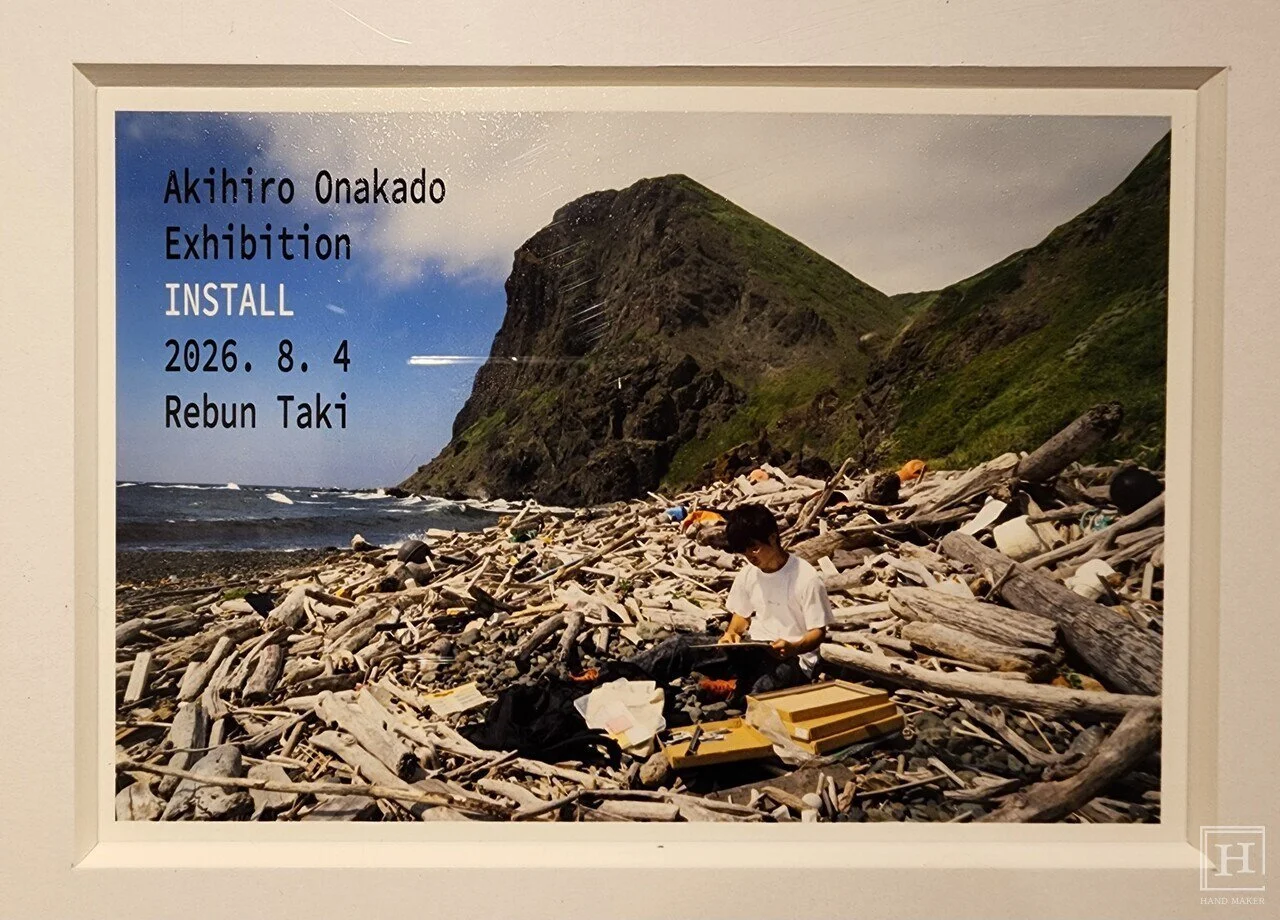
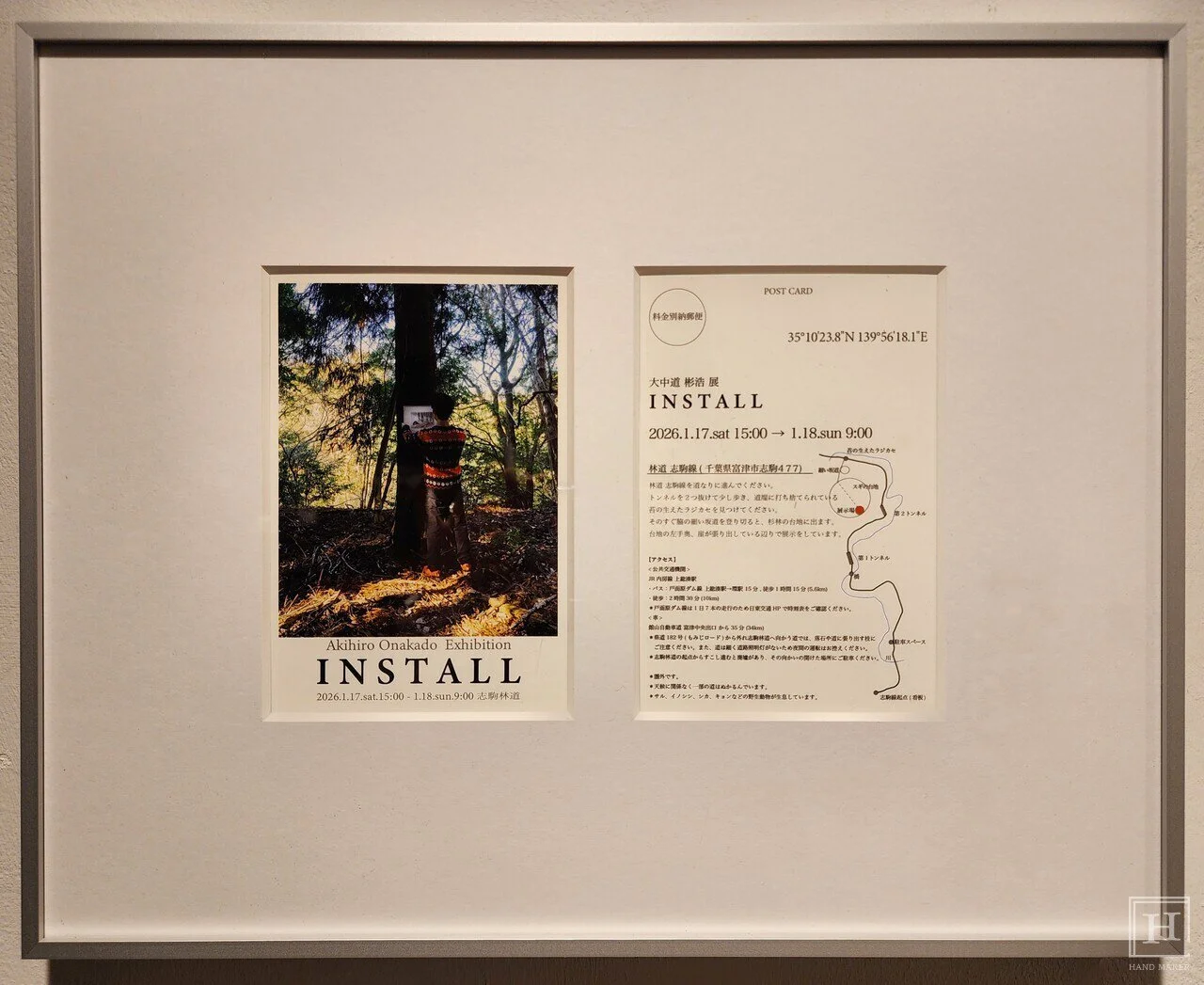
The artist holds exhibitions in outdoor spaces such as forests and coasts where there is not a single visitor. After photographing himself installing the works using an instant camera and spending time in that space, he immediately puts those photos in frames and hangs them on-site. That moment is when the exhibition begins. In that way, the exhibition proceeds for a few hours.
There is no one who knows the exhibition exists, and no one comes to see it. In this way, a secret exhibition known only to the artist is held. Only the act of installing the work, the photos recording it, and the process of exhibiting those photos again follow in succession.
Therefore, the exhibition becomes an event that actually exists yet does not exist, witnessed by no one. The unique way of his artistic philosophy lies in the 'transportation' that artist Akihiro Onakado considers important. It clearly shows the thought that even if someone cannot see it directly, as photos and records are delivered to other places and times, it can prove that something actually happened there.
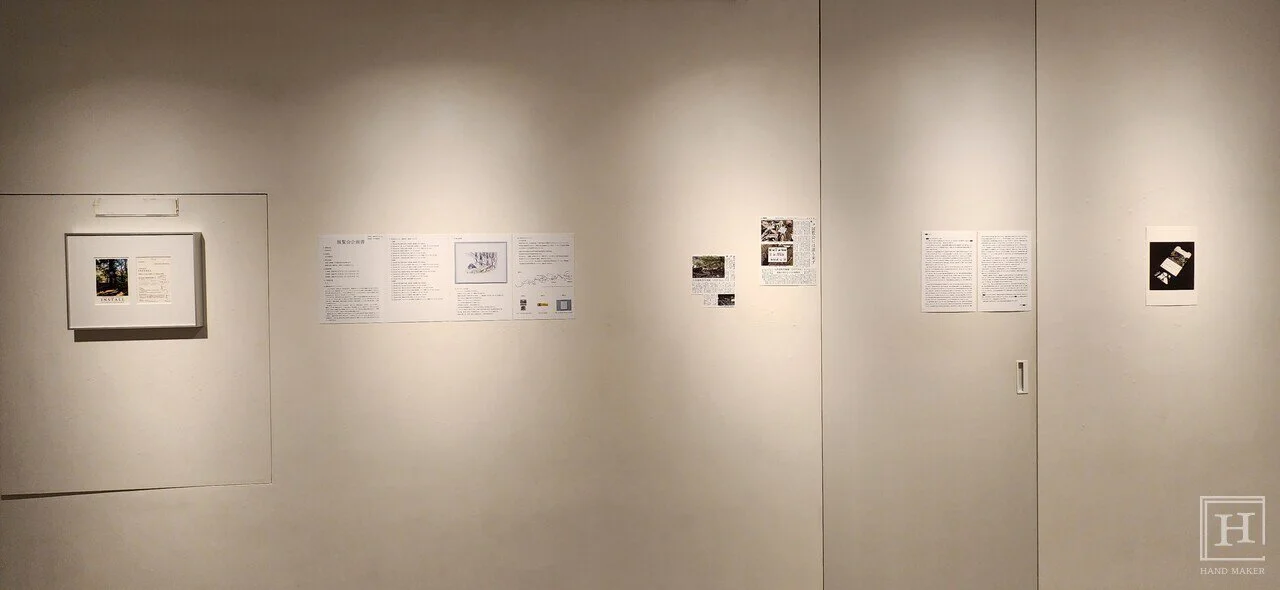
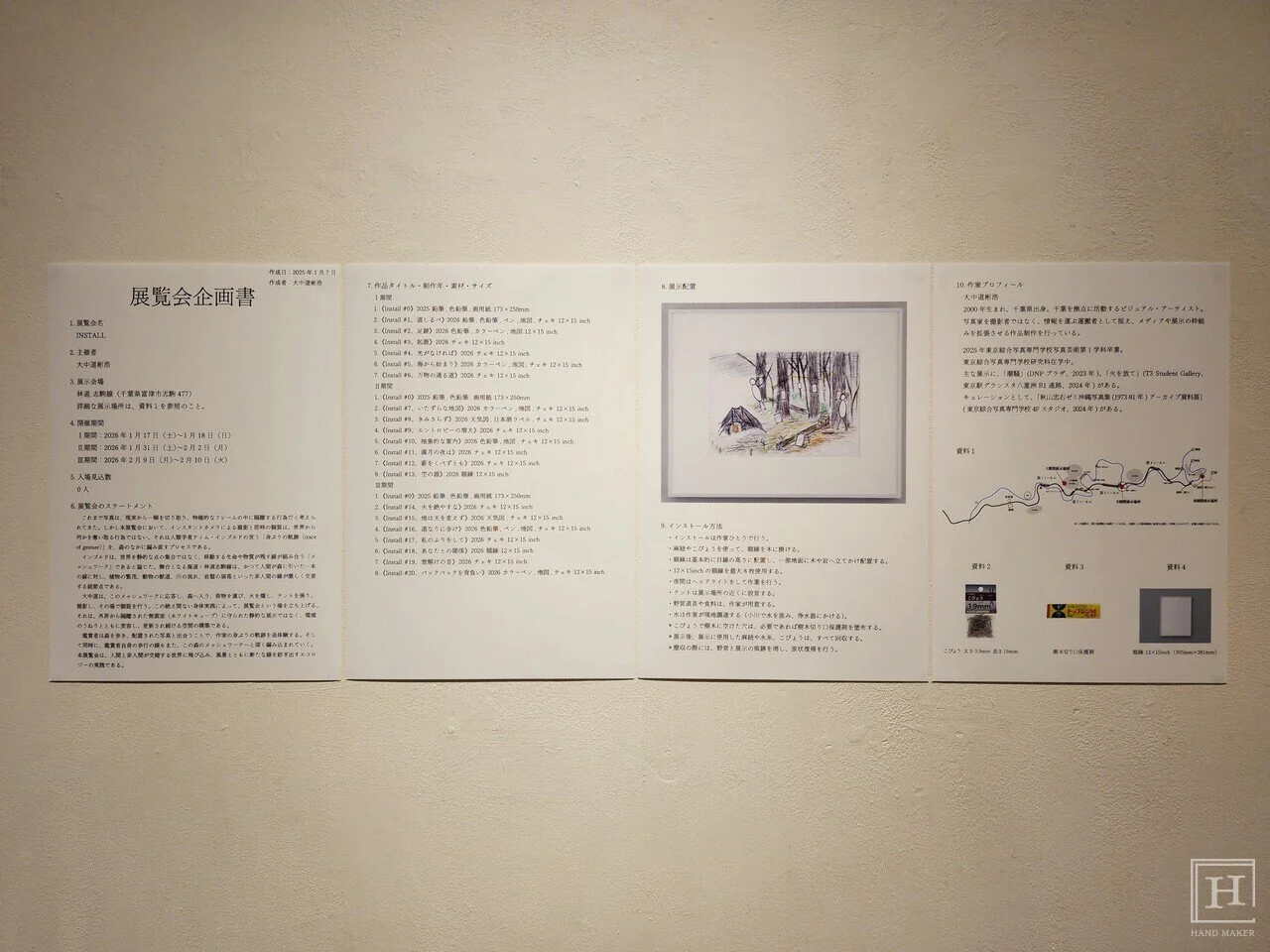
Artist Akihiro Onakado personally creates everything necessary for the exhibition, including the exhibition planning, work introductions, an overview showing the project themes, and even fictional work introduction articles and viewer reviews of the exhibition.
However, all of this cannot be called merely "fictional." It is just that no one saw it; the artist actually installed the works and conducted the exhibition in real forests and coasts. Adding fictional records onto real events, and then using those records to make one imagine the existence of the exhibition—the charm of Akihiro Onakado's work lies in this point of skillfully navigating the boundary between reality and fiction.
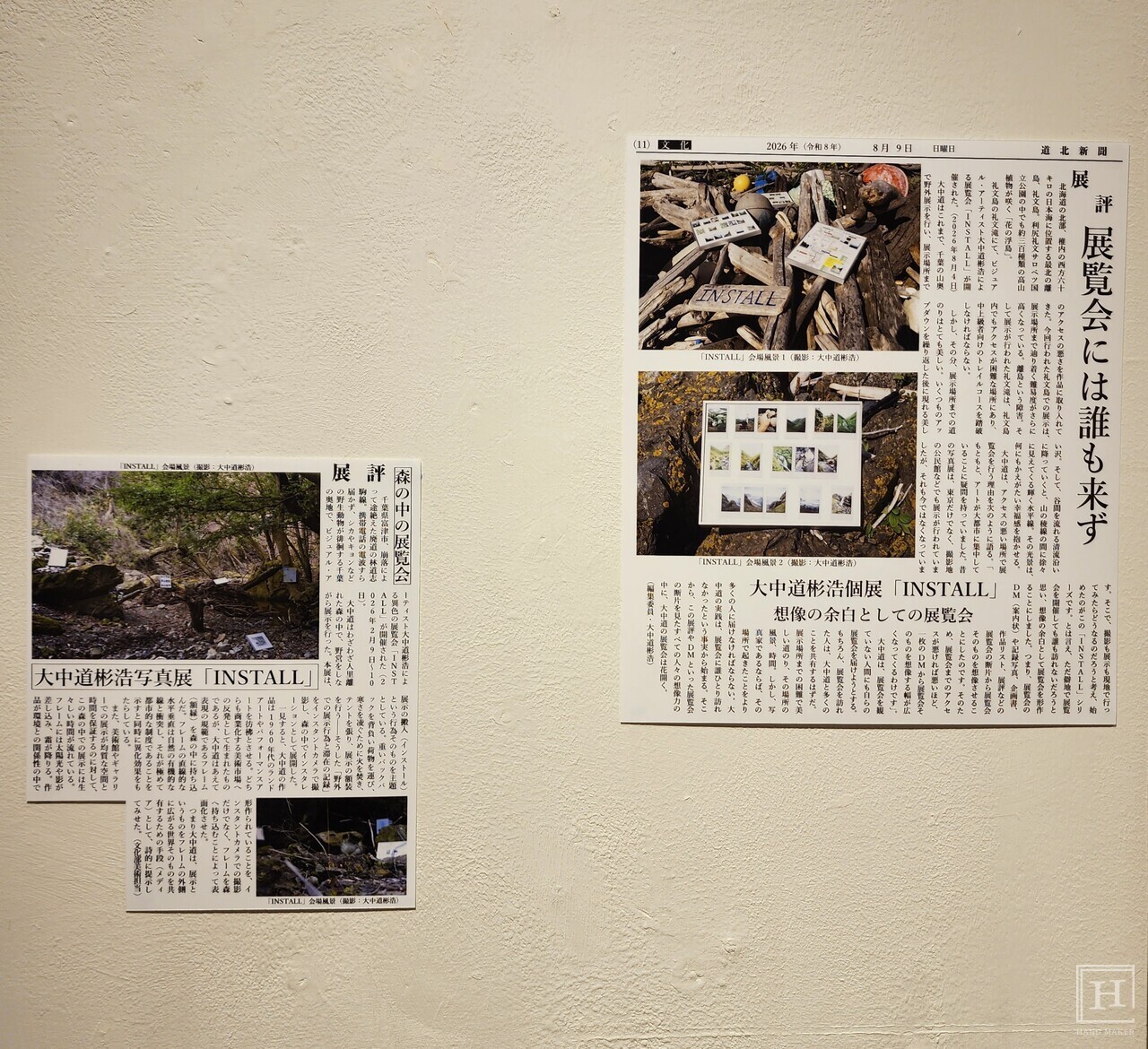
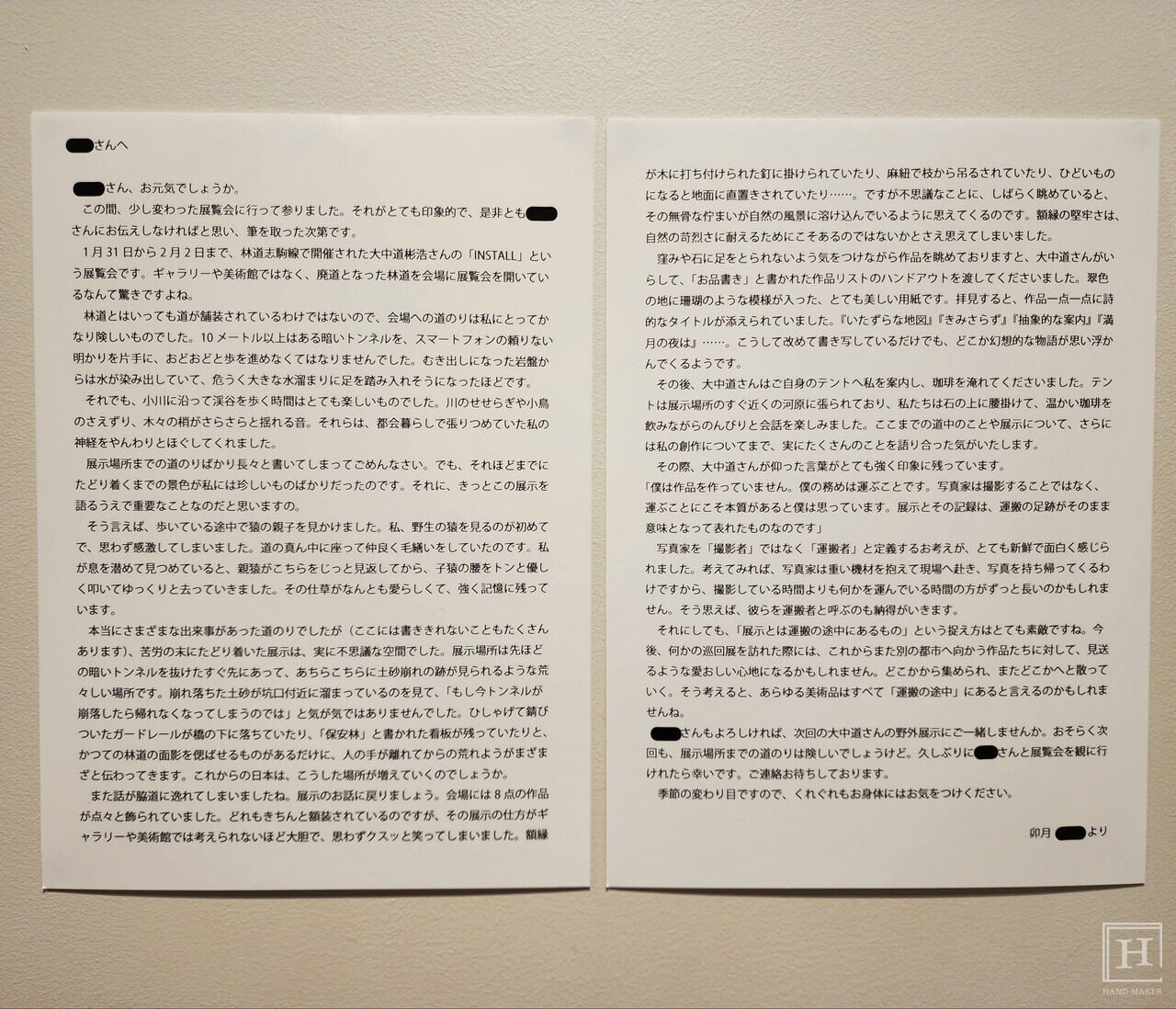
Above all, Akihiro Onakado's exhibition feels unique in its "raw" nature. Generally, exhibitions are organized neatly and planned so that the audience can comfortably appreciate the works and each piece can stand out. Works are placed according to specific intervals and movement paths, and the audience encounters the completed exhibition in that organized state.
In contrast, the exhibition conducted by Akihiro Onakado in the forest and on the coast includes the natural elements themselves and the image of the artist himself spending time while installing the works within them. The works that were actually hung on-site and the works we encounter in the gallery now are not the same. One is closer to an "event" that occurred within a specific place and time, while the other is a refined result organized to convey that event again through photographs and documents.
The interesting point is that if viewers only see the completed results in the current gallery, they cannot easily perceive that difference. If the artist does not reveal the exhibition methods and processes of that time through records such as 〈Exhibition Proposal〉, 〈Exhibition Review #1, #2〉, and 〈Viewer's Letter〉, we would not know what kind of exhibition actually took place in the forest and sea. Ultimately, Akihiro Onakado's work makes us rethink what it means to "view an exhibition," and whether what we are seeing is a real event or a record that stands in for that event.
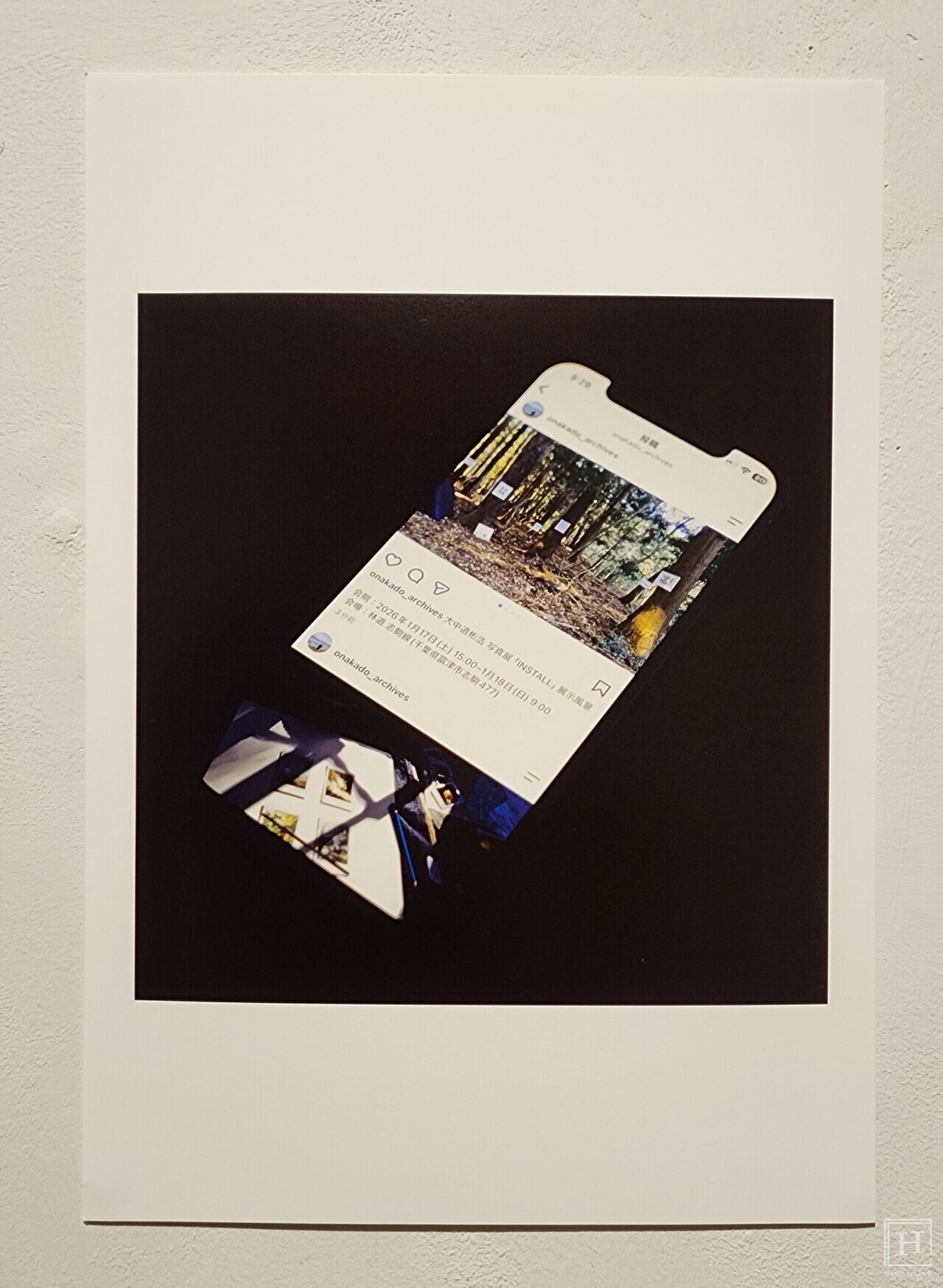
Akihiro Onakado does not lose sight of his intention until the very end. Once the exhibition concludes, he films it again and uploads it to a separate Instagram account. However, this account is private, and as expected, only the artist can check it. In this way, the exhibition is kept strictly secret.
〈Photographer's account〉 turns the traces of the exhibition that moved online back into a single photographic work. The exhibition that began in the actual forest and coast is recorded as a photograph, moves to another space called SNS, and then becomes an image inside a gallery again. Although the exhibition itself has already ended, the records are essentially being "carried" continuously, changing media and locations.
This aligns with the thoughts of artist Akihiro Onakado, who views the photographer not as a 'shooter' who captures images, but as a 'carrier' who moves events and information to different places and times. An exhibition that no one has seen is finally delivered to others through photography and records, ultimately leaving the question of whether it is 'what actually happened' or 'the image showing that event' that makes an exhibition exist.
A gaze that defines by appearance, deconstructed into 'mushrooms'
- Qingyu Tang
Based on her experience working as a fashion photographer in New York and Shanghai, Chinese artist Qingyu Tang explores the ways in which appearance, gender, and the gaze of others define a person. Having worked in the field of fashion photography to present people as images, she reacts sensitively to what people are actually looking at when they judge that they have 'understood this person' by looking at them.
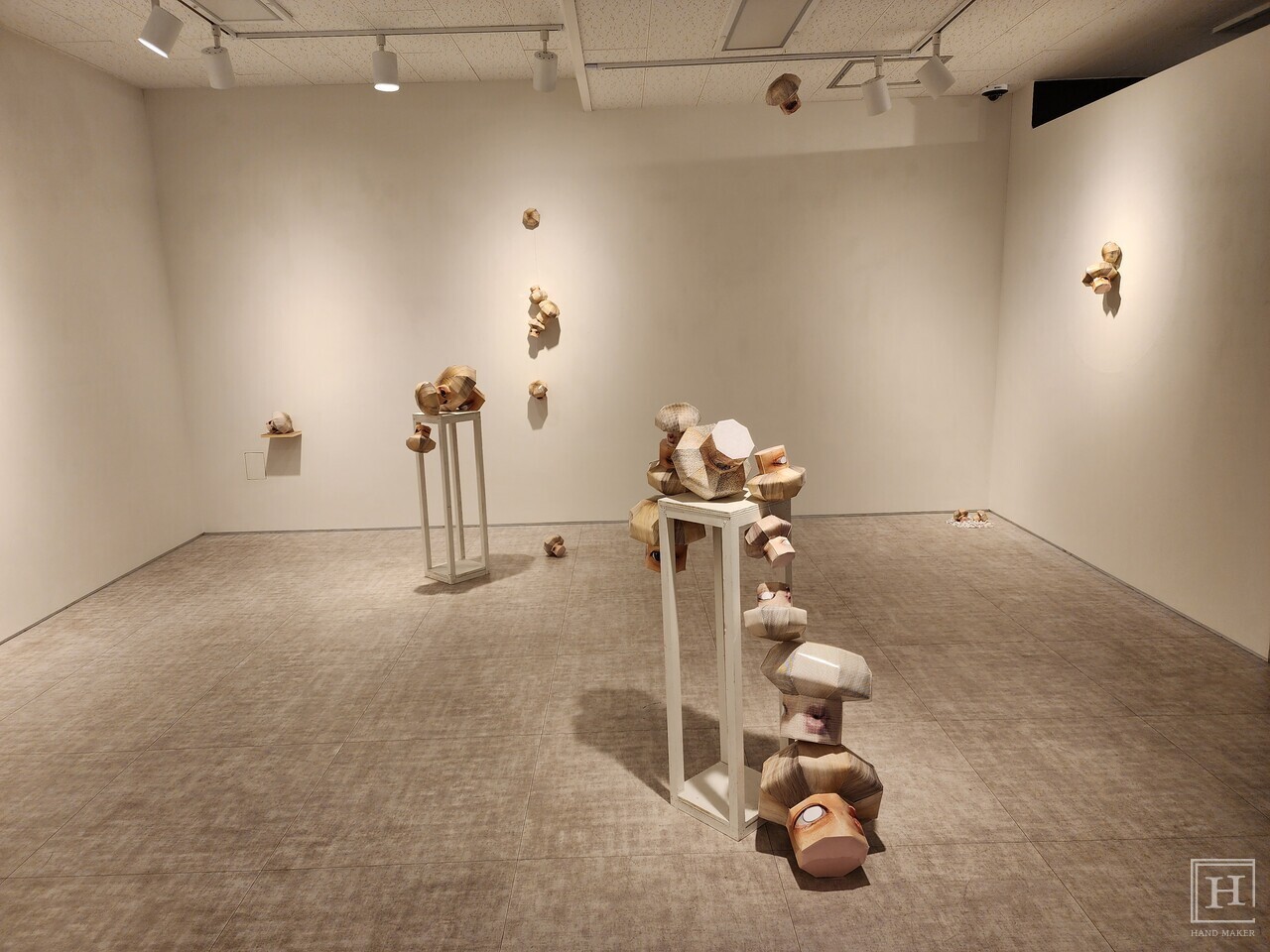
In this exhibition, Tang created works using photographs of her own physical characteristics, such as her blonde bobbed hair, eyes, and lips. After cutting out her physical images, the artist repeatedly performs mountain folds and valley folds to assemble the flat photographs into three-dimensional mushroom shapes.
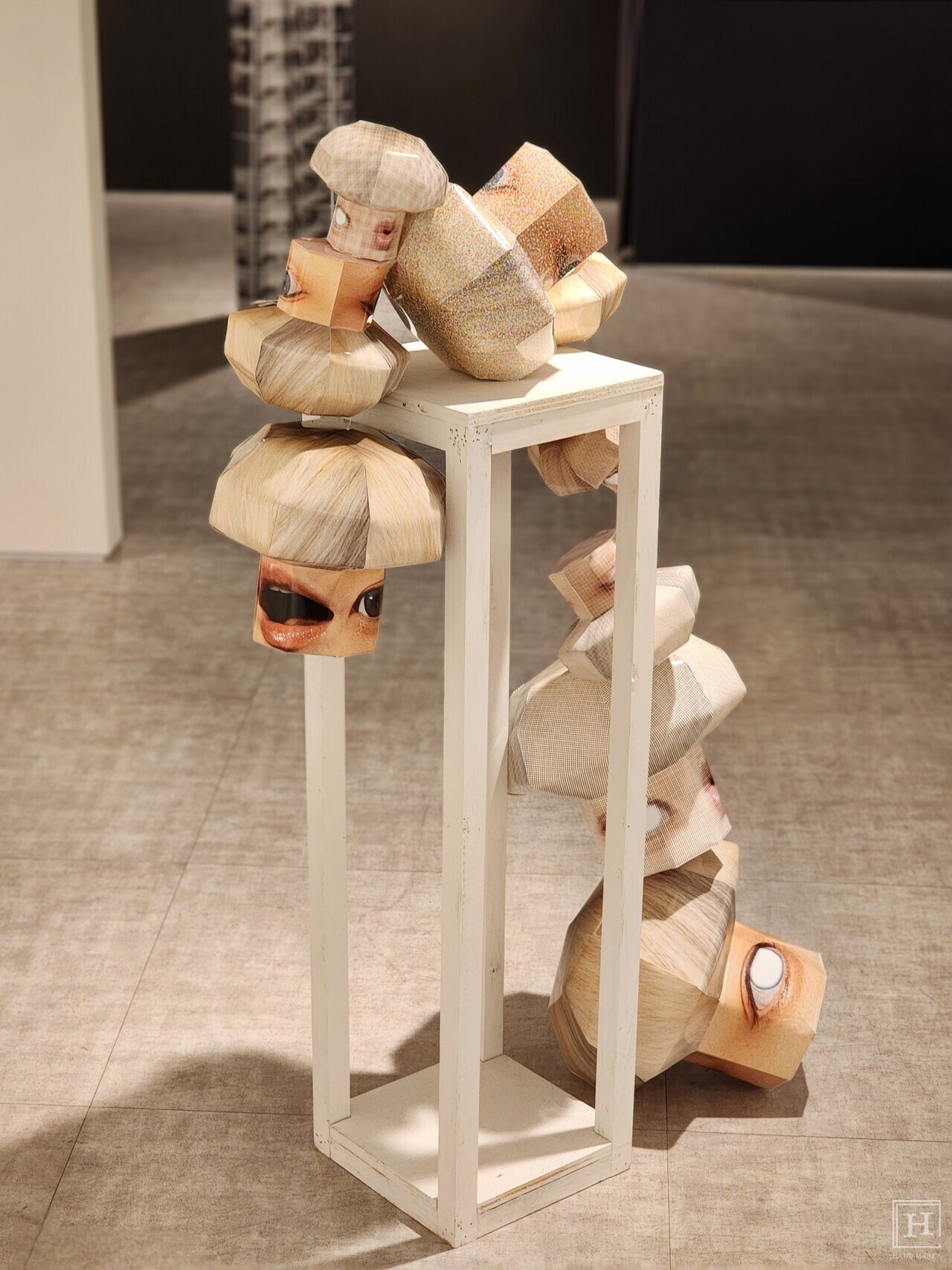
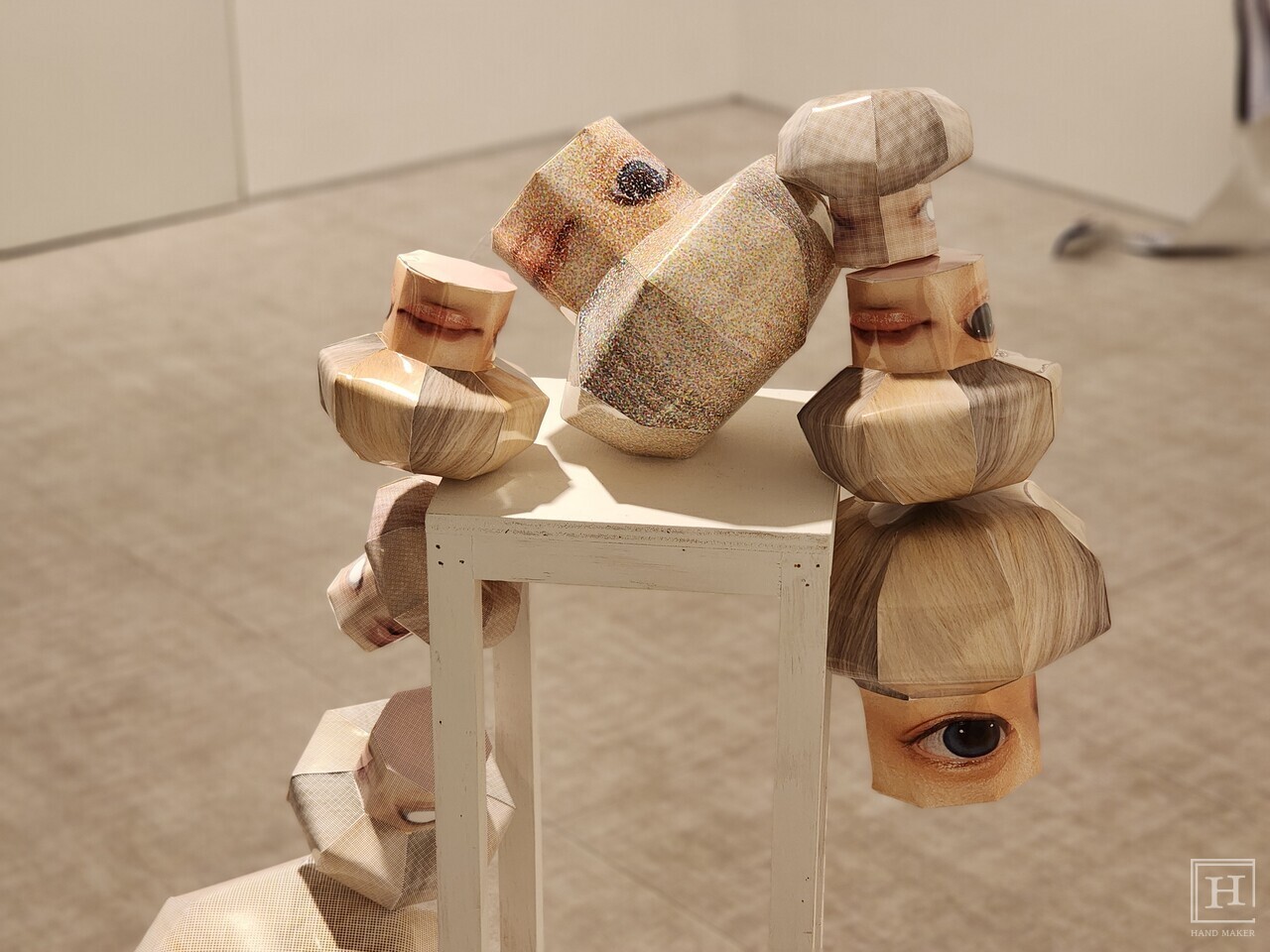
The visual impression given by the works is distinct. The photograph shapes, resembling button mushrooms, hang down like sculptural objects. Inside them are the artist's eyes, mouth, and hair; because they are a recombination of a real person, some may feel repulsion, while others may find it interesting.
Perhaps Tang intended to show the diverse evaluations people make regarding appearance through a sculptural form, even though they are photographs. If you look closely at each photograph, you may see beautiful eyes and mouths, but some lack pupils, which can evoke a sense of horror.
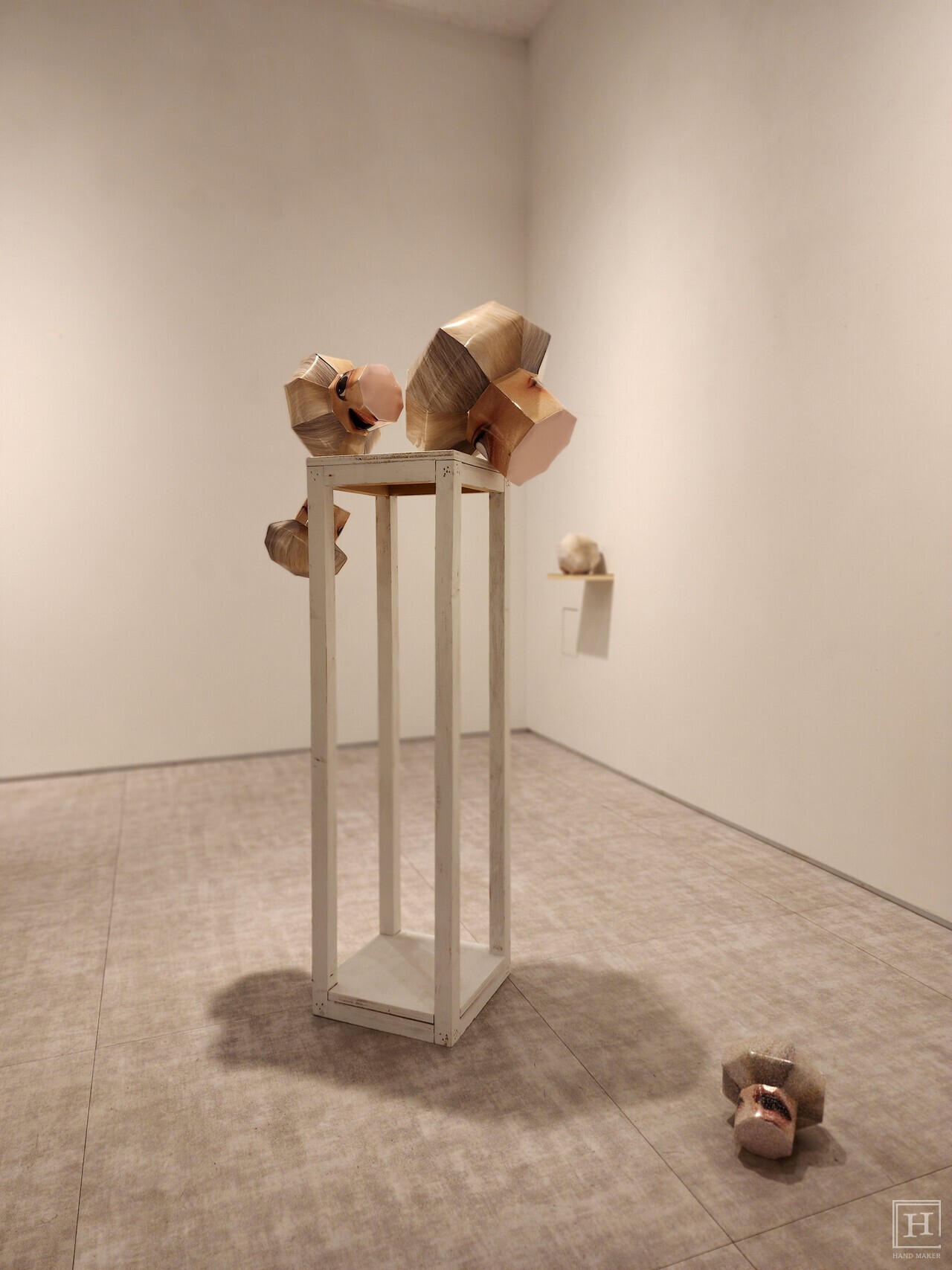
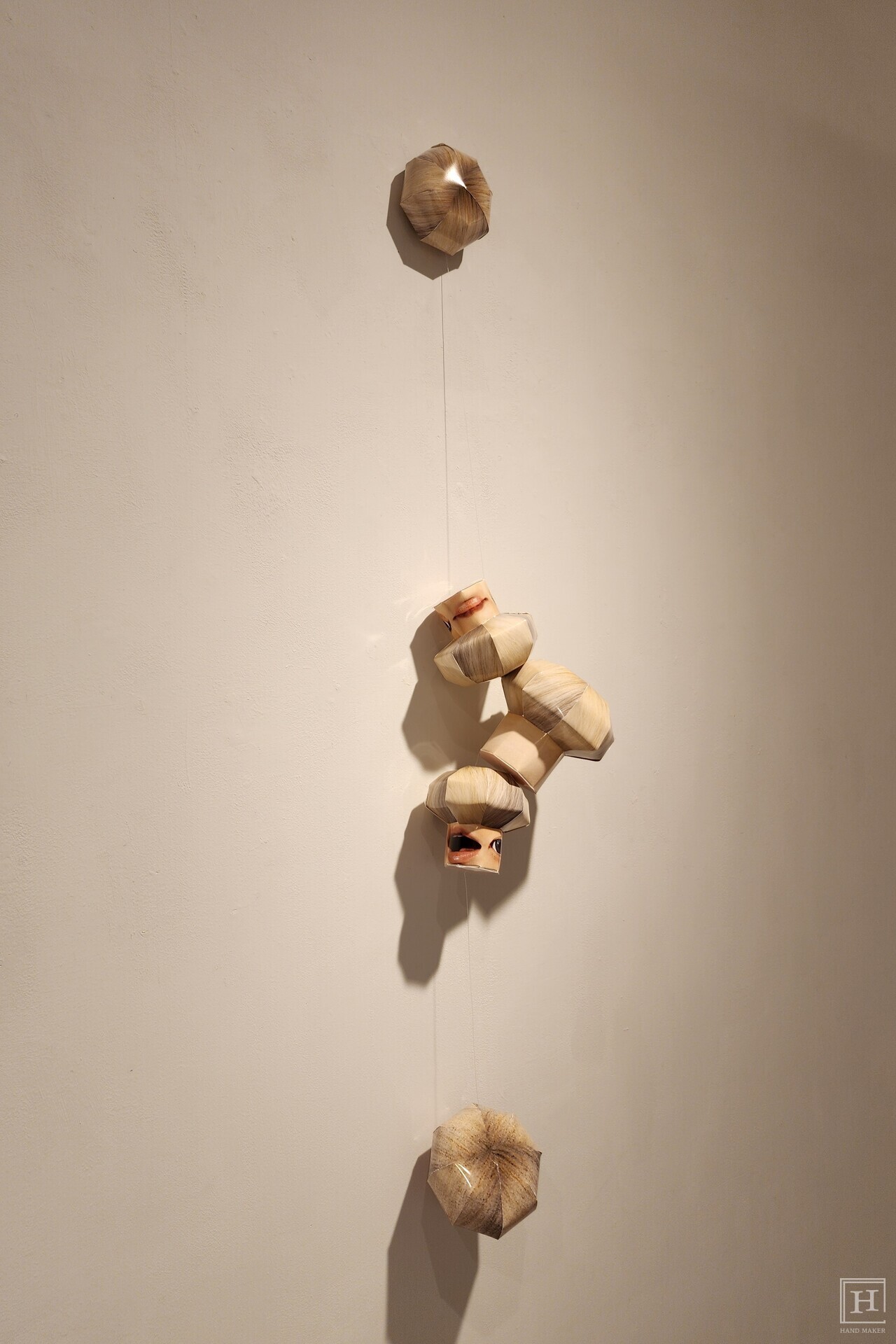
Similar sculptural forms either hang down as if capturing a moment of pouring out, or appear to be hanging on a wall and falling. They simultaneously feel like sculptures and like photographs that capture a single moment.
In particular, the sight of the same physical images repeating and multiplying in multiple mushroom shapes is reminiscent of how a single image and its evaluation are constantly replicated and spread through 'likes' on social media. Through this, the artist questions how much the image of 'me' created by the gaze of others truly shows the real self.
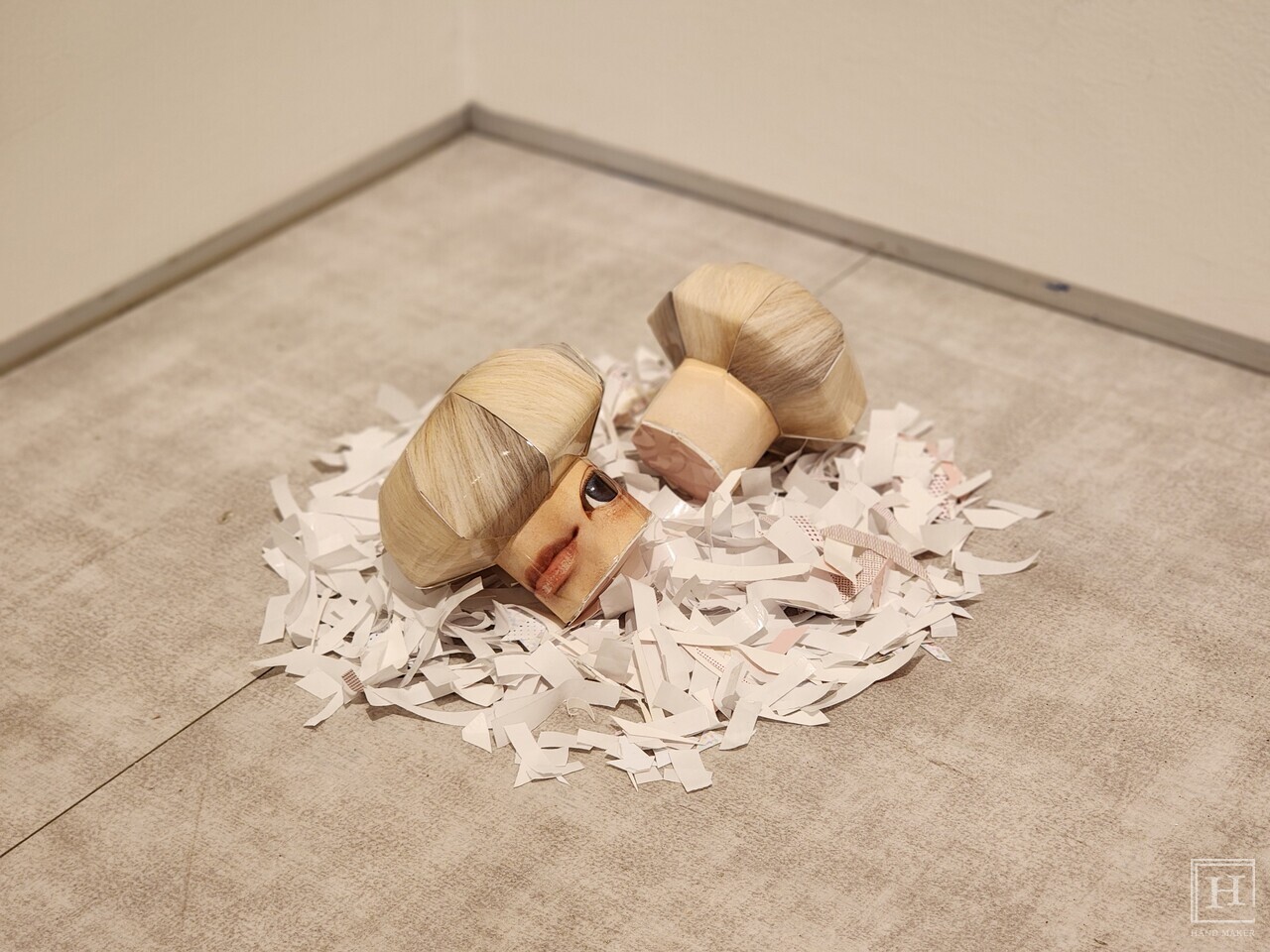
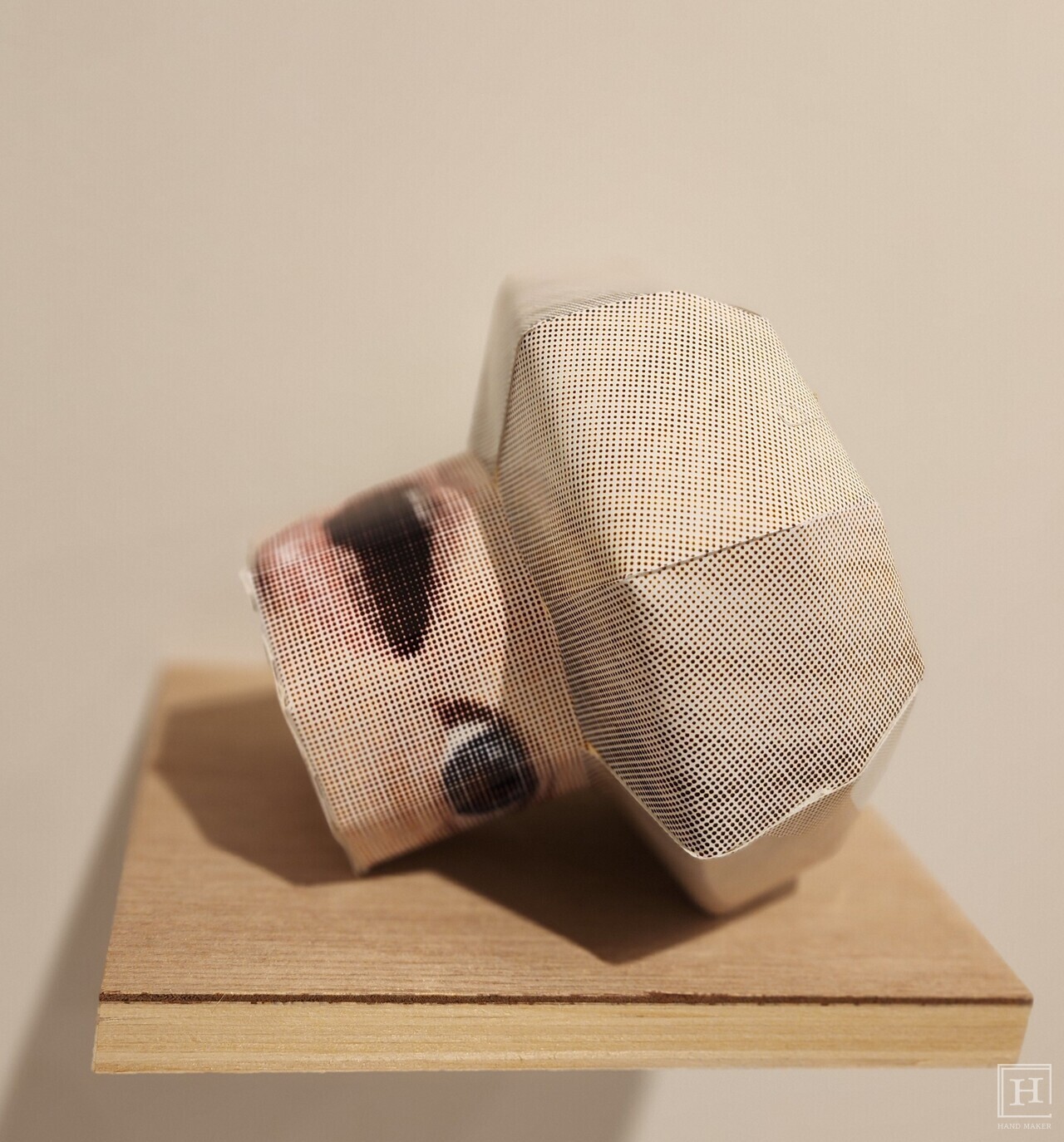
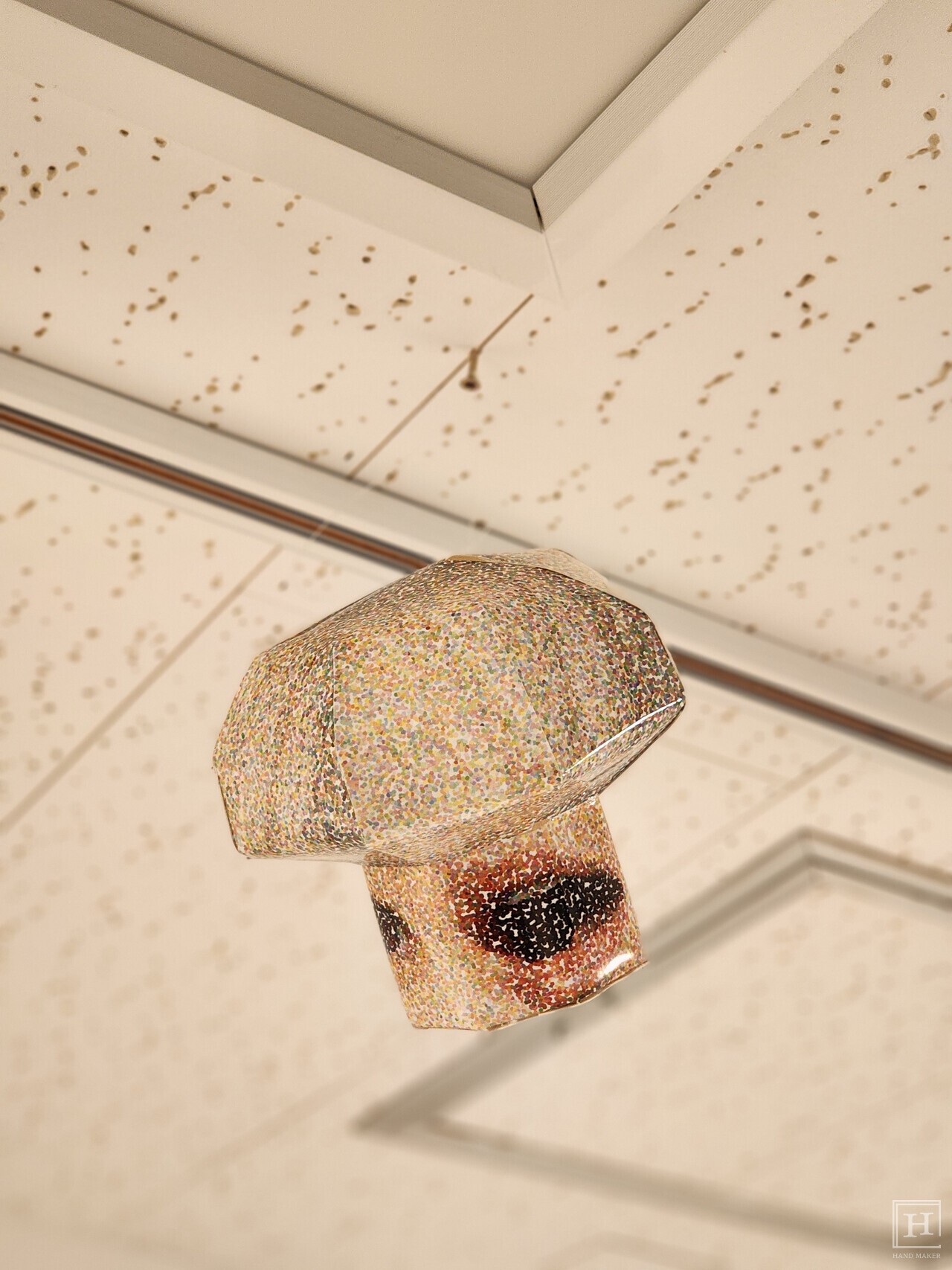
Among the feelings conveyed by the works, one can also sense the artist's rebellion against escaping the binary gender images of male and female. The mushroom-shaped forms are so deconstructed that they cannot be assigned to a specific gender. It seems to pose a question to the gaze that judges others based on gender stereotypes.
In this regard, the philosophy of the artist Qingyu Tang is clearly conveyed. It is an attempt to deconstruct the gaze that easily defines a person by familiar standards such as appearance and gender, and to show the image of a new existence that has escaped those frameworks.
Cutting and weaving daily life, making it mine again
- Misuzu Kosaka
Artist Misuzu Kosaka works by cutting and then "weaving" photographs she has taken of her room and personal life scenes. After returning the completed images back into a physical material, she reconstructs them into new forms of images by crossing them like warp and weft.
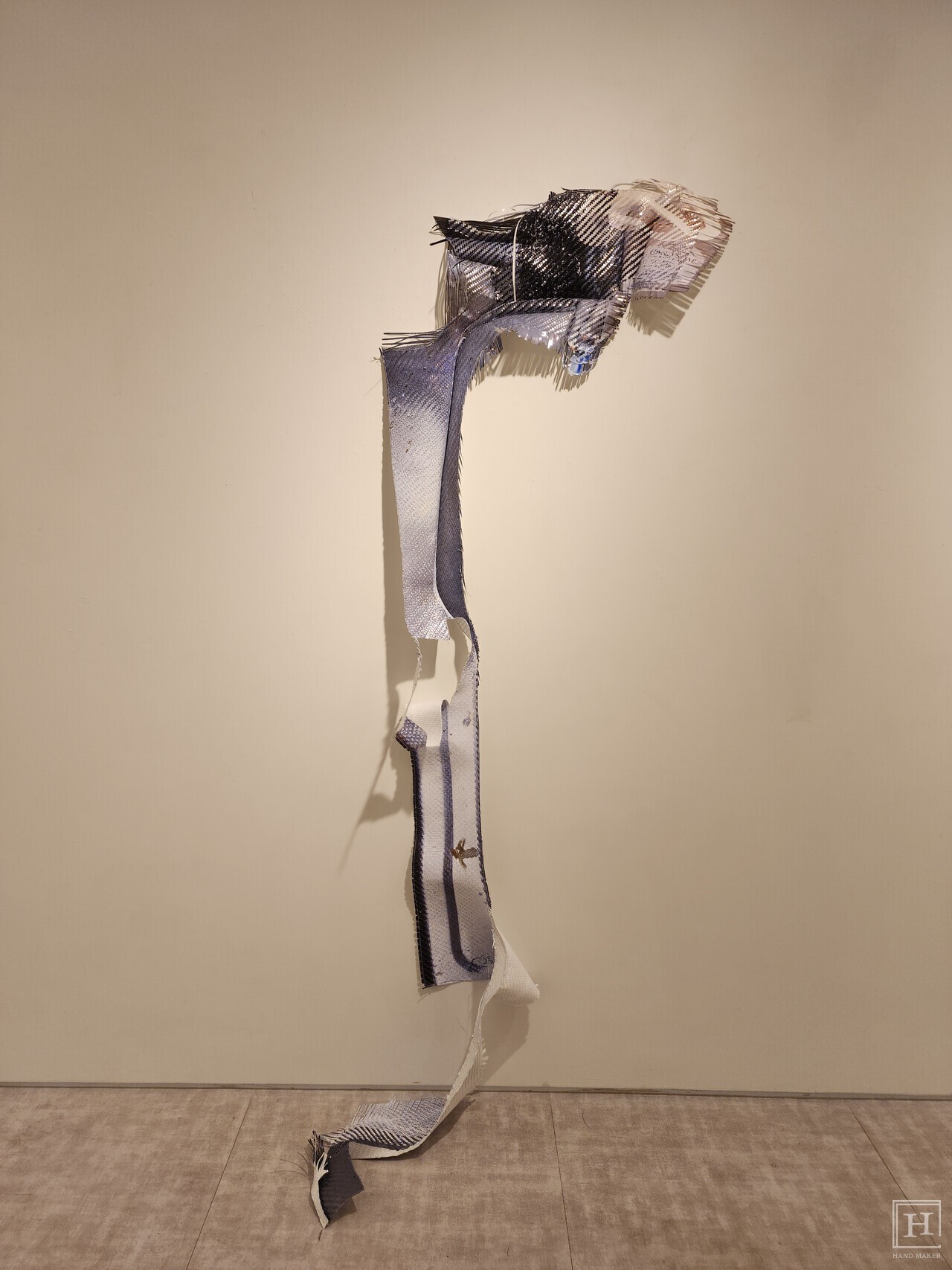
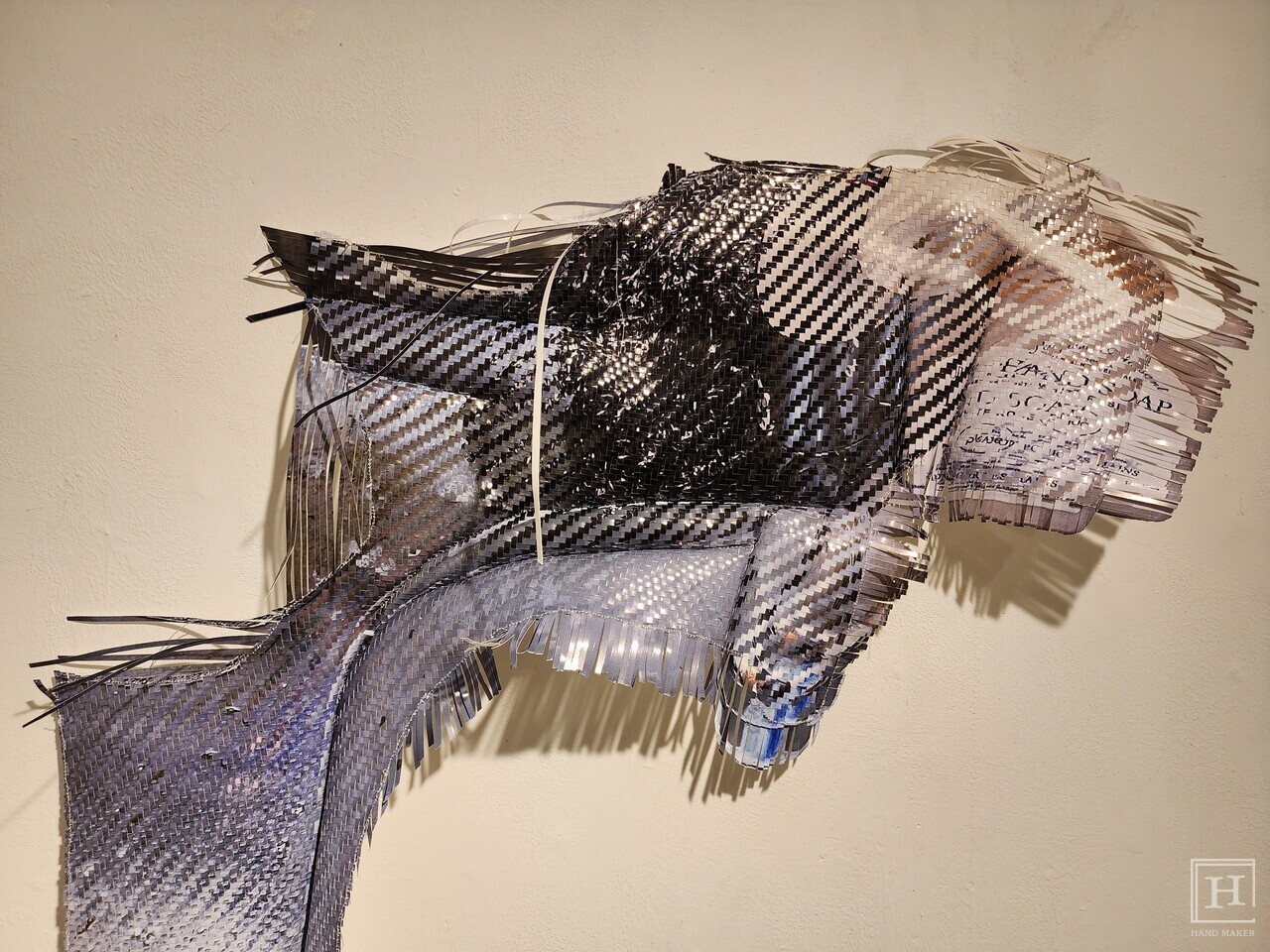
〈star-shaped cut_sink〉 is a work in which photographs of her living space were cut into thin strips, woven like warp and weft, and then hung down long. The photograph no longer remains a plane showing a single scene; through the process of being cut and woven, it transforms into a form with materiality like cloth or fragments. As part of the work extends long down to the floor, it also appears as if the photograph is flowing out into the actual space, breaking free from the frame of the wall.
The 'sink' appearing in the title refers to a kitchen sink. However, if one views the work without knowing the title, it is difficult to easily notice that the starting point of this image was a sink. This is because artist Misuzu Kosaka finely deconstructed and re-wove the images of a familiar living space, almost erasing the original form and context.
By finely deconstructing and hand-weaving places and times that are encountered repeatedly every day but not consciously noticed, she imparts new forms and values to a scene of ordinary daily life. It can be read as a process where private time, which one might pass by unthinkingly, returns to being her own through the artist's hands.
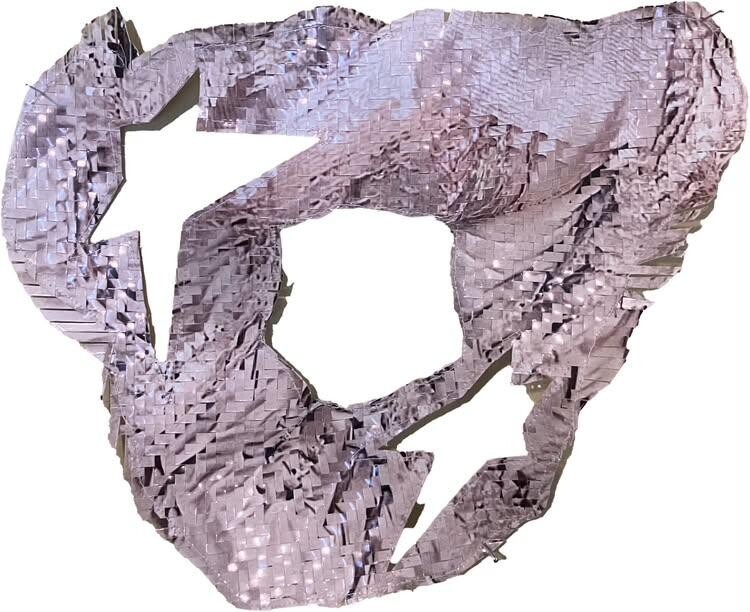
〈star-shaped cut_panties〉 is also a work made by cutting photographs into small pieces and weaving them densely. From a distance, it looks like a single abstract shape, but upon approaching, one can confirm that small photographic fragments are intersecting to form the surface. The specific scenes originally contained in the photographs are deconstructed, and instead, the traces of hand-weaving and the texture of the material become more vivid.
In particular, it is interesting that she took underwear, an extremely private object close to the body, as the title. Considering that Misuzu Kosaka seeks to reclaim the time of private life and physicality that are easily forgotten in the labor of daily life, this work also makes us look again at the private life and body of the individual that exists behind the image shown in society. The act of weaving photographs is, in a sense, a way of grasping her own daily life in her hands again.
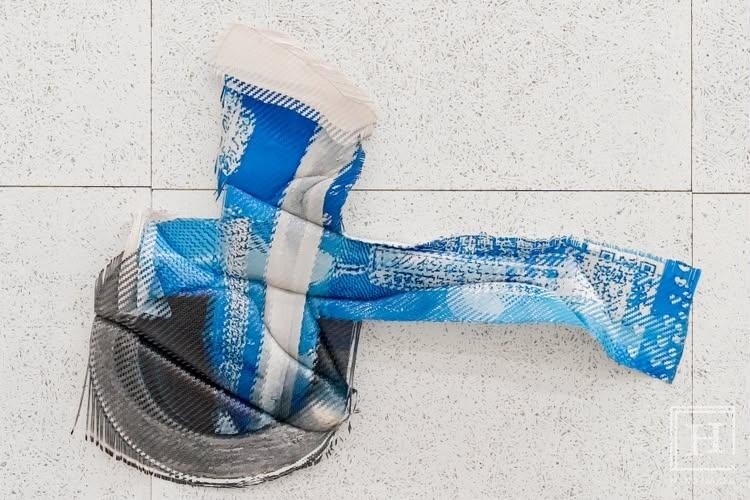
Recently, Misuzu Kosaka has been expanding photographs of her living space into forms that overlap with the body, seeking to reclaim the individual's time and physicality that are easily forgotten in repetitive labor.
〈legs for star rating〉 is a work where the cut and woven form of the photograph extends long, like human legs. The photograph, which was a plane, changes into a three-dimensional shape reminiscent of a part of the body as it bends and overlaps. As the image and the body overlap, the individual's daily life that remained within the photograph comes out into the space as if it has an actual body.
The 'star rating' in the title is connected to the point system the artist experienced during her time as an office worker. Experiencing a system where one earns points for doing 'good work,' the artist says she felt a sense of strangeness in seeing how people easily work and act for the sake of a single system. As the 'legs' that constantly move and work meet the system that assigns ratings, it makes us ask ourselves what we are moving for every day.
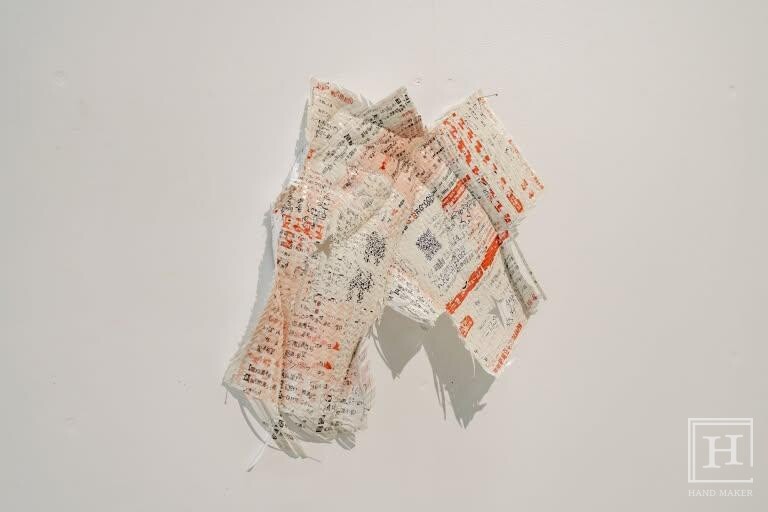
In 〈hands for star rating〉, papers such as tax notices printed with small text, numbers, and symbols are cut and woven in layers to form shapes reminiscent of hands. Rather than a smoothly finished photograph, the torn and overlapping edges and the traces of handwork are revealed as they are, making the act of creating the work itself more prominent.
'Hands' are also closely related to Misuzu Kosaka's working method. This is because the process does not end with taking a photograph, but requires repetitive labor to directly cut, weave, and reshape it. When combined with the 'star rating' evaluation system, it evokes the hands that move constantly to achieve something and earn points, along with the individual's accumulated time in that process.
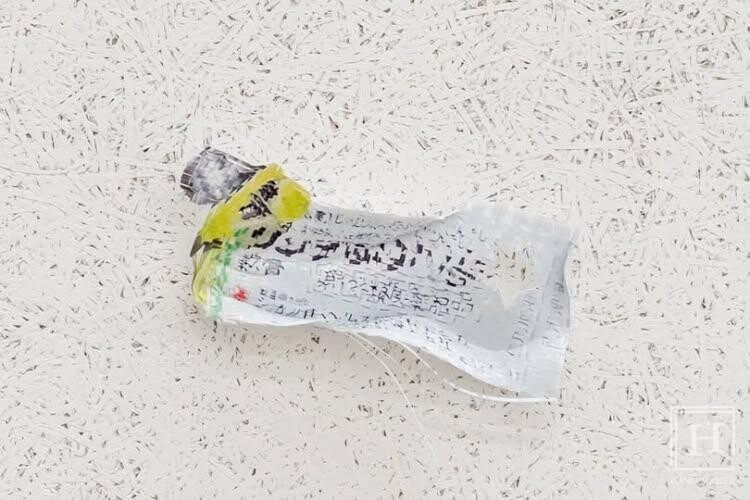
〈toe for star rating〉 is smaller in size than the previous work, creating photographic fragments in shapes reminiscent of toes. The appearance, as if only a very small part rather than the whole body has been detached, resembles Misuzu Kosaka's working method of capturing and collecting moments that are easily passed by in daily life. Although traces of the photograph remain, it is difficult to easily recognize what was originally photographed, and it approaches as a single, unfamiliar object.
Misuzu Kosaka cuts out and collects time, occasions, and opportunities from her daily life one by one like 'stars,' turning their value into a visible form. In that sense, even a small toe is not a trivial or insignificant part, but a part that constitutes a person's life. By elevating even small, inconspicuous parts of the body into artworks, she makes us look again at the value of daily life that cannot be converted into evaluations and scores.
The exhibition concludes today (the 18th).
Reporter at HANDMAKER (핸드메이커), a Korean magazine devoted to crafts and handmade culture. Covers exhibitions, design and the people who make things by hand.
Related Articles
![[Field Sketch] Unexpected Encounters and Records of 26 Teams Touching Summer: 《To Our Summer》 Exhibition](/storage/handmk-global/2026/09/fb9e35d7-c34d-4318-897d-fdb3c3857356-14760ffc-thumb.webp)
[Field Sketch] Unexpected Encounters and Records of 26 Teams Touching Summer: 《To Our Summer》 Exhibition
![[On-site Sketch] An Artistic World Made of Hangeul Offers Only Answerless Freedom, 《Hangeul…](/storage/handmk-global/2026/09/53d245f8-5a92-41b3-960f-671be6ce94f6-53ed35ad-thumb.webp)
[On-site Sketch] An Artistic World Made of Hangeul Offers Only Answerless Freedom, 《Hangeul Creativity, Jiphyeonjeon》 Exhibition
![[Press Conference] A World of Ceramics Crafted by Earth and Soil from Human Hands: 《2026 Gyeonggi Ceramics Biennale》 to Open](/storage/handmk-global/2026/09/cf17830c-fc0a-41cf-af99-10f296cc2feb-91e5e8a4-thumb.webp)
Comments 0
Comments are currently disabled.