
Back Together After 22 Years... Special Exhibition of Wooden Seated Arhat Statues of Seogosa Temple at Jeonju National Museum
The Jeonju National Museum, in collaboration with the Jogye Order of Korean Buddhism's Seogosa Temple…
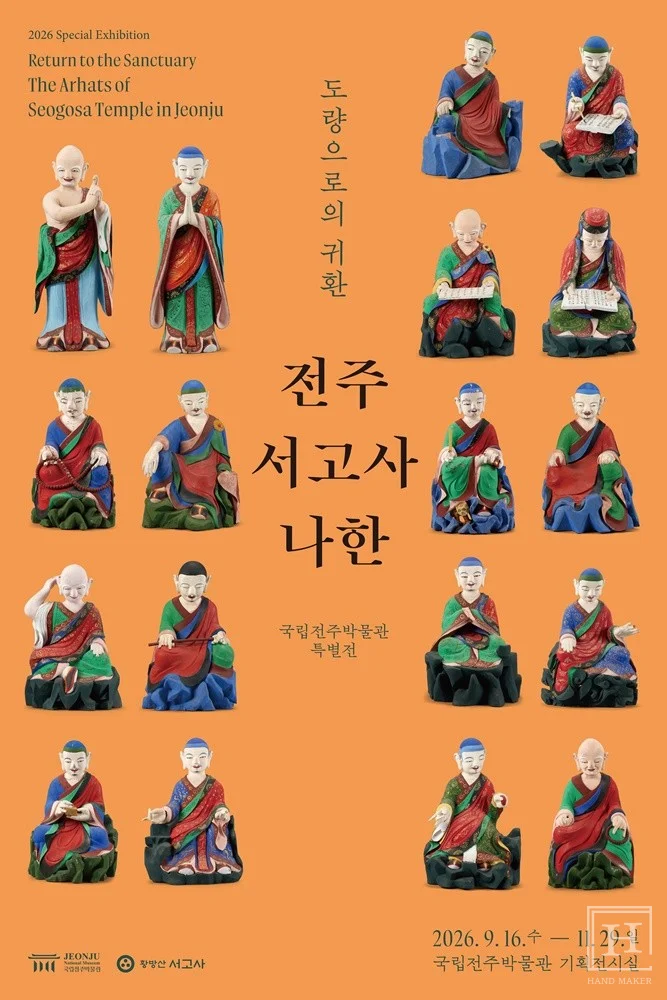
For the first time since parts of the Wooden Seated Arhat Statues of Seogosa Temple in Jeonju were recovered after being stolen in 2004, they are being gathered in one place. An exhibition that allows visitors to examine the characteristics of late Joseon Buddhist sculpture and the meaning of Arhat worship is being held at the Jeonju National Museum.
The Jeonju National Museum, together with the Jogye Order of Korean Buddhism's Seogosa Temple, will hold the special exhibition 《Return to the Temple Grounds: Arhats of Seogosa Temple in Jeonju》 at the special exhibition hall from September 16 to November 29. The exhibition will feature 126 items across 44 categories, including the Wooden Seated Arhat Statues of Seogosa Temple.
The Wooden Seated Arhat Statues of Seogosa Temple, consisting of Mahakasyapa, Ananda, and the Sixteen Arhats, have been enshrined in the Arhat Hall. However, in 2004, 8 out of the 16 statues were stolen, causing some to leave their place. Since then, 4 statues were recovered in 2014 and another 4 in 2020, bringing all 16 back.
This exhibition is significant because it presents the Arhat statues, which had been divided between Seogosa Temple and the Geumsansa Museum of Buddhist Art, etc., in a single space for the first time in 22 years since the theft. Along with the recovery process, the results of investigations and research regarding the creation, enshrinement, and ritual objects (bokjangmul) of the Arhat statues will also be revealed.
Through a prayer document, it was confirmed that the Wooden Seated Arhat Statues of Seogosa Temple were created on May 23, 1695 (the 21st year of King Sukjong's reign) by the monk sculptor Seong Sim and others. Through this, the production style of late Joseon Buddhist sculpture and the state of Arhat worship at that time can be examined.
The exhibition consists of three parts.
Part 1, ‘Four Historical Temples, Hwangbangsan Seogosa Temple’, covers the history of Seogosa Temple, which is recorded to have been founded by Myeongdeok by order of Gyeon Hwon of Later Baekje. The location and changes of the temple will be examined through the 《Sinjŭng Tongguk yŏji sŭngnam》, 《Wansanji》, and Map of Jeonju, and seated stone Buddhas and Dokseongdo paintings passed down at Seogosa Temple will also be introduced.
Part 2, ‘Contemplation, Looking While Drawing Arhats’, examines the iconography and religious meaning of the Arhat statues, centered on Mahakasyapa, Ananda, and the Sixteen Arhats. In particular, the theft and recovery process is organized, and the names and iconography of each of the Sixteen Arhats are introduced so that visitors can understand the composition and meaning of the Arhat statues.
Part 3, ‘Containing Prayers and Desires’, examines the circumstances at the time of production and Buddhist rituals through the ritual objects found inside the Arhat statues. Prayer documents, scriptures, dharanis, and huryeongtong (votive bells) confirmed from the Statue of the Third Venerable, Vanavasin, the Statue of the Fifth Venerable, Nakula, and the Statue of the Fourteenth Venerable, Vanavasin, will be exhibited.
In particular, the huryeongtong found in the ritual objects of the Statue of the Fourteenth Venerable, Vanavasin, is introduced as an example made of white porcelain. The results of Computed Tomography (CT) and X-ray Fluorescence (XRF) investigations are also released, allowing visitors to examine the internal structure, production techniques, and pigment components of the Arhat statues.
In the experience space linked to the exhibition, programs such as writing prayer documents, making one's own Arhat, and attaching ritual objects will also be operated.
The Jeonju National Museum will also hold an academic conference on October 15 at 1:00 PM in the museum auditorium under the theme ‘Jeonju Seogosa Temple and the Arhat Statues’. The conference will present the historical and art historical significance of Seogosa Temple and the Arhat statues, as well as scientific investigation results, and will feature discussions by relevant researchers.
Park Gyeong-do, director of the Jeonju National Museum, said, “It is meaningful in that the Wooden Seated Arhat Statues of Seogosa Temple, which had been scattered for a long time, have gathered in one place again. I hope that through the exhibition and the academic conference, people can examine the prayers and desires contained in the Arhat statues and the significance of the Buddhist cultural heritage that has returned to the temple grounds.”
Reporter at HANDMAKER (핸드메이커), a Korean magazine devoted to crafts and handmade culture. Covers exhibitions, traditional crafts and the makers behind them.
Related Articles

Giving New Purpose to Discarded Materials... HOTEL ANTEROOM SEOUL Hosts 《TASTE OF GREEN》

Encountering the Time of Joseon at Royal Tombs in Autumn... World Heritage Joseon Royal Tombs Festival to be Held in October

Comments 0
Comments are currently disabled.