
Time Accumulated at the Fingertips of Artisans Becomes Art: "2026 National Intangible Heritage Holders’ Works Exhibition" to be Held
The National Intangible Heritage Center will host the "2026 National Intangible Heritage Holders’ Works Exhibition" from the 22nd to October 18th in Jeonju…
The time of work and training that artisans have repeated until a single piece of work is completed will unfold in the exhibition hall. An exhibition will be held to observe the process of tradition being passed from one generation to the next through the works of successors in the field of National Intangible Heritage traditional technology.
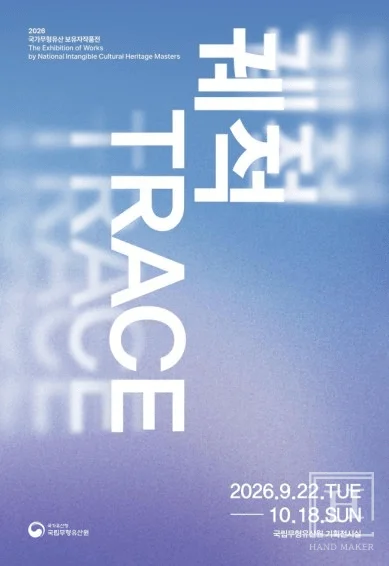
The National Intangible Heritage Center of the Korea Heritage Service announced that it will hold the ‘2026 National Intangible Heritage Holders’ Works Exhibition’ from the 22nd to October 18th at the National Intangible Heritage Center Special Exhibition Hall in Jeonju, Jeonbuk.
This year's exhibition, marking its 54th year, features 102 holders and transmission instructors in the field of National Intangible Heritage traditional technology under the theme ‘TRACE’, presenting a total of 231 works.
The Holders’ Works Exhibition began in 1973 as the ‘Human Cultural Treasures Craft Exhibition’. This year's exhibition focuses not only on the completed works themselves but also on the process of mastering materials and honing skills, as well as the artisan's senses and experience formed through repetitive work.
The exhibition is composed of three themes: ‘Density’, ‘Polishing’, and ‘Devotion’.
In ‘Density’, it shows how the process of the artisan understanding the materials and becoming familiar with the work is accumulated in the pieces. Go Heung-gon's 〈Ottchil Haegeum〉 (lacquered haegeum) expresses vine and flower patterns using mother-of-pearl, and Kim Yeong-seong's ‘Geungnakjeon Hall of Hwaamsa Temple, Wanju Ha-ang Gong-po’ is a work that reproduces a scaled-down portion of the Geungnakjeon Hall of Hwaamsa Temple, Wanju.
In ‘Polishing’, it deals with the process through which the unique skills and senses of an artisan are formed through repetitive work and training. Kim Yeong-hui's 〈Baekok Samjak Norigae〉 (white jade three-piece norigae) utilizes white jade pieces with different patterns, and in Lee Hyeong-man's 〈Vine Pattern Document Box〉, the detailed expression of mother-of-pearl craft can be seen.
In ‘Devotion’, it introduces the work and results of artisans who have carried on their skills for a long time. Park Chang-yeong's 〈Dangu Hwangchalsul Gat〉 (black hat) is a work that reproduces the form of the gat that was popular from the early to mid-Joseon period, and An Chi-yong's 〈Hanji Leather〉 is an example of developing a functional material by processing traditional Hanji.
The exhibition also shows that traditional technology does not stop at merely preserving past methods. The flow where the experience and skills of one generation are contained in a work and then passed down to the next generation, and then changed and expanded again through the work of new successors, is interpreted through the concept of ‘TRACE’.
Through the exhibition, visitors can view works from various fields such as wood, lacquer, ceramics, jade and stone, metal, and clothing in one place. In particular, it differentiates itself from craft exhibitions centered on the final product by highlighting the production process and the meaning of transmission accumulated in each work.
The exhibition can be viewed for free except for Mondays.
Reporter at HANDMAKER (핸드메이커), a Korean magazine devoted to crafts and handmade culture. Covers exhibitions, design and the people who make things by hand.
Related Articles
TVs wearing yarn and stopped fans… Savina Museum of Contemporary Art hosts Hwang Jae-won's 《Slowly Connecting》

Exploring the Temporal Gap Between Reality and Photographic Representation: Min Byung-hun Solo Exhibition 《BETWEEN FORMS》
Comments 0
Comments are currently disabled.