
Park Jin-hwa Re-examines ‘The Clay Figurine Awakened Me’ Atop Black Carbon Fiber
The special exhibition "One Surface, Four Perspectives" is currently being held at Itda Space and Itda Space Small Art Museum…
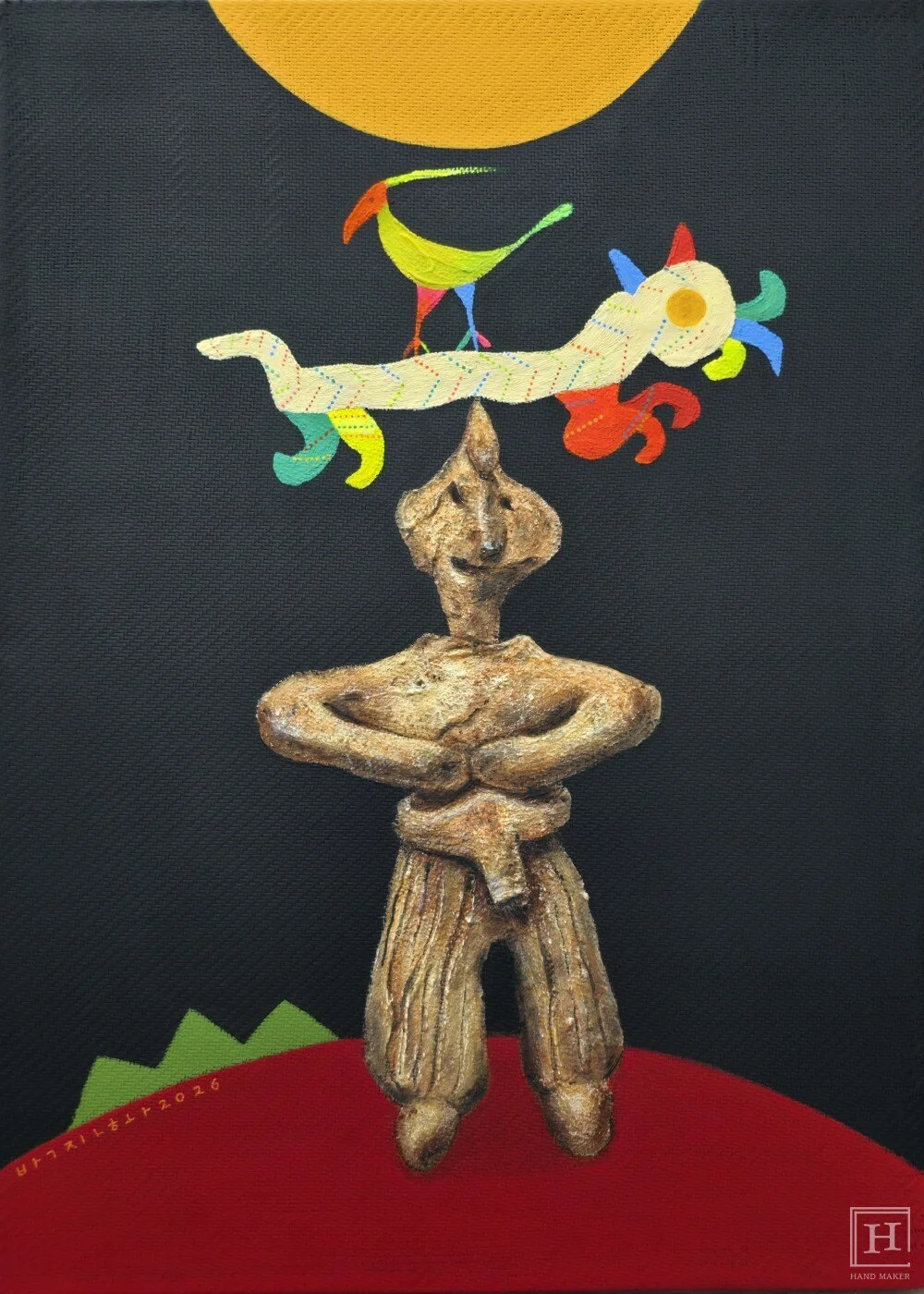
The special exhibition "One Surface, Four Perspectives," held at Itda Space and Itda Space Small Art Museum, is currently underway, featuring four artists—Park Jun-seok, Park Jin-hwa, Yoo Chang-ho, and Jang Yeong-ae—who interpret the same material, carbon fiber fabric, in their own respective ways.
Carbon fiber, an industrial material, becomes the canvas—the foundation of art—in this exhibition. Its black surface and unique weaving structure create physical properties different from conventional canvases, influencing not only the content of the works but also the process of their creation.
In this exhibition, artist Park Jin-hwa meets her own artistic world, 〈The Clay Figurine Awakened Me〉, with the new surface of carbon fiber.
The artist's work begins with the question, "Who am I, and what are we?" Starting from the search for 'self,' the questions expand to 'you' and 'us,' to relationships and the universe, and finally return to the self by meeting 'humans before themselves' through the clay figurine.
To the artist, the clay figurine is not merely an ancient relic. She discovers herself in its small, imperfect, and wounded appearance, observing the point where the human forms molded from clay thousands of years ago meet her present self.
In this work, Park Jin-hwa, who has explored earth, time, and human forms, faces the black carbon fiber surface, which possesses different physical properties.
Carbon fiber shows new possibilities in that it creates a unique texture different from ordinary canvases once the work is completed.
On the other hand, during the working process, because the base of the panel is visible through the weave of the carbon fiber, a large amount of paint was required to fill it. To improve this, the artist suggested a method of painting the panel black before covering it with the canvas cloth.
Additionally, because the carbon fiber canvas itself is black, there was the inconvenience of having to first lay down white to express the desired colors.
However, the black background does not act solely as a disadvantage. If the desired color sense is achieved when working with a black base, the black surface of the carbon fiber itself can actually become an advantage of the work.
For Park Jin-hwa, this work is also an experiment in experiencing the process where painting meets a new surface, stepping away from the familiar canvas.
Just as the artist's method involves converting ceramic inlay techniques into a painterly way—building up the base, hardening it, carving it out, and then filling it with color—this encounter with carbon fiber also became a process of understanding the physical properties of a new material and connecting it to her painterly language.
In "One Surface, Four Perspectives," Park Jin-hwa's work creates another kind of screen through the meeting of familiar human forms and unfamiliar industrial materials.
This exhibition is hosted and organized by Itda Space and Itda Space Small Art Museum, and supported by Incheon Metropolitan City and Incheon Foundation for Arts and Culture. "One Surface, Four Perspectives" can be viewed at Itda Space Small Art Museum until September 30.
Related Articles

Vacant Stores on Sharosu-gil to be Filled with Digital Art Created by Residents… 《New-Life Art Radio Shop》 Opens

Art Starting from Earth, 《Gyeonggi Ceramics Biennale 2026》 Opens on the 18th in Icheon, Gwangju, and Yeoju
Comments 0
Comments are currently disabled.